
How to Identify Grace's Warbler Feathers
A guide to identifying Grace's Warbler feathers by their gray back, yellow throat, and distinctive yellow-fronted eyebrow stripe.
Read the full Grace's Warbler encyclopedia entry →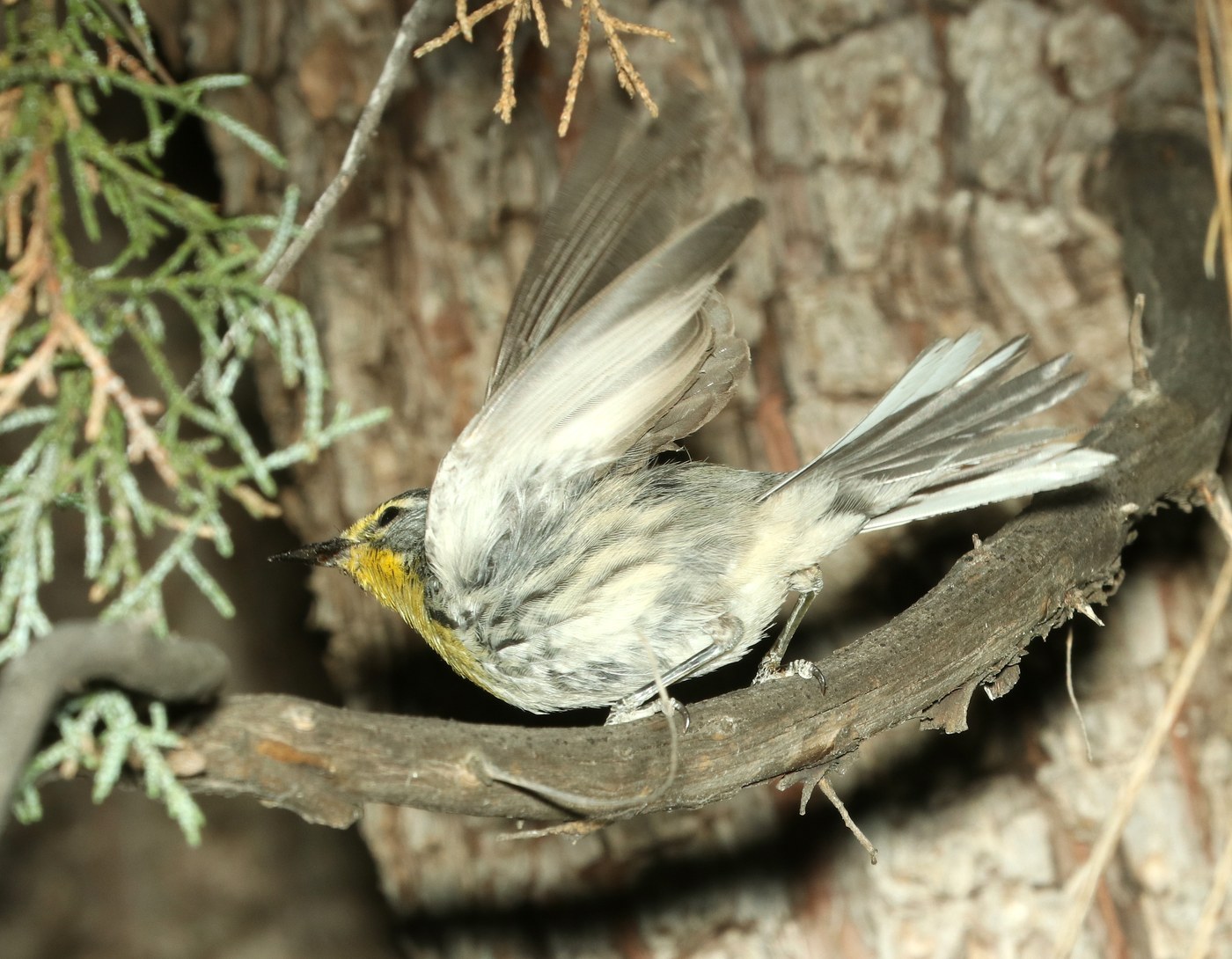
What Grace's Warbler's Feathers Look Like
This small warbler of southwestern pine forests shows a fairly subdued but distinctive palette. The back is bluish-gray, marked with fine black streaking, while the throat and breast are bright yellow, fading to white on the belly. One of its most useful features is the eyebrow stripe (supercilium), which is yellow in front of the eye and whitish behind it — a broken, two-toned stripe that shows up clearly even on a small facial feather. Flanks carry fine black streaking similar to the back. Wings show two crisp white wingbars against otherwise gray-black flight feathers. Overall the feathers are small and delicate, consistent with this species' status as a canopy-dwelling warbler of pine and pine-oak forest. The undertail coverts are pale yellow fading toward white, and the tail feathers themselves are plain gray-black without the white outer-tail patches shown by many other warblers, a helpful negative clue when a tail feather is the only piece available.
Step-by-Step: Is This Feather From a Grace's Warbler?
- Check for a two-toned eyebrow stripe. A small facial feather that is yellow toward the front and white toward the back is a strong, fairly specific clue for this species.
- Look at throat color. Bright yellow throat and upper breast feathers, fading toward white on the belly, match this species' underparts pattern.
- Examine the back. Bluish-gray with fine black streaking (not olive-green) supports Grace's Warbler over several similarly sized warblers.
- Confirm the wingbars. Two clean white bars on a gray-black wing feather fit this species.
- Consider elevation and habitat. Feathers found high in mature pine or pine-oak canopy in the southwestern mountains support this identification, since the species forages mostly in treetops.
Similar Species & How to Tell Them Apart
- Yellow-throated Warbler: Larger overall, with a bold white (not yellow-fronted) supercilium and a more strongly contrasting black-and-white face pattern, and typically found in different, more eastern deciduous or pine habitat.
- Black-throated Gray Warbler: Has a black throat rather than a yellow one, making throat color the quickest way to separate the two.
- Yellow-rumped Warbler: Shows a bright yellow rump patch that Grace's Warbler lacks, along with a different overall face pattern.
Where & When You'll Find Them
Grace's Warblers are closely tied to mature pine and pine-oak forest in mountainous parts of the southwestern United States and Mexico, foraging high in the canopy where they are often heard more easily than seen. Feathers are most likely to be found on the ground beneath tall, mature pines, particularly ponderosa and similar species used for both foraging and nesting. Molt generally occurs in late summer before birds migrate south to Mexico and Central America for the winter, making late summer the most likely period to find feathers within the breeding range.
Frequently asked questions
What's the most distinctive single feature to check?
The two-toned eyebrow stripe — yellow in front of the eye and white behind it — is one of the more specific field marks available even on a small facial feather.
How do I rule out Yellow-throated Warbler?
Check the supercilium color and overall size — Yellow-throated Warbler is larger with a bold white supercilium, while Grace's Warbler is smaller with a yellow-fronted, two-toned stripe.
Why would I find these feathers specifically under pine trees?
Grace's Warbler forages almost exclusively in pine and pine-oak canopy, so feathers accumulate beneath tall mature pines rather than in open or deciduous habitat.
When is the best time to find feathers in the breeding range?
Late summer, during the pre-migration molt, is typically the most productive period before birds head south for winter.