
How to Identify Golden-crowned Kinglet Feathers
A step-by-step guide to identifying Golden-crowned Kinglet feathers by their tiny size, striped face, and orange or yellow crown patch.
Read the full Golden-crowned Kinglet encyclopedia entry →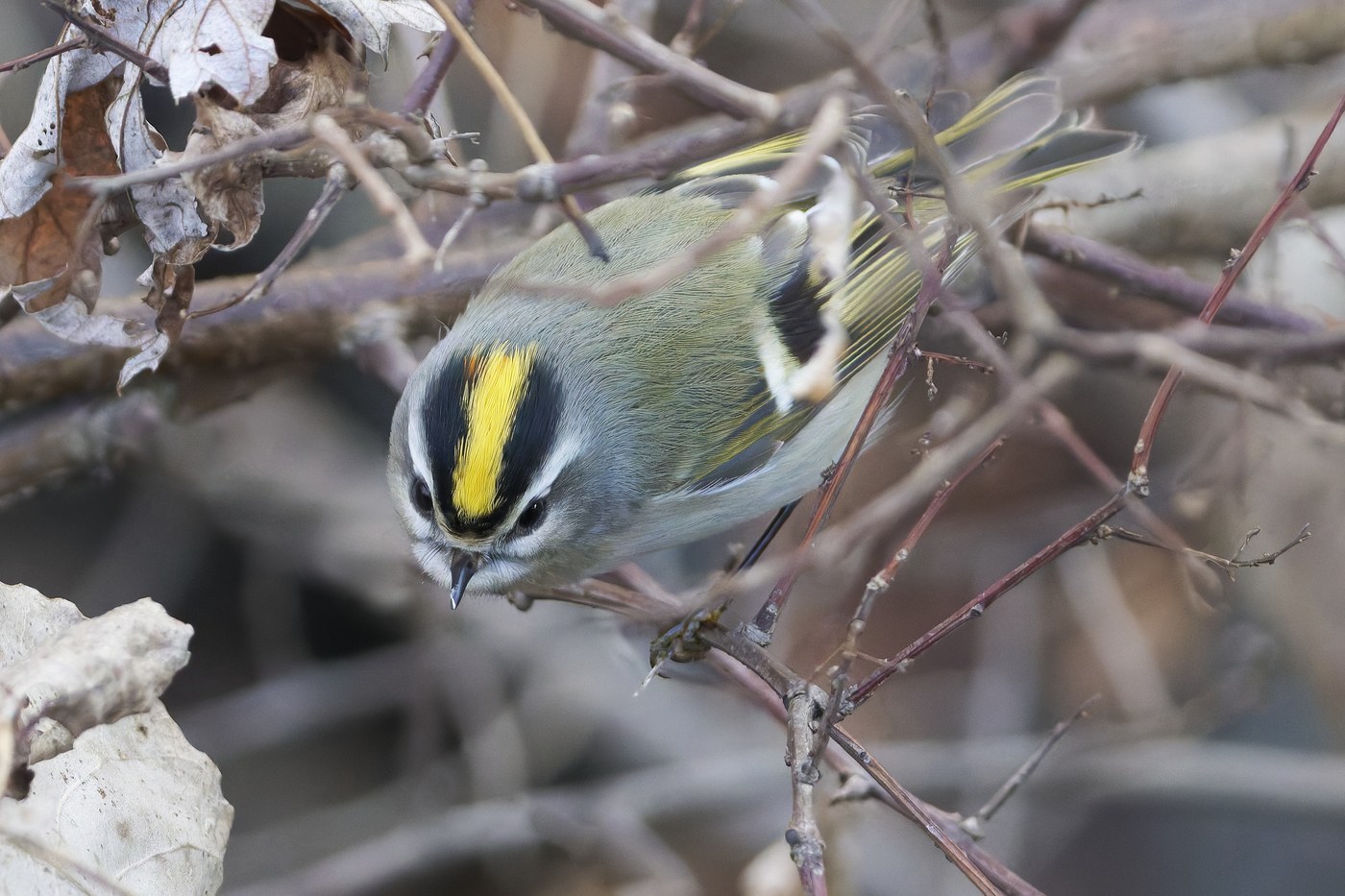
What Golden-crowned Kinglet's Feathers Look Like
Golden-crowned Kinglets are among North America's smallest songbirds, and their feathers are correspondingly tiny. The most identifiable feathers come from the head: a black-bordered white supercilium (eyebrow stripe) running above a black eyeline, framing a central crown patch that is orange in males and yellow in females, itself bordered by black on both sides. Body feathers are olive-green above and pale grayish-white below, soft and fine. Wings show two white wingbars, with a small blackish patch just below the lower bar, visible even on an isolated covert feather. Flight feathers are minuscule, only about 4-5 cm, olive-edged over a dark base. The tail is short, notched, and olive-brown.
Step-by-Step: Is This Feather From a Golden-crowned Kinglet?
- Check the size. Anything much longer than 5 cm is unlikely to be from this species — its feathers rank among the smallest of any regularly encountered songbird.
- Look for the striped face pattern. A tiny feather combining black, white, and orange or yellow in a striped arrangement is close to diagnostic for this species.
- Note the crown color. Bright orange in the center suggests a male; yellow suggests a female — both are still bordered by black.
- Check the wingbars. Two crisp white bars with a dark smudge just beneath them on an olive-green feather supports the ID.
- Consider the habitat. Feathers found beneath dense conifers, especially spruce or fir, fit this species' strong habitat preference.
Similar Species & How to Tell Them Apart
- Ruby-crowned Kinglet: Lacks the bold striped face pattern entirely, showing a plain face with a white eyering instead, and the male's red crown patch is usually concealed and rarely seen on a shed feather.
- Goldcrest (Old World counterpart): Similar tiny size and crown-stripe idea, but lacks the bold white supercilium bordered by black that Golden-crowned Kinglet shows, and occurs in a different region.
- Small warblers in the same habitat: Generally larger, with longer flight feathers and without the specific black-white-orange/yellow face striping.
Where & When You'll Find Them
Golden-crowned Kinglets favor dense coniferous and mixed forest, particularly spruce, fir, and hemlock, foraging high in the canopy in a manner that makes them hard to observe directly but leaves feathers on the forest floor beneath preferred foraging or roosting trees. They are resident year-round across much of their northern range and move to lower elevations or farther south in winter, sometimes joining mixed flocks with chickadees and other kinglets. Molt occurs in late summer after breeding, making that the most likely period to find feathers, though winter flocking activity and predation by small owls and hawks can produce feathers throughout the colder months as well.
Frequently asked questions
How do I tell a male feather from a female feather?
The center of the crown patch is the key: orange indicates a male, while yellow indicates a female, with both bordered by black stripes.
What separates this from Ruby-crowned Kinglet?
Ruby-crowned Kinglet has a plain face with a white eyering and no bold black-and-white striping, and its red crown patch is usually hidden, making a striped facial feather a strong point in favor of Golden-crowned Kinglet.
Why are the feathers so small?
Golden-crowned Kinglets are among the tiniest songbirds in North America, so even their flight feathers rarely exceed about 5 cm.
Where on the forest floor should I look?
Beneath tall conifers, especially spruce and fir stands, since this species forages and roosts high in coniferous canopy.