
How to Identify European Turtle Dove Feathers
A guide to the tortoiseshell-patterned wing coverts and striped neck-patch feathers that set this dove apart from town pigeons.
Read the full European Turtle Dove encyclopedia entry →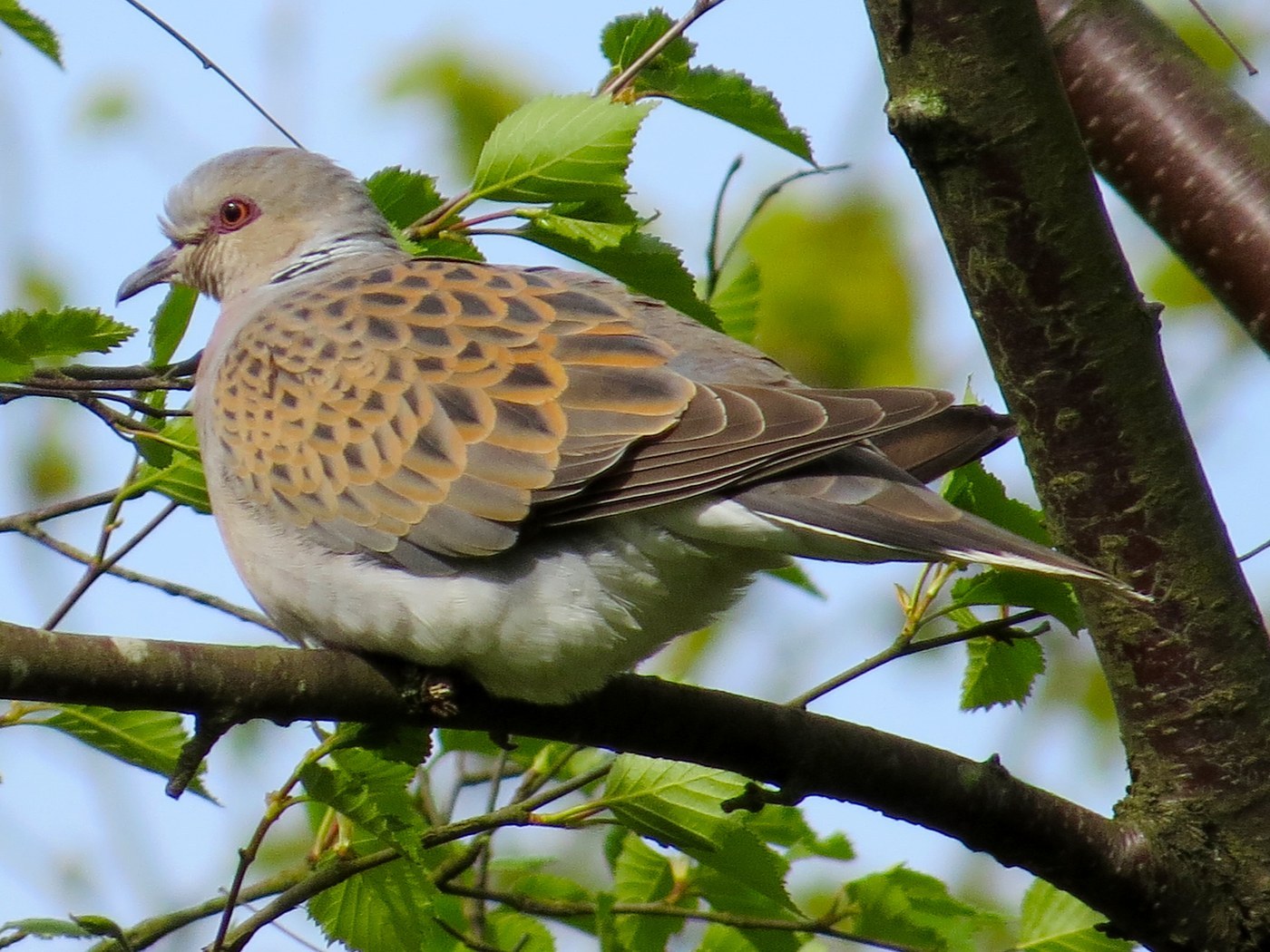
What European Turtle Dove's Feathers Look Like
European Turtle Dove has one of the most easily recognized feather patterns among European doves: the wing covert and back feathers show a striking "tortoiseshell" pattern, each feather chestnut-orange in the center with a bold black border, creating a scaled, checkered look across the folded wing. The head and neck feathers are soft blue-gray, and on the side of the neck sits a small, distinctive patch of feathers finely barred black-and-white, like tiny stripes, unique among common European doves. Breast feathers are a soft pinkish-vinous color, fading to white on the belly and undertail. Flight feathers are gray-brown, unremarkable, but primaries are moderately long and pointed for a fast, direct-flying dove, roughly 12-14 cm. Tail feathers are dark with clean white tips and white outer edges, visible as a white terminal band when the tail is fanned.
Step-by-Step: Is This Feather From a European Turtle Dove?
- Look for the tortoiseshell pattern: a wing covert or back feather that is chestnut in the middle with a crisp black edge is the single best diagnostic feature.
- Check for a striped neck feather: a small feather finely barred in black and white, distinct from the plain gray of the rest of the neck, points strongly to this species.
- Note the breast color: a soft pinkish-vinous wash on an otherwise plain feather is consistent with turtle dove underparts.
- Check tail feathers for white tips: dark tail feathers with a clean white terminal band and white outer edges support this species over plainer doves.
- Measure overall size: turtle dove is small and slim for a dove, smaller than a Collared Dove, so feathers should be somewhat modest in size.
Similar Species & How to Tell Them Apart
The most likely confusion is with the Eurasian Collared Dove, now common in towns and gardens across the same range. Collared Dove feathers are plain grayish-buff with no chestnut-and-black scaling whatsoever, and instead of a striped neck patch it shows a simple, solid black half-collar edged in white on the back of the neck, a completely different pattern from the turtle dove's finely barred side patch. Oriental Turtle Dove, found further east and as a vagrant in Europe, is larger, with a similar scaled wing pattern but a grayer, more purplish breast and a broader, more diffuse neck-patch pattern with more blue-gray mixed in. Feral/Rock Pigeon feathers vary widely but typically show either plain gray, checkered gray-and-black, or white patches, never the clean chestnut-and-black scaling of a genuine turtle dove.
Where & When You'll Find Them
European Turtle Doves favor farmland with hedgerows, scrubby woodland edges, and orchards across Europe, migrating to sub-Saharan Africa for the winter, which makes them a strictly summer visitor (roughly April-September) across most of their breeding range. Feathers are most likely to be found near hedgerow nest sites, farmland field margins, and stubble fields where the birds feed on seeds. Because the species has declined sharply in parts of Western Europe, feather finds have become notably less common than a few decades ago. The main molt window falls in late summer, both before autumn migration and, for some individuals, on the African wintering grounds.
Frequently asked questions
What is the single best feather clue for European Turtle Dove?
A chestnut-centered feather with a bold black border, the tortoiseshell pattern on the wing coverts and back, is unique among common European doves.
How is the neck patch different from a Collared Dove's?
Turtle dove shows a small patch of feathers finely barred black-and-white on the side of the neck, while Collared Dove shows a solid black half-collar edged white at the back of the neck.
Is the breast color useful for identification?
Yes, a soft pinkish-vinous wash on the breast feathers, fading to white on the belly, matches turtle dove and differs from the plainer buff-gray of Collared Dove.
When is this species present to leave feathers behind?
It's a summer migrant in Europe, present roughly April through September, and absent during winter when it moves to sub-Saharan Africa.
Are turtle dove feathers common to find nowadays?
They are less common than in the past because the species has undergone a significant population decline in much of Western Europe.