
How to Identify European Shag Feathers
A guide to recognizing the glossy dark-green contour feathers and stiff blackish flight feathers of this cliff-nesting cormorant relative.
Read the full European Shag encyclopedia entry →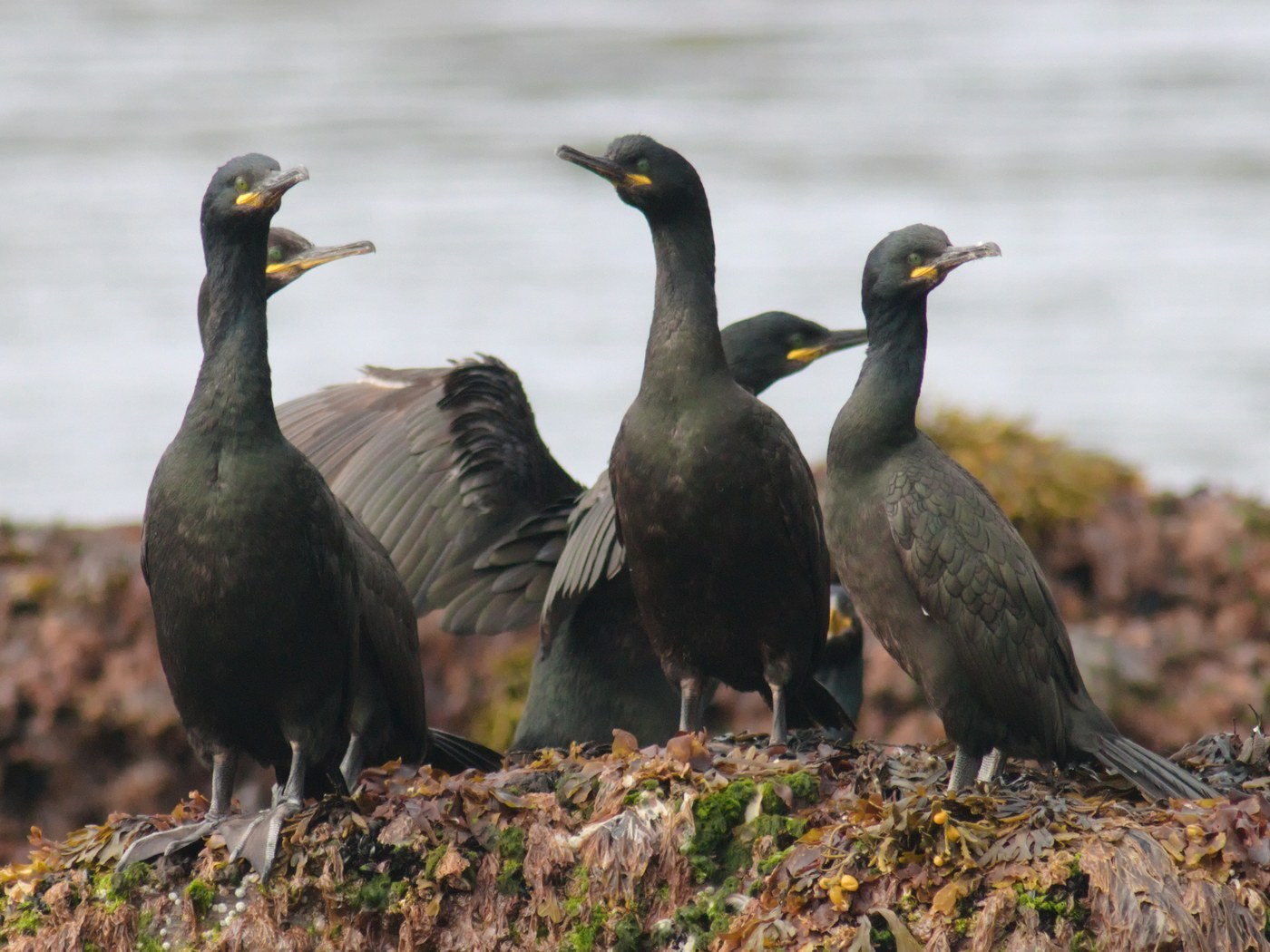
What European Shag's Feathers Look Like
European Shag body (contour) feathers are among the most distinctive of any European seabird: they are dark, oily-looking black feathers with a strong bottle-green or bronze-green iridescence that flashes in direct sunlight and looks almost black in shade. The barbs are tightly interlocked and slightly stiff, an adaptation for a bird that dives and swims underwater, so the feather surface often feels smoother and less fluffy than a typical land bird's contour feather. Flight feathers (primaries and secondaries) are longer and more matte, dark sooty-brown to blackish-brown with little to no green sheen, measuring roughly 18-25 cm for primaries on an adult. Tail feathers are short, stiff, and dark brown-black, used as a rudder and prop while swimming and perching on rock ledges, so tips are often abraded or frayed. In breeding season adults grow a forward-curling crest of thin, wispy black feathers on the forehead; these crest feathers are unusually narrow and hair-like compared to normal contour feathers and are a strong seasonal clue.
Step-by-Step: Is This Feather From a European Shag?
- Check the color in raked light: tilt the feather to catch the sun. A genuine green-bronze iridescent sheen over black points strongly to a shag rather than a plain black seabird feather.
- Feel the texture: contour feathers should feel dense, oily, and slightly stiff, not soft and downy.
- Measure length: flight feathers 15-25 cm suggest a mid-sized diving bird in the shag/cormorant size class, not a gull or duck.
- Look for a curved shaft: primaries are moderately curved and robust, built for underwater propulsion, not for soaring.
- Check for narrow, wispy crest feathers: if you find thin, almost hair-like black feathers with a forward curl, that is a strong sign of a breeding-season shag crest feather.
- Rule out oiliness from spill or algae: genuine iridescence is structural (color shifts with angle); an oil-stained feather stays the same dark color from all angles.
Similar Species & How to Tell Them Apart
The main confusion species is the larger Great Cormorant, which shares the same rocky coastlines. Great Cormorant contour feathers show more bronze and coppery-brown tones mixed with black, rather than the shag's cleaner bottle-green gloss, and Great Cormorant feathers run noticeably larger overall (it is a bigger bird). Great Cormorant also shows white feathers on the throat and, in breeding plumage, white flank patches and white filoplumes on the head and neck, which shags never show. Common Guillemot (Murre) and Razorbill feathers are also blackish but lack any green iridescence, are found on open water and cliffs together with auks' characteristically stubbier, more compact body feathers, and their flight feathers are shorter and more rounded, built for underwater "flying" rather than surface diving.
Where & When You'll Find Them
European Shags nest colonially on rocky sea cliffs, offshore islands, and jetties along the Atlantic coasts of Europe, the British Isles, and the Mediterranean, rarely straying far from saltwater. Feathers turn up most often on cliff ledges, rocky shorelines below colonies, and harbor breakwaters where birds roost and preen. The best time to find dropped feathers is during the post-breeding molt in late summer and early autumn (roughly July-September), when adults replace worn flight feathers, and again in late winter as birds molt into breeding condition and grow those distinctive crest feathers.
Frequently asked questions
What makes a European Shag feather different from a Great Cormorant feather?
Shag feathers show a cleaner, more uniform bottle-green iridescence on black, while Great Cormorant feathers mix in bronze-brown tones and the birds show white throat and flank feathers the shag lacks.
Why do some feathers look green and others just black?
Iridescence in shag feathers is structural, produced by the microscopic arrangement of the barbules, so the green sheen only appears at certain angles to light; in shade the same feather can look plain black.
Are shag flight feathers curved?
Yes, primaries are moderately curved and stiff-shafted, an adaptation for swimming underwater rather than gliding, which distinguishes them from feathers of soaring seabirds.
When is the best time to find shag feathers on a beach?
Late summer through early autumn, during the post-breeding molt, is when the most flight and body feathers are shed and wash up near coastal colonies.
Do shag feathers ever show white?
Adults can show a small white thigh patch in breeding plumage, but overall white feathering is minimal; extensive white points instead to Great Cormorant.