
How to Identify Eurasian Pygmy-Owl Feathers
A field guide to recognizing the tiny, round-winged flight and body feathers of Europe's smallest owl, and separating them from scops owl and small falcon feathers.
Read the full Eurasian Pygmy-Owl encyclopedia entry →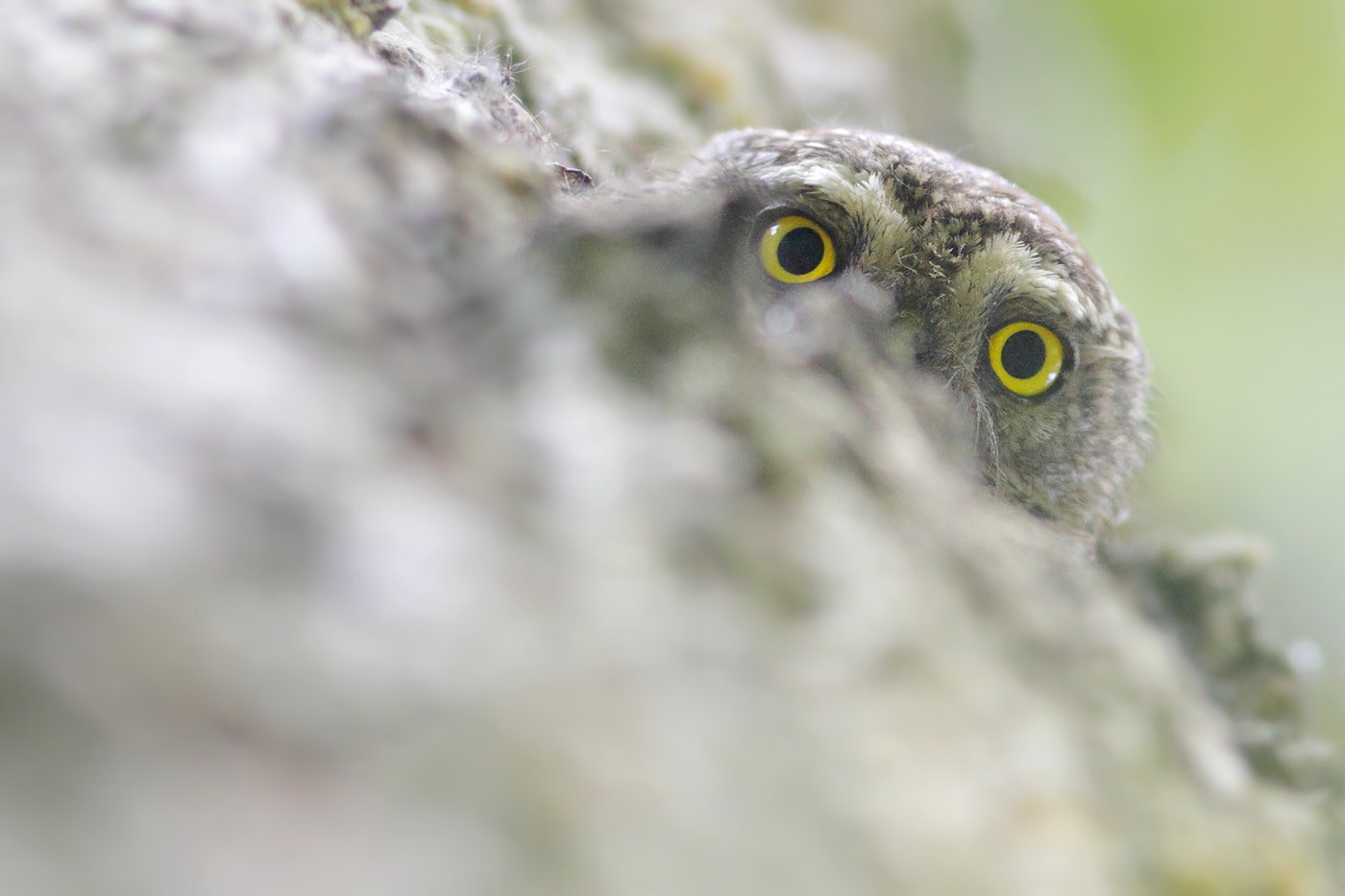
What Eurasian Pygmy-Owl Feathers Look Like
The Eurasian Pygmy-Owl is the smallest owl in Europe, and its feathers reflect that: nothing on this bird runs longer than about 9-10 cm (primaries), with most contour feathers under 4 cm. Overall coloring is grayish-brown to rufous-brown with crisp white or pale buff spotting, not streaking, arranged in neat rows on the crown, back, and wing coverts. Underparts feathers are whitish with bold rufous-brown blotches or bars along the sides, leaving a cleaner white strip down the center of the belly. The tail is relatively long for such a small owl and shows 3-4 narrow pale bars across a dark brown ground color. Flight feathers have a soft, slightly fringed edge typical of owls (for quiet flight), but the fringing is much less pronounced than on large owls like Tawny or Eagle Owls because this species hunts actively in daylight almost as often as at night and doesn't rely purely on stealth.
Step-by-Step: Is This Feather From a Eurasian Pygmy-Owl?
- Measure it. Anything over 10 cm is too large — you're likely looking at a Tawny Owl, Sparrowhawk, or larger bird. Pygmy-Owl feathers top out around body feathers 3-4 cm and longest primaries 9-10 cm.
- Check the leading edge of a flight feather. A soft, comb-like fringe (even if subtle) points to an owl rather than a falcon or thrush of similar size.
- Look at the pattern. Rows of clean white/buff spots on a brown ground, not smudgy streaks, are diagnostic — this rules out Scops Owl (vermiculated, bark-like) and most songbirds.
- Check the belly feathers. Bold rufous side-bars with a whiter center strip is a strong pygmy-owl signature.
- Note the tail bars. 3-4 narrow, evenly spaced pale bars on a dark tail feather fits; wide, irregular, or absent barring does not.
Similar Species & How to Tell Them Apart
- Eurasian Scops Owl feathers are finely vermiculated (fine wavy lines) for bark camouflage, lacking the crisp round white spots of the Pygmy-Owl, and the Scops Owl is a summer migrant while the Pygmy-Owl is resident in boreal/montane forest.
- Tengmalm's (Boreal) Owl is noticeably larger, with longer flight feathers (12+ cm) and a more rounded facial disc pattern reflected in denser facial feathering.
- Little Owl feathers show coarser, more streaky spotting and a stockier overall feather shape, and Little Owls favor open farmland rather than dense conifer forest.
- Common Kestrel juveniles have similarly sized barred feathers but with a warmer rufous ground color, black shaft streaks, and a stiffer, more pointed feather shape typical of falcons rather than the soft-edged owl feather.
Where & When You'll Find Them
Eurasian Pygmy-Owls are non-migratory residents of coniferous and mixed boreal/montane forest across Scandinavia, the Alps, and eastward through Russia. Because they're year-round residents, feathers can turn up at any time near old woodpecker holes they use for nesting and roosting, under favorite perch trees, or at plucking sites where they've cached small birds. Feather finds increase modestly in late summer through autumn during and after the post-breeding molt, and again near nest holes in early spring when adults are actively feeding young and feather wear from squeezing through cavity entrances is highest.
Frequently asked questions
How big is a Eurasian Pygmy-Owl feather compared to other owls?
Very small — the longest primaries reach only about 9-10 cm, versus 20+ cm for a Tawny Owl, making overall size the fastest first check.
Why don't Pygmy-Owl feathers show the same silent-flight fringing as big owls?
Because this species hunts in daylight as often as at dusk and covers short, fast distances rather than relying on prolonged silent gliding, so the comb-like fringe on the flight feather edge is present but much subtler.
What's the easiest single diagnostic feature?
Neat rows of round white or buff spots (not streaks or vermiculations) on a brown body feather, combined with an overall length under 10 cm.
Could a small feather with white spots be a juvenile of a bigger owl instead?
Check total feather length and fringe softness — juveniles of larger species still grow feathers within their species' larger size range, so a true sub-10 cm flight feather with owl fringing points strongly to Pygmy-Owl or Scops Owl rather than a young larger owl.
Does the tail pattern help narrow it down?
Yes — 3-4 narrow, regularly spaced pale bars on a dark brown tail feather is a good match, whereas wider or fewer bars suggest a different small owl species.
Eurasian Pygmy-Owl identified by the community
Recent Eurasian Pygmy-Owl feathers identified with Feather Identifier.
