
How to Identify Emerald Toucanet Feathers
How to recognize the near-uniform grass-green body feathers and chestnut-tipped tail of this Central and South American cloud-forest toucan.
Read the full Emerald Toucanet encyclopedia entry →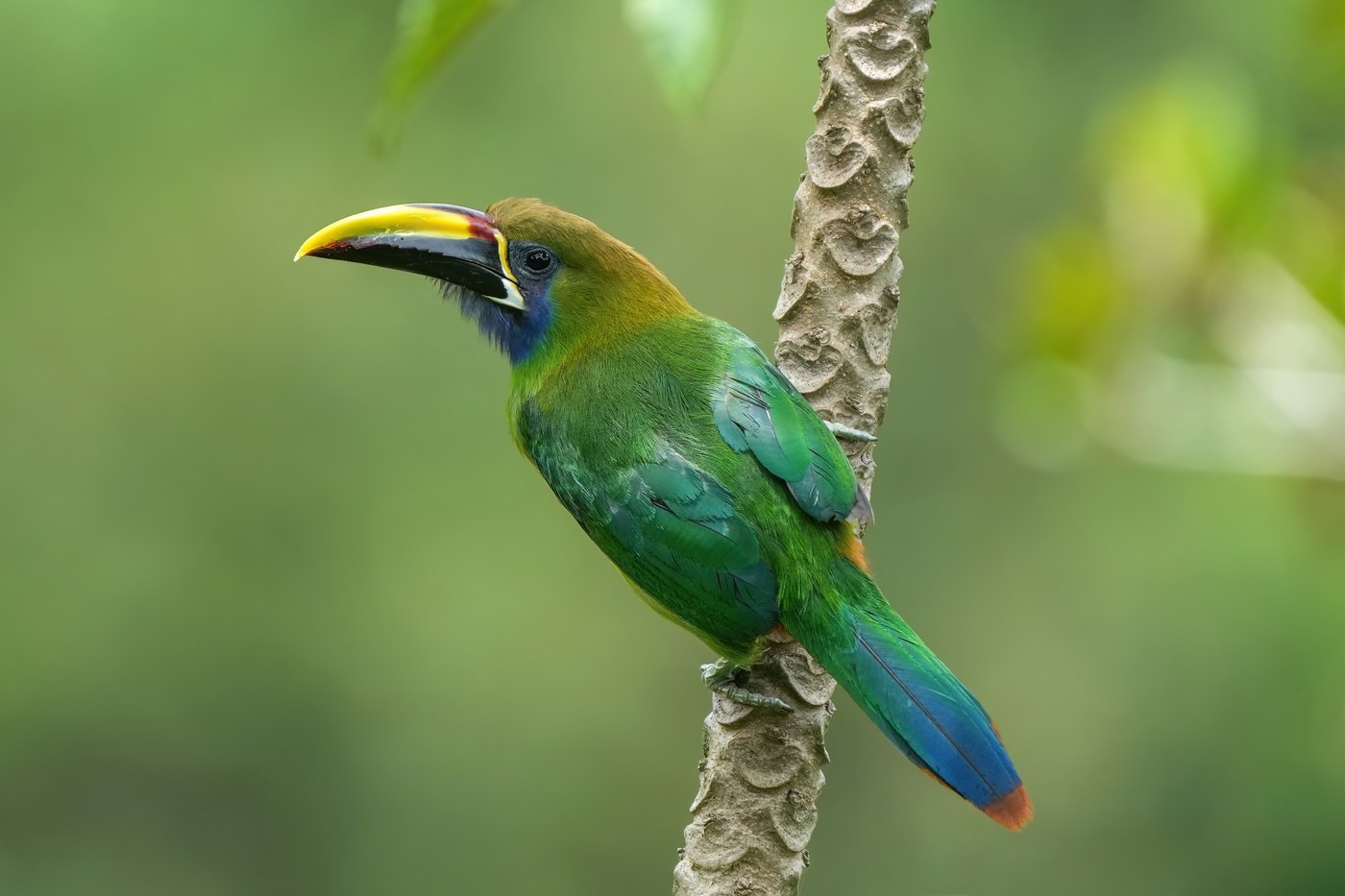
What Emerald Toucanet Feathers Look Like
Among forest birds, an almost entirely grass-green body is unusual, and that uniform color is the Emerald Toucanet's calling card.
- Body/contour feathers: bright, fairly uniform green across the back, breast, and belly, sometimes with a bluish tinge on the throat in certain populations.
- Tail feathers: green on top but tipped with warm chestnut/rufous, an elongated and somewhat graduated shape compared to a typical songbird tail.
- Undertail coverts: rufous-chestnut, contrasting with the green body.
- Wing coverts: matching green, without bars or spots, giving a smooth, unbroken color field.
- Overall texture: fairly stiff, glossy-looking contour feathers typical of toucans, larger than a typical songbird's but much smaller than the wing/tail feathers of the bird's larger toucan relatives.
Step-by-Step: Is This Feather From an Emerald Toucanet?
- Check for near-uniform green. A body feather that is green with little to no barring, spotting, or streaking is the starting point.
- Look at the tail tip. A chestnut or rufous tip on an otherwise green tail feather is a strong diagnostic, since few green birds share this specific combination.
- Examine undertail coverts. Rufous-chestnut coloring here, paired with green elsewhere, supports toucanet.
- Compare feather stiffness. Toucanet contour feathers tend to feel a bit stiffer and glossier than typical green songbird feathers like tanagers.
- Consider elevation and habitat. A feather found in cool, mossy cloud forest at moderate-to-high elevation fits this species better than lowland habitat.
Similar Species & How to Tell Them Apart
Various parrot species sharing the same forest are also green, but parrot tail feathers are typically uniform green without a contrasting chestnut tip, and parrot contour feathers often show a slightly different, more powdery texture from the specialized down that parrots produce. Other toucanet species, such as Groove-billed Toucanet, are extremely similar and mostly separated by range rather than feather details, though subtle differences in the exact shade of the tail tip can help. The chestnut-tipped, green, somewhat elongated tail feather is the most reliable single feature separating toucanets from co-occurring green parrots.
Where & When You'll Find Them
Emerald Toucanets inhabit humid highland and cloud forest from Mexico south through Central America and into parts of the Andes, generally favoring cooler, wetter elevations than lowland toucan species. They are non-migratory residents, so feathers can be found across the year, with molt most concentrated around the transition from the wet to dry season in a given region, following the completion of breeding. Because the species travels in small, noisy family groups and forages at mid-to-upper canopy levels for fruit, shed feathers often turn up on the forest floor beneath fruiting trees rather than in open clearings, so checking under fig or melastome trees in cloud forest can be more productive than searching open trail edges.
Frequently asked questions
Why is the tail tip a different color from the rest of the feather?
The chestnut tip is a pigment-based color pattern distinct from the surrounding green, and this two-toned tail feather design is a shared trait across several toucanet species, likely aiding in visual signaling or camouflage against forest leaf litter.
Can I distinguish Emerald Toucanet from a small parrot by feel alone?
It helps somewhat — toucanet feathers tend to be slightly stiffer and glossier — but color pattern, especially the chestnut tail tip, is a more reliable diagnostic than texture alone.
Does the blue throat tinge appear in all populations?
No, the bluish throat tone varies by subspecies and region, so its absence doesn't rule out the species, especially in populations further south in its range.
Are Emerald Toucanet feathers ever found at low elevation?
It's less common, since the species generally prefers cooler highland and cloud forest, so a feather found in lowland tropical forest is somewhat less likely to be this species compared to other toucan relatives.
Is there a way to tell age from the feather?
Juvenile Emerald Toucanets tend to show duller, less saturated green and a less crisply defined chestnut tail tip compared to adults, though this distinction can be subtle on a single feather.