
How to Identify Common Black Hawk Feathers
A guide to recognizing the broad, sooty-black feathers of this heavyset raptor and distinguishing them from other dark hawks.
Read the full Common Black Hawk encyclopedia entry →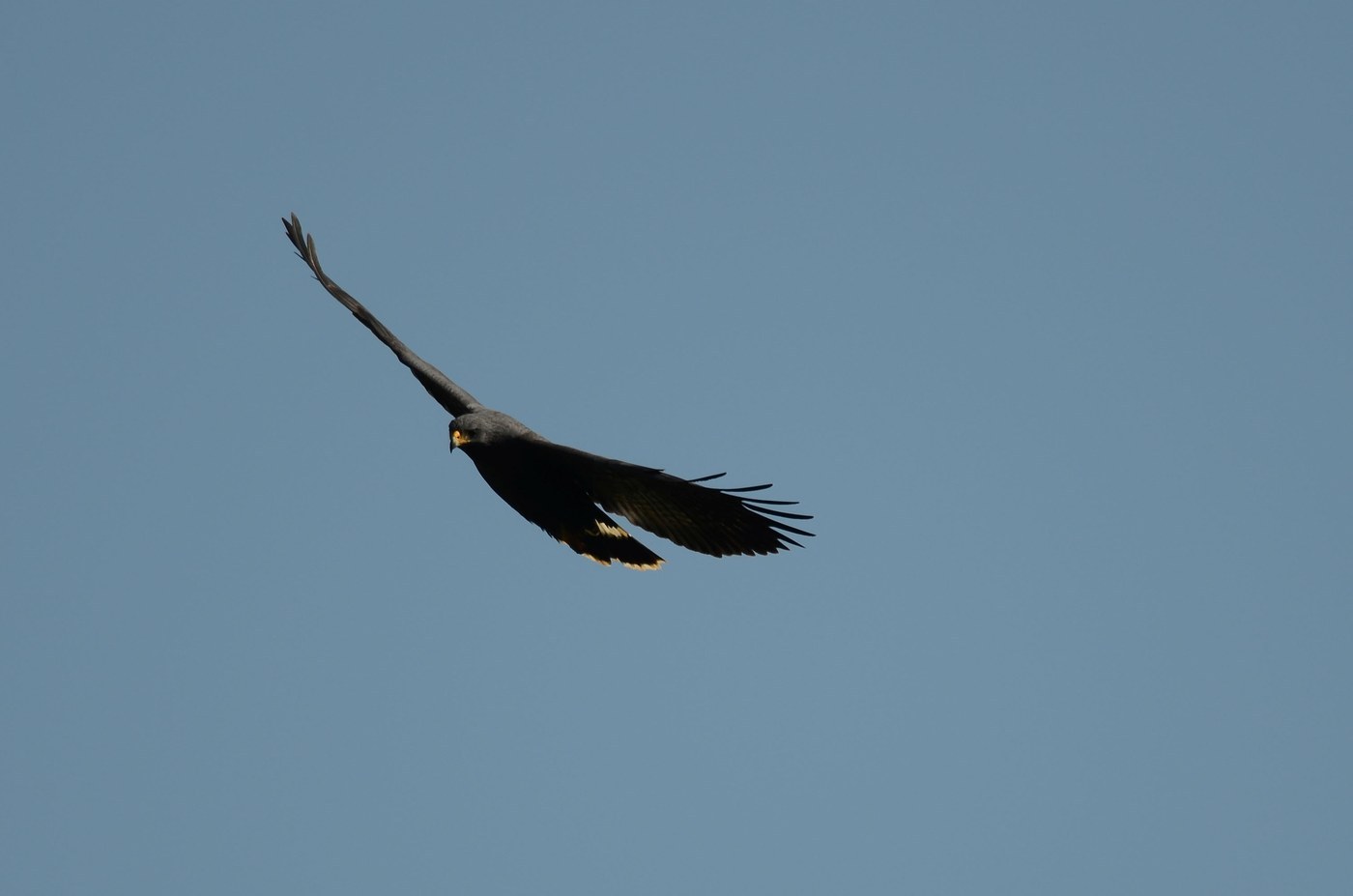
What Common Black Hawk's Feathers Look Like
The Common Black Hawk is a stocky, broad-winged raptor of wooded streams and wetlands from the southwestern United States through Central and South America, and its feathers match its heavy, deliberate flight style. Adult body and covert feathers are essentially uniform sooty black to slate-black, with little visible patterning at rest — a very different look from the streaked or barred plumage of most other hawks. Flight feathers (primaries and secondaries) are blackish above but show paler, faintly barred gray undersides, visible mainly on feathers from the underside of the wing.
The most distinctive single feather to find is a tail feather: adults show a broad, bold white band across an otherwise black tail, usually just one wide band rather than several narrow ones, sometimes with a thin white tip as well. Juveniles look quite different — heavily streaked brown and buff below with a multi-banded, browner tail — and their feathers can be mistaken for a different species entirely if compared only to adult images. Feathers are large and stout, reflecting a bird with a wingspan approaching 1.2 meters, with thick, sturdy rachises typical of a raptor built for perch-and-wait hunting near water.
Step-by-Step: Is This Feather From a Common Black Hawk?
- Measure it. Primaries commonly run 25–33 cm and tail feathers 18–23 cm — solidly in large-hawk territory, bigger than a Cooper's Hawk or kestrel but smaller than an eagle.
- Check overall color first. Nearly solid sooty-black body feathers with no strong streaking or barring is the fastest initial clue.
- Look for the tail band. A single broad white (or pale gray) band crossing an otherwise black tail feather is the most diagnostic mark for an adult.
- Inspect the underside of flight feathers. Faint pale gray barring on an otherwise blackish primary or secondary fits this species.
- Consider juvenile plumage separately. A heavily streaked brown-and-buff feather with multiple narrower tail bands may still be a Common Black Hawk if it's an immature bird.
- Think about habitat. A feather found along a wooded river, stream, or mangrove edge in the appropriate range supports this species over an open-country hawk.
Similar Species & How to Tell Them Apart
The Zone-tailed Hawk, which mimics vultures in flight, is also blackish but shows two or three narrower gray-white tail bands rather than one broad band, and its flight feathers are more evenly barred gray below. Turkey Vultures, often confused with black hawks on the wing, have longer, more ragged-edged flight feathers and lack the crisp single tail band. The Great Black Hawk, found farther south in the Neotropics, is very similar but larger overall with proportionally longer legs; range is often the deciding factor. Dark morphs of buteos such as Swainson's Hawk or Red-tailed Hawk can look superficially black but typically retain some rufous or streaked tones and a differently patterned tail.
Where & When You'll Find Them
Common Black Hawks favor riparian corridors — wooded streams, rivers, and mangrove edges — from the southwestern U.S. and Mexico south through Central America into parts of South America, rarely straying far from water. Many U.S. and northern Mexican populations are migratory, wintering farther south and returning to nest sites in spring, so feathers in the northern part of the range are most likely to appear from spring through early fall. Look for feathers below regular perch trees along streamsides and near nest sites in tall riparian trees; molt of body and flight feathers is gradual and occurs mainly during and after the breeding season.
Frequently asked questions
What's the single best clue for identifying a Common Black Hawk feather?
A large, otherwise blackish tail feather crossed by one broad white band is the most reliable diagnostic mark for an adult of this species.
How do juvenile feathers differ from adult feathers?
Juveniles are heavily streaked brown and buff rather than solid black, with a multi-banded rather than single-banded tail, so a streaky feather doesn't rule out this species if it's an immature bird.
Could this be a vulture feather instead?
Turkey Vultures are similarly dark and share riparian/open habitat, but their flight feathers are more evenly barred and ragged-edged, and they lack the hawk's crisp single white tail band.
How does it differ from a Zone-tailed Hawk feather?
Zone-tailed Hawks show two or three narrower gray-white tail bands, while Common Black Hawk typically shows just one broad band.
When during the year are these feathers most likely to turn up?
In the northern part of the range (US/northern Mexico), spring through early fall while birds are present for breeding; farther south where populations are resident, feathers can appear year-round near streamside perches and nests.