
How to Identify Calliope Hummingbird Feathers
How to identify the tiny, streak-gorgeted feathers of North America's smallest breeding bird.
Read the full Calliope Hummingbird encyclopedia entry →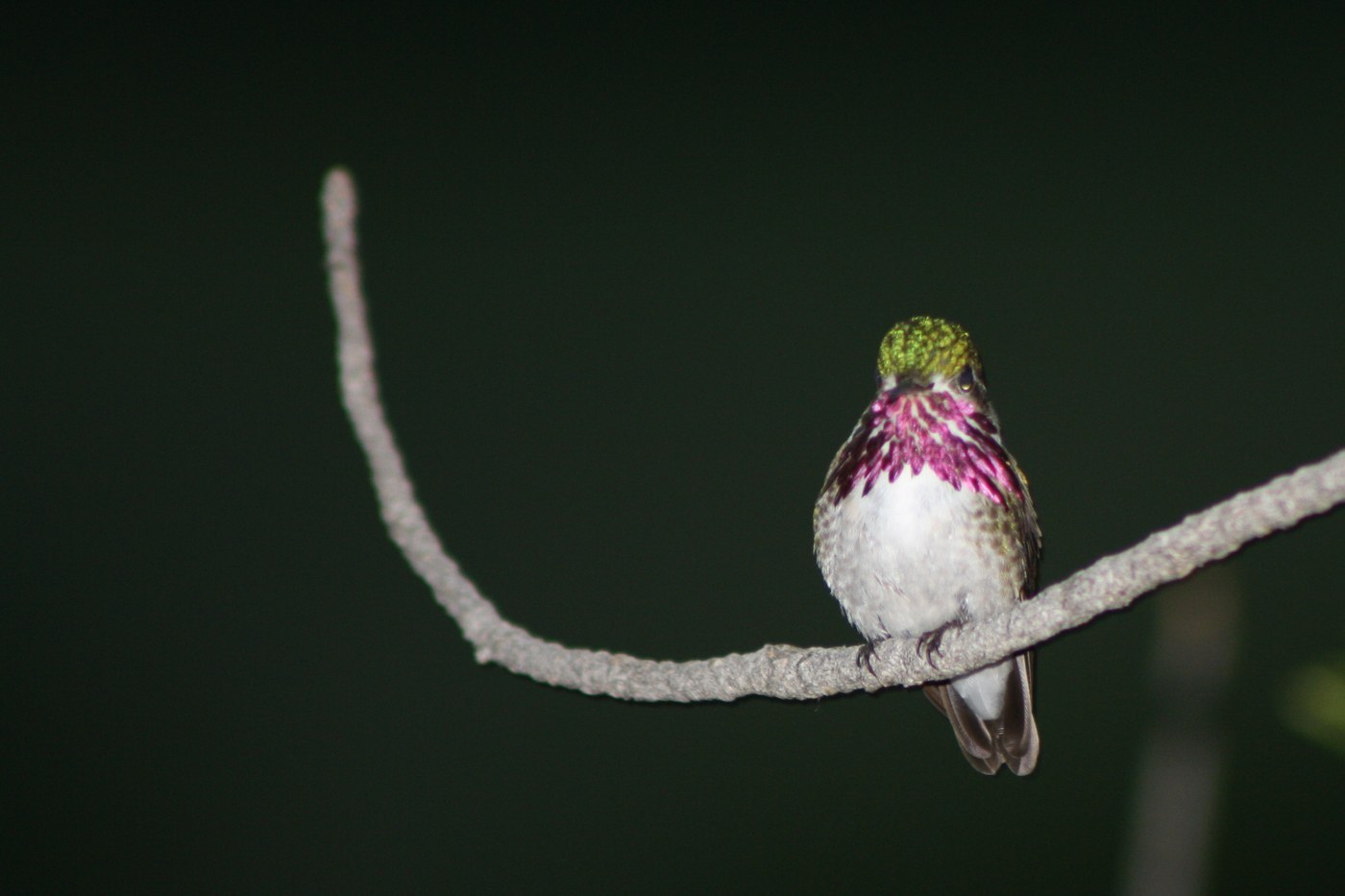
What Calliope Hummingbird's Feathers Look Like
Calliope Hummingbird is the smallest breeding bird in the United States and Canada, and its feathers are correspondingly minuscule — even smaller than those of most other North American hummingbirds. The male's throat (gorget) feathers are the most distinctive feature: rather than a solid, uniform iridescent patch as in many hummingbirds, Calliope's gorget feathers are arranged in individual streaks or "rays" of magenta-wine iridescent color radiating down over a whitish throat, creating a streaked rather than solid look even at close range.
Back and crown feathers are iridescent green, typical of many western hummingbirds, while underparts show white on the throat and belly with greenish wash along the flanks. Females and immatures lack the colorful streaked gorget, showing plain whitish throats sometimes with faint dusky spotting. Tail feathers are notably short and narrow, reflecting the species' tiny overall size (around 3 inches, the smallest of any North American breeding bird), with the outer tail feathers showing some rufous at the base in females and immatures.
Step-by-Step: Is This Feather From a Calliope Hummingbird?
- Check for extremely small size. Any feather under roughly 2 cm, especially a tiny narrow tail feather, is consistent with this being the smallest North American breeding bird.
- Look for streaked (not solid) gorget feathers. Individual magenta-wine streaks over a white throat, rather than one solid colored patch, is highly distinctive for adult males.
- Assess back feather color. Iridescent green crown and back feathers fit this species alongside many other western hummingbirds, so pair this with the gorget or size clue.
- Note tail feather proportions. Very short, narrow tail feathers reflect this species' unusually small body size.
- Consider basal rufous color. Some rufous coloring at the base of outer tail feathers can appear in females/immatures.
- Factor in elevation and range. A tiny hummingbird feather found in mountain meadows or forest edges of the western US or Canada, particularly at moderate-to-high elevation, supports this species over lowland hummingbirds.
Similar Species & How to Tell Them Apart
Broad-tailed Hummingbird, which shares similar mountain habitat, is noticeably larger with a solid rose-pink (not streaked) gorget in males, making gorget pattern the key differentiator. Rufous and Allen's Hummingbird females and immatures can show some superficial similarity in size and green-backed coloring, but both are somewhat larger overall and often show more extensive rufous coloring in the tail and flanks compared to Calliope's more limited rufous tones. Because immature and female hummingbirds across species can look quite similar, the streaked male gorget is by far the most reliable single feature when present; without it, overall small size combined with mountain habitat context is the best available clue.
Where & When You'll Find Them
Calliope Hummingbird breeds in mountain meadows, open coniferous forest edges, and shrubby slopes across the western United States and southwestern Canada, often at surprisingly high elevations for such a tiny bird. It is a long-distance migrant despite its small size, wintering in Mexico, so feathers within the breeding range are most likely found from late spring through summer. Molt typically follows breeding in late summer, so feathers turn up near mountain meadow flowers, feeders, and nest sites during this late-summer window before birds depart for wintering grounds.
Frequently asked questions
What makes the male's throat feathers so distinctive?
Unlike most hummingbirds with a solid-colored throat patch, Calliope Hummingbird males show individual magenta-wine streaks or rays over a white throat, creating a streaked rather than solid gorget.
How small are this species' feathers exactly?
Extremely small — this is the smallest breeding bird in the US and Canada at around 3 inches total length, so even tail feathers are only a centimeter or two long.
How do I tell this apart from a female Rufous Hummingbird feather?
Female Rufous Hummingbirds are somewhat larger and show more extensive rufous coloring in the tail and flanks compared to Calliope's more limited rufous tones, though the two can be quite similar without a male gorget feather to check.
Does elevation matter for identification?
Yes, Calliope Hummingbird favors mountain meadows and forest edges often at high elevation, so a tiny hummingbird feather found in montane western habitat fits well.
When are feathers most likely to be found?
Late spring through summer during the breeding season, with molt concentrated in late summer before birds migrate to Mexican wintering grounds.