
How to Identify California Thrasher Feathers
How to identify the plain brown feathers and clues from this chaparral specialist's uniquely long, curved bill.
Read the full California Thrasher encyclopedia entry →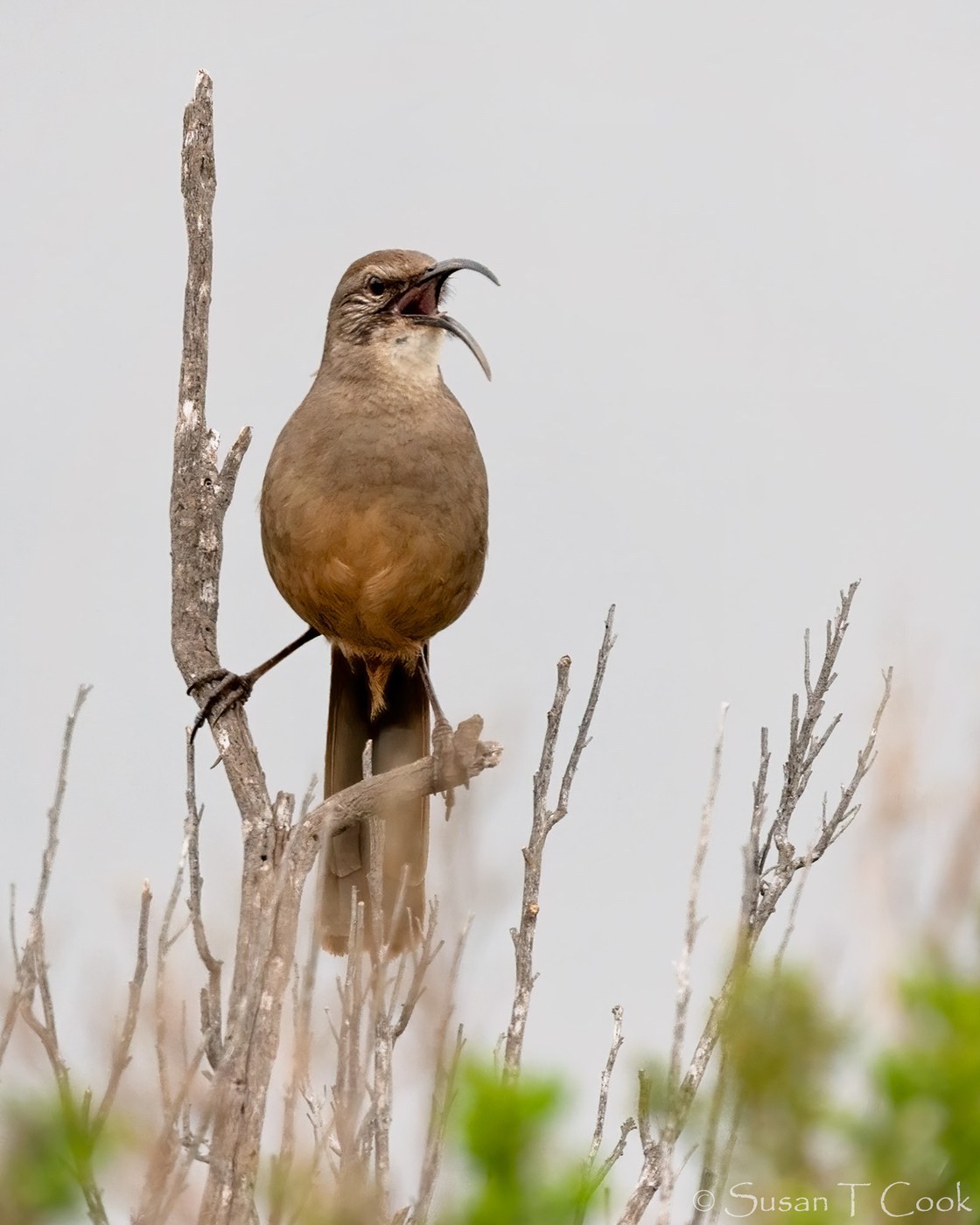
What California Thrasher's Feathers Look Like
California Thrasher is a chaparral specialist best known for its long, strongly down-curved bill, and its feathers are correspondingly understated to match a life spent foraging in dense, shadowy shrub cover. Overall body plumage is uniform grayish-brown to dark brown, without bold spotting, streaking, or barring — one of the plainest-looking thrashers in North America. The throat and face show only subtle contrast, with a faint pale eyebrow and a slightly paler throat compared to the darker crown and back.
The tail is notably long and broad, proportionally one of the longer tails among North American songbirds, colored a uniform dark brown without strong banding. A useful identifying feature is the buffy-to-cinnamon wash on the undertail coverts, providing a warmer tone that contrasts subtly with the otherwise drab brown body — often the most distinctive color feature available on an isolated feather. Flight feathers are broad and rounded rather than pointed, consistent with this species' relatively weak, short-distance flight style suited to dense shrub habitat rather than long migration.
Step-by-Step: Is This Feather From a California Thrasher?
- Check for plain, unpatterned brown color. The near-total absence of streaking or spotting on body feathers is itself a useful clue for this species by elimination.
- Look at undertail covert feathers. A cinnamon-buff wash on feathers from this area, contrasting with plainer brown elsewhere, supports this identification.
- Assess tail feather length and shape. Long, broad, uniformly dark brown tail feathers fit this species' silhouette.
- Note wing feather shape. Broad and rounded rather than pointed flight feathers suggest a non-migratory, shrub-dwelling bird.
- Consider overall feather size. This is a fairly large songbird (around 12 inches long), so feathers should be moderately sized, larger than typical sparrows or wrens.
- Factor in habitat. A feather found in dense California chaparral supports this species strongly, since it rarely strays from that habitat type.
Similar Species & How to Tell Them Apart
Crissal Thrasher, found in desert habitats further east and south, is extremely similar in overall plain brown coloring but typically shows a somewhat richer rufous-chestnut undertail covert patch and occupies desert wash habitat rather than coastal chaparral. LeConte's Thrasher is notably paler overall, almost sandy-gray, fitting its more open desert habitat. Curve-billed Thrasher, found in the desert Southwest, shows some breast spotting that California Thrasher lacks, along with a shorter, less dramatically curved bill. Because these thrashers are quite similar in plain brown feather coloring, range and habitat (chaparral versus desert) are often the most useful tie-breakers alongside subtle undertail covert color differences.
Where & When You'll Find Them
California Thrasher is essentially endemic to California (with a small range extending into northern Baja California), living year-round in dense chaparral and coastal scrub where it forages by sweeping its long curved bill through leaf litter. As a non-migratory resident, feathers can be found in any season, but molt is concentrated in late summer, following the breeding season, when this typically secretive species may be somewhat more detectable while replacing worn plumage. Feathers are most likely to be found on the ground beneath dense chaparral cover, where this species spends the vast majority of its time close to or under shrub canopy.
Frequently asked questions
What's the best clue on an otherwise plain brown feather?
Check the undertail covert feathers for a cinnamon-buff wash — this warmer tone against otherwise uniform brown plumage is one of the few distinguishing color features available.
Why don't California Thrasher feathers show much pattern?
This species forages in dense, shadowy chaparral where a plain brown color provides effective camouflage, so it lacks the bold spotting or streaking seen in more open-country birds.
How do I rule out Crissal Thrasher?
Crissal Thrasher shows a richer rufous-chestnut undertail patch and lives in desert wash habitat rather than coastal chaparral, so both color and location help separate the two.
Is the tail a useful identifying feature?
Yes, the tail is long, broad, and uniformly dark brown, fitting this species' overall silhouette even without bold pattern to check against.
Where within its range are feathers most likely to be found?
On the ground beneath dense chaparral cover, since this species rarely strays from thick shrub habitat throughout its life.