
How to Identify Bridled Titmouse Feathers
Learn the crested gray feathers and unique black-and-white facial pattern that make the Bridled Titmouse the only North American titmouse with a striking harlequin-like face.
Read the full Bridled Titmouse encyclopedia entry →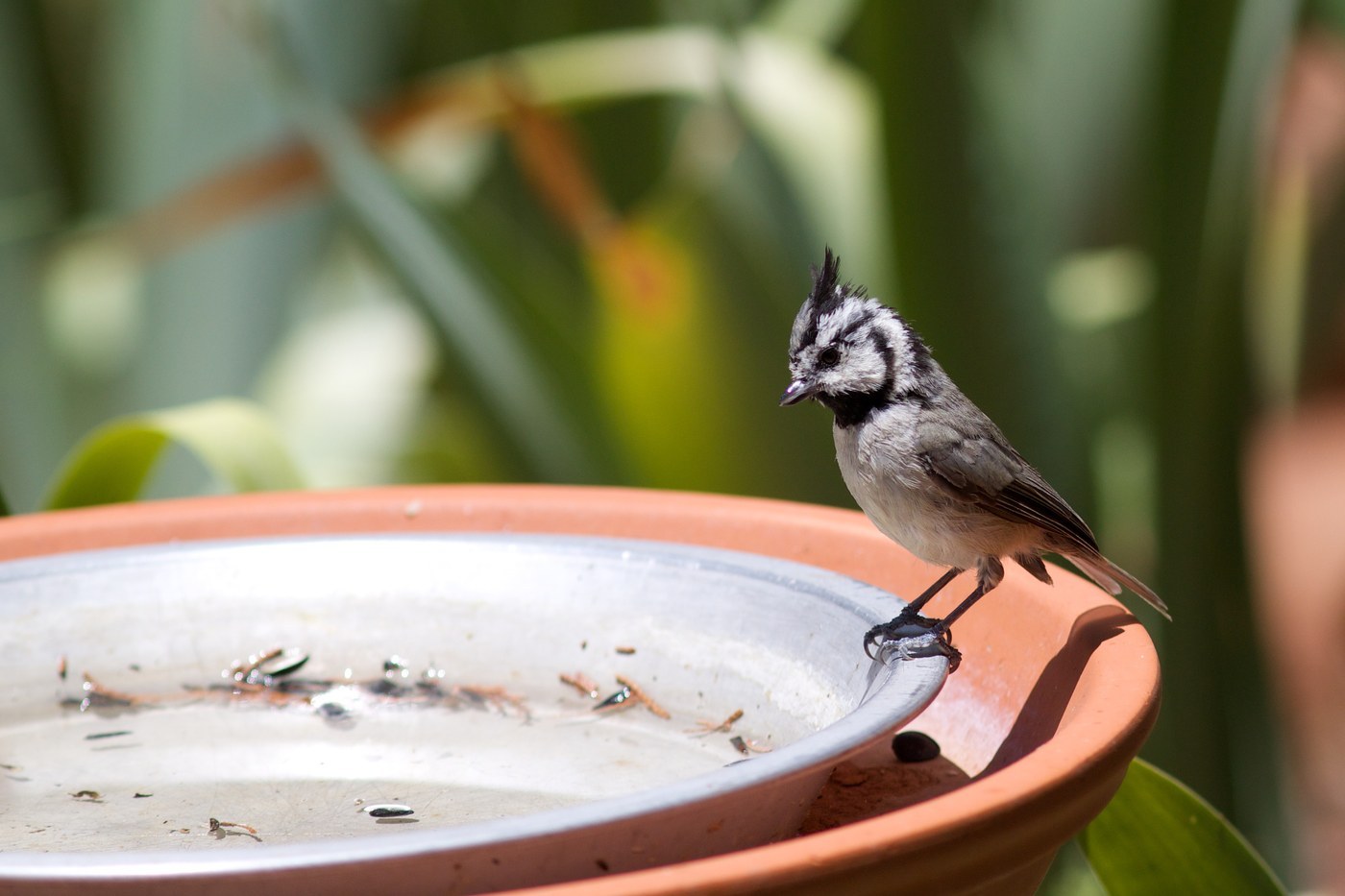
What Bridled Titmouse Feathers Look Like
The Bridled Titmouse is a small, crested songbird of southwestern oak and pine-oak woodlands, and it's the only North American titmouse with a bold black-and-white facial pattern, making its head feathers especially useful for identification.
- Face feathers: a striking black-and-white "bridled" pattern — a black throat patch, black line through and around the eye, and a black V or bridle-like marking framing pale cheeks and forehead, quite unlike the plain face of other titmice.
- Crest feathers: gray, moderately long and pointed, forming a distinct peak on the crown — shared in shape with other titmice but plainer gray in color, without the facial markings extending onto the crest itself.
- Body/contour feathers: soft pale gray on the back, wings, and tail, fading to whitish on the belly with a faint buffy wash on the flanks — overall coloring is subdued, letting the face pattern stand out as the main feature.
- Flight feathers: plain gray, 4-5 cm, without wing bars or bold markings.
- Tail feathers: gray, medium length (5-6 cm), plain and unpatterned.
- Shaft color: pale gray, unremarkable.
Step-by-Step: Is This Feather From a Bridled Titmouse?
- Check for black-and-white facial feathers. A small black feather with an adjoining white or pale patch, especially forming part of a throat patch or eye-line, is a strong clue — no other North American titmouse shows this pattern.
- Look for a gray crest feather. A moderately long, pointed gray feather from the crown supports a titmouse identification generally.
- Assess overall body color. Plain pale gray body feathers without patterning, paired with the distinctive face feathers, fit this species well.
- Rule out plain-faced titmice. If the face feathers are uniformly gray without black-and-white markings, consider Tufted or Oak Titmouse instead, since Bridled Titmouse is the only one with this bold facial contrast.
- Match to habitat. Feathers found in oak, pine-oak, or sycamore-lined canyon woodlands in the southwestern US (Arizona, New Mexico) and Mexico support this identification, since the species is restricted to this specific habitat and range.
Similar Species & How to Tell Them Apart
- Oak Titmouse: plain gray-brown overall with no facial pattern at all — a completely unmarked face immediately separates it from Bridled Titmouse.
- Juniper Titmouse: also plain-faced and grayer overall, lacking any black-and-white markings.
- Tufted Titmouse: shows a black forehead patch and rusty flanks but no black throat/bridle pattern, and occurs well east of Bridled Titmouse's range with no overlap.
- Black-crested Titmouse: has a black crest (not gray) but a plain gray face without the bridled black-and-white pattern, and occurs in Texas/Mexico rather than the Arizona/New Mexico stronghold of Bridled Titmouse.
Where & When You'll Find Them
Bridled Titmice are non-migratory residents of oak and pine-oak woodlands and wooded canyons in the southwestern US (primarily Arizona and New Mexico) and down through the Mexican highlands. Because they don't migrate, feathers can be found year-round near suitable woodland, with the main molt period in late summer after breeding. Look near oak groves, sycamore-lined canyons, and mixed woodland edges, where these active, acrobatic little birds forage in mixed-species flocks outside the breeding season.
Frequently asked questions
What makes this species' feathers unlike any other titmouse?
The bold black-and-white 'bridled' facial pattern — a black throat patch and eye-line framing pale cheeks — is unique among North American titmice, which otherwise have plain, unmarked faces.
How do I rule out a Tufted Titmouse feather?
Tufted Titmouse shows a black forehead patch and rusty flanks but no black throat/bridle pattern, and its range doesn't overlap with Bridled Titmouse's southwestern stronghold.
What color is the crest?
Plain gray, moderately long and pointed — similar in shape to other titmice but without any facial markings extending onto it.
Where should I look for these feathers?
Oak and pine-oak woodlands and wooded canyons in Arizona, New Mexico, and the Mexican highlands, where the species is a year-round resident.