
How to Identify Booted Racket-tail Feathers
Identify the tiny, brilliant green body feathers, fluffy white leg 'boots,' and unmistakable wire-thin racket tail feathers of this small Andean cloud-forest hummingbird.
Read the full Booted Racket-tail encyclopedia entry →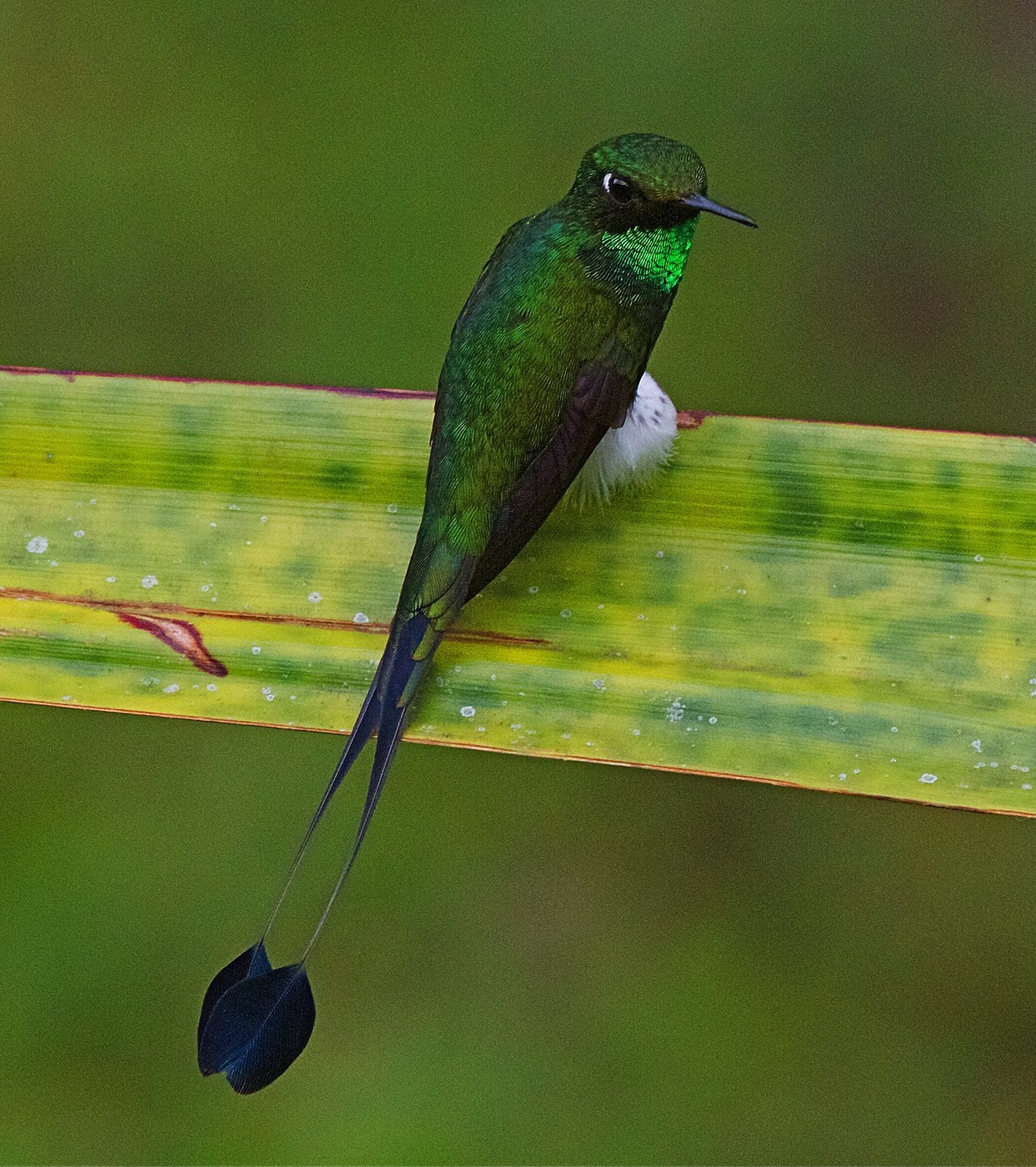
What Booted Racket-tail Feathers Look Like
The Booted Racket-tail is a small hummingbird of Andean forest edges and cloud forest in South America, and it produces some of the most unusual and unmistakable feathers of any hummingbird thanks to its namesake leg tufts and racket-shaped tail.
- Body/contour feathers: brilliant iridescent green on the back and crown, shifting to emerald or bronze-green depending on light angle, tiny (under 1 cm), with the glossy, scale-like sheen typical of hummingbirds.
- Throat/gorget feathers (males): iridescent green, small and intensely glossy, blending closely with the body color rather than contrasting sharply.
- "Boot" feathers: soft, fluffy, pure white puffs of down found at the base of the legs — a genuinely unique feature among hummingbirds and an instant giveaway if found still attached near the foot; this is exactly the trait that gives the species its "booted" name.
- Tail feathers: the outer tail feathers are dramatically modified into long, bare, wire-thin shafts (4-6 cm) ending in a small, spatula-shaped iridescent black or blue-green "racket" at the very tip — unmistakable and shared with only a small number of other racket-tailed hummingbirds in the same genus.
- Flight feathers (primaries): tiny (2-3 cm), dark blackish-brown, stiff and narrow, typical of fast-whirring hummingbird wings.
- Shaft color: dark brown to blackish on flight and racket-tail feathers; pale on the fluffy white boot feathers.
Step-by-Step: Is This Feather From a Booted Racket-tail?
- Check for the racket tail. A thin, bare wire-like shaft ending in a small black or greenish paddle-shaped tip is diagnostic of a racket-tail hummingbird — if you find this alongside white leg-boot down (below), identification is essentially confirmed.
- Look for white leg-boot down. Small tufts of pure white, fluffy down near where legs would attach are a signature feature that combines with the racket tail to distinguish this species from other Andean hummingbirds.
- Assess overall size. All feathers should be tiny — body feathers under 1 cm and flight feathers just 2-3 cm — consistent with a small hummingbird.
- Note the iridescence. Bright, shifting emerald-green sheen under different light angles supports a hummingbird identification generally.
- Match to habitat. Feathers found in humid montane forest edges, clearings, or gardens along the Andes fit this species' range and habits.
Similar Species & How to Tell Them Apart
- Other Andean hummingbirds with white leg puffs (e.g., pufflegs): pufflegs have similarly fluffy white or buff leg tufts but lack the wire-thin racket-tipped tail feathers entirely, making the tail the deciding feature.
- Other racket-tailed hummingbirds: a small number of related species elsewhere in the Neotropics also show racket-tipped tails, but the combination of racket tail plus bright white (not buff or colored) leg boots is most closely associated with this species within its Andean range.
- Andean emeralds and other green hummingbirds: share the same brilliant green body iridescence but have plain, unmodified tail feathers and no leg-boot down, quickly ruling them out once the tail and legs are checked.
- Sunangels and coquettes: some show ornamental head or neck plumes, but none combine a wire-thin racket tail with white leg boots the way this species does.
Where & When You'll Find Them
The Booted Racket-tail is resident year-round in humid montane forest edges, second growth, and gardens along the Andes from Venezuela and Colombia south through Ecuador, Peru, and into Bolivia, typically at middle elevations. Because it doesn't migrate, feathers — including shed racket-tail feathers, which can become damaged and dropped during vigorous display flights — can be found any time of year, with molt and feather turnover occurring gradually rather than in one sharp seasonal wave. Look near flowering shrubs, forest edges, and garden feeders in Andean cloud-forest habitat where the birds feed on nectar.
Frequently asked questions
What is the single most unmistakable feature of this species' feathers?
The racket tail feather: a thin, bare wire-like shaft tipped with a small black or greenish paddle-shaped tip, combined with fluffy white leg-boot down.
What are the white 'boots'?
Fluffy white down tufts at the base of the legs, the trait that gives the species its name and a strong confirming clue alongside the racket tail.
How small are the feathers?
Extremely small — body feathers are under 1 cm and even the flight feathers are only 2-3 cm, consistent with this tiny hummingbird's size.
Could a puffleg feather be confused with this species?
Pufflegs share fluffy white or buff leg tufts but lack the wire-thin, racket-tipped tail feathers, so checking the tail resolves the confusion.