
How to Identify Blue-and-yellow Macaw Feathers
How to recognize the long cobalt-blue flight feathers and vivid yellow body plumes of this large South American macaw, and rule out other big blue-and-yellow parrots.
Read the full Blue-and-yellow Macaw encyclopedia entry →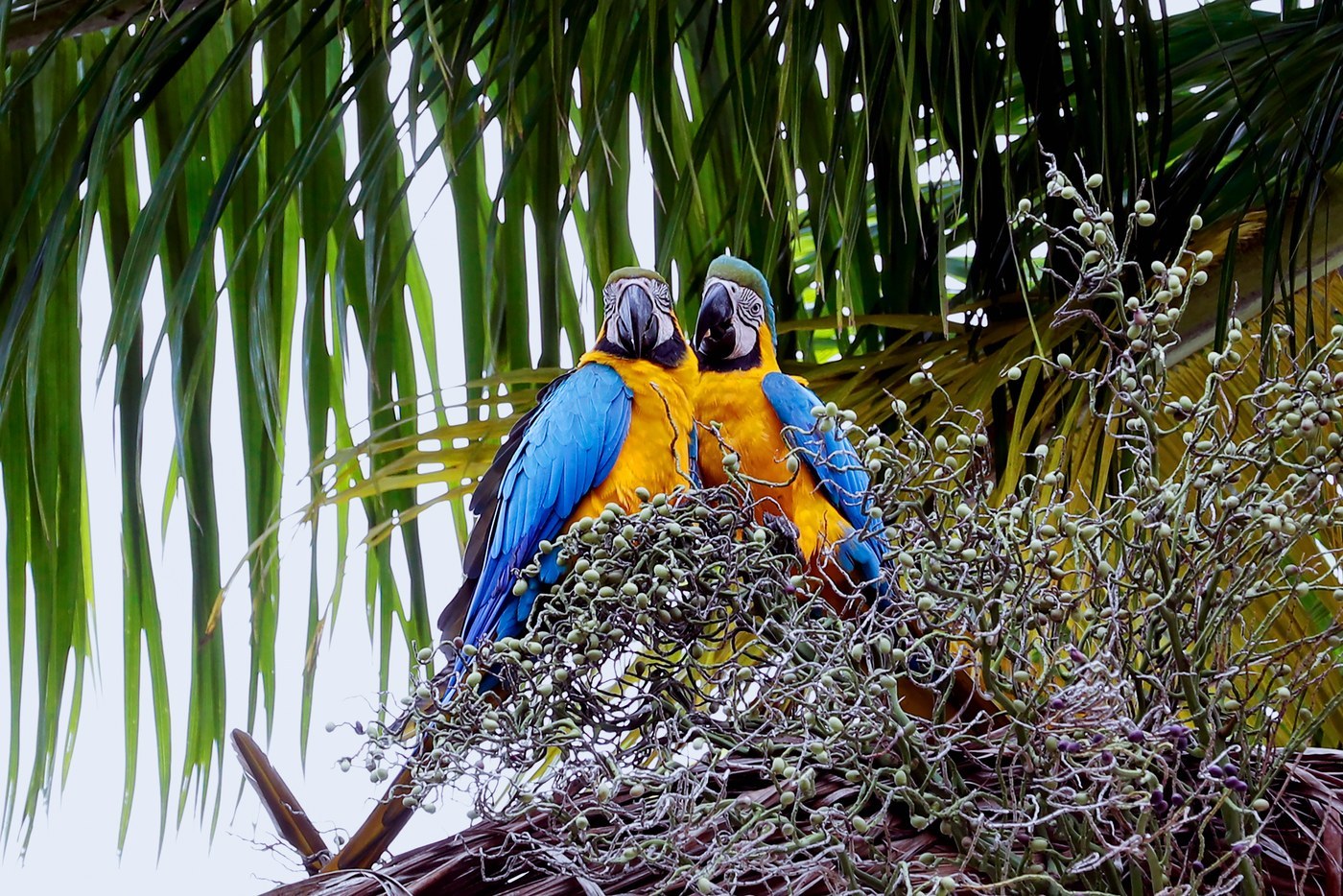
What Blue-and-yellow Macaw's Feathers Look Like
This is one of the largest parrots in the world, and its feathers are correspondingly oversized and vividly two-toned. Flight feathers (primaries and secondaries) are a rich, deep cobalt-to-royal blue on the upper surface, often with a slightly duller blue-gray underside, and are long and broad — primaries can reach 30-40 cm. Tail feathers are extremely long and graduated, blue above with a yellow-tinged underside, tapering to a point. Body and chest feathers show the species' signature contrast: breast and belly feathers are golden-yellow to orange-yellow, while the back, wings, and crown are blue, with a narrow green band across the forehead. Feathers are notably thick, stiff, and glossy compared to songbird feathers, reflecting the parrot's robust flight muscles and long lifespan. Down feathers at the base are fluffy and grayish-white. A key micro-clue: macaw feathers, like other parrots, lack the fine hooked barbules of the aftershaft seen in some birds, giving them a slightly waxy sheen when viewed in good light.
Step-by-Step: Is This Feather From a Blue-and-yellow Macaw?
- Check size first. Anything under 15 cm is too small — flight and tail feathers from this macaw are large by any songbird standard.
- Confirm the two-tone rule: blue on the back/wing/tail-top, yellow on the chest/belly/tail-underside — true bicolor blocking, not mottled or streaked.
- Look at the forehead/crown feathers for a thin band of green where blue meets the bare white facial skin line.
- Feel the texture. Stiff, glossy, slightly waxy feel is typical of large parrots and unlike softer songbird plumage.
- Rule out dye or captive origin if found far outside South America — escaped or released pet macaws are common near cities worldwide.
Similar Species & How to Tell Them Apart
The main look-alike is the Blue-throated Macaw, which is smaller, has a distinct sky-blue throat patch bordered by a blue (not black) throat band, and lacks the sharp green forehead band seen in Blue-and-yellow. Military Macaw and other all-green macaws lack yellow underparts entirely. Hyacinth Macaw feathers are solid cobalt-blue with no yellow at all and are even larger. If the feather shows yellow underparts with blue everywhere else and a black throat/chin patch of bare skin (visible only on intact birds, not loose feathers), that combination confirms Blue-and-yellow over its close relatives.
Where & When You'll Find Them
In the wild, Blue-and-yellow Macaws range through humid lowland forest, palm swamps, and gallery forest from Panama through much of tropical South America east of the Andes. Feathers are most often found near riverside clay licks, palm groves (they favor Mauritia palm swamps), and nest cavities in large emergent trees. Because macaws molt gradually and continuously rather than in one synchronized event, feathers can be found year-round, though slightly more body-feather turnover follows the breeding season. Given how widely this species is kept in captivity, feathers found in urban parks, zoos, or outside the native range are just as likely to be from a pet or aviary bird as a wild one.
Frequently asked questions
What are the two main colors to look for?
Deep cobalt-to-royal blue on the back, wings, and tail-top, contrasted with golden-yellow on the chest, belly, and tail-underside.
How can I tell this apart from a Blue-throated Macaw feather?
Blue-throated Macaw is smaller overall and shows a distinct pale blue throat patch and blue throat band rather than the sharp green forehead band of Blue-and-yellow Macaw.
Why do the feathers feel stiff and glossy?
Large parrots like macaws have robust, thick-shafted feathers built for strong flight and long feather life, giving them a waxy, stiff texture compared to songbird feathers.
Could a feather like this be from a pet bird rather than a wild one?
Yes — Blue-and-yellow Macaws are extremely popular in aviculture, so feathers found outside South America, or near towns and zoos, are commonly from captive or escaped birds.
Do these macaws molt all at once?
No, molt is gradual and continuous through the year, so feathers can turn up in any season, though body-feather turnover often rises after breeding.
Blue-and-yellow Macaw identified by the community
Recent Blue-and-yellow Macaw feathers identified with Feather Identifier.


