
How to Identify Black Oystercatcher Feathers
A guide to recognizing the entirely sooty-black feathers of this Pacific rocky-shore shorebird, with no white anywhere to be found.
Read the full Black Oystercatcher encyclopedia entry →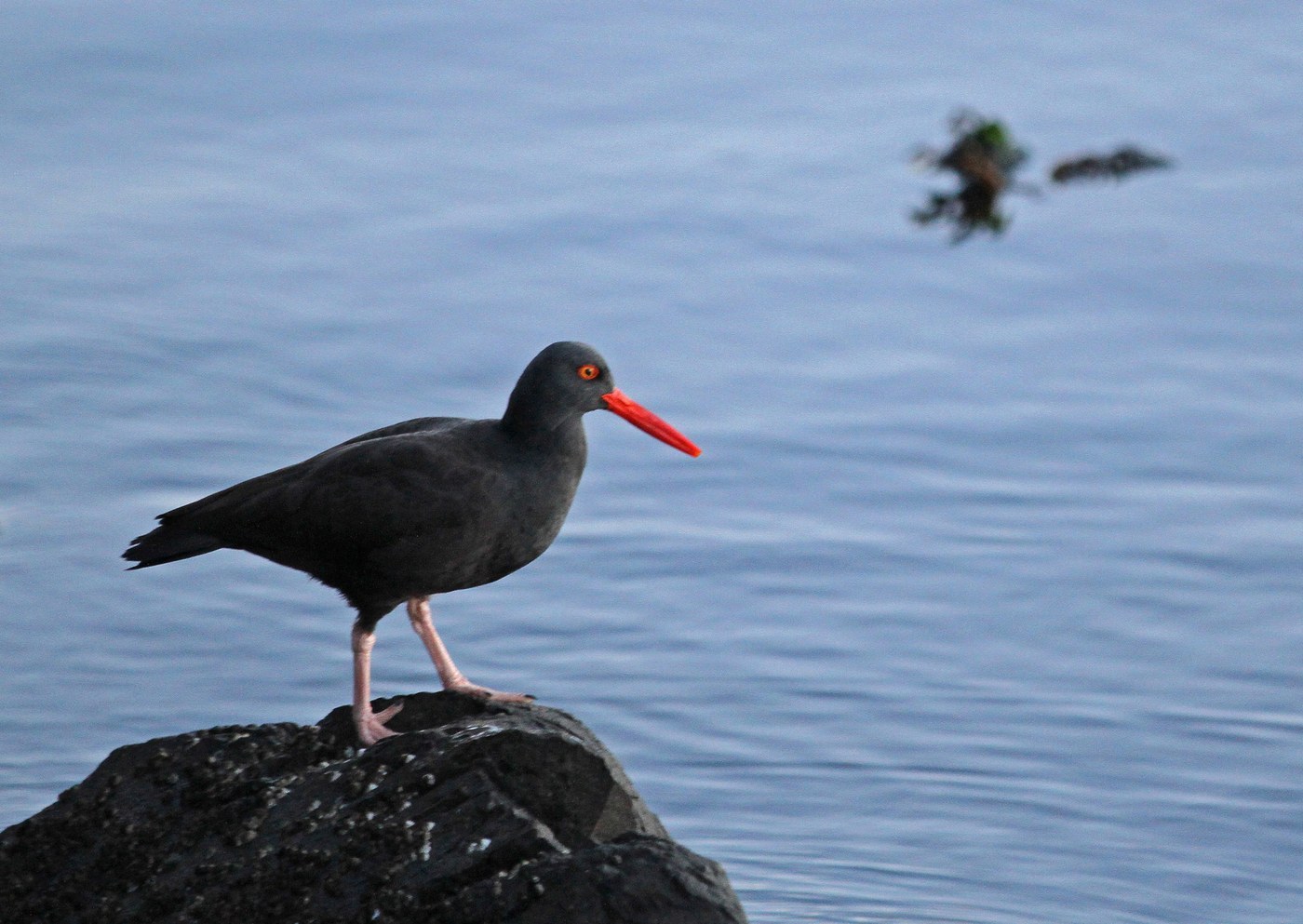
What Black Oystercatcher Feathers Look Like
The Black Oystercatcher is unusual among shorebirds because it shows no white anywhere in its plumage — body, wing, and tail feathers are all a uniform sooty blackish-brown, sometimes with a faint warmer brown cast when worn late in the season. Contour feathers from the breast and back are dense and fairly stiff for a shorebird, 3-6 cm long, solid dark brown-black with dark shafts. Flight feathers (primaries) are longer and more pointed, 15-18 cm, blackish-brown on both webs with no pale patches, bars, or tips. Tail feathers are similarly solid dark brown-black with no white base or terminal band, which sets this species apart from almost every other shorebird sharing its coastline.
Step-by-Step: Is This Feather From a Black Oystercatcher?
- Check for any white at all. If a shorebird-sized feather is entirely sooty blackish-brown with absolutely no white patches, bars, or tips anywhere on it, that's the single strongest clue for this species.
- Measure it. Contour feathers run 3-6 cm; primaries 15-18 cm — fits a fairly large, robust shorebird, not a small sandpiper.
- Look at the shaft. Shafts are dark brown to blackish, matching the vane, not pale or contrasting.
- Consider feather stiffness. Body feathers feel dense and slightly stiff compared to the softer down of many small shorebirds, reflecting this species' life on wave-battered rocks.
- Rule out waterfowl. If the feather has the thick, rounded, oily-based structure of a duck rather than the flatter shorebird contour shape, look at waterfowl instead.
Similar Species & How to Tell Them Apart
The American Oystercatcher is the closest relative but shows a bold white wing stripe and white belly, so any white patch on an oystercatcher-type feather points to that species instead (their ranges barely overlap, mainly in Baja California). Black Turnstone and Surfbird, which share the same rocky shoreline, are true blackish shorebirds too, but both are much smaller birds with correspondingly smaller feathers (covert feathers under 3 cm) and show at least some white patterning in the wing. Black Scoter feathers are also solid dark, but they come from a duck and have the thicker, more rounded, waterproof structure typical of diving waterfowl rather than a shorebird's flatter contour feather.
Where & When You'll Find Them
Black Oystercatchers live year-round on rocky intertidal shorelines, sea stacks, and jetties from the Aleutian Islands down to Baja California, rarely straying from wave-washed rock. Because they're non-migratory, feathers can turn up at any time of year, but the heaviest feather drop follows the complete post-breeding molt in late summer through fall (roughly July to October), when adults replace worn flight and body feathers near their nesting rocks and adjacent foraging shoreline.
Frequently asked questions
Why does this feather have no white on it at all?
Black Oystercatchers are one of the few entirely dark shorebirds — unlike most sandpipers and plovers, they have no white wing stripe, rump, or tail band anywhere in their plumage.
How is this different from an American Oystercatcher feather?
American Oystercatcher shows a bold white wing stripe and white belly; if you see any white at all on an oystercatcher-type feather, it's the American species, not the Black.
Could this be a Black Turnstone feather instead?
Turnstones are much smaller birds with smaller feathers and still show some white wing patterning, while Black Oystercatcher feathers are larger and completely without white.
When are feathers most commonly found?
Late summer through fall, during and after the post-breeding molt, along the same rocky shorelines where the birds feed and nest.
Do the feathers feel different from typical shorebird feathers?
Yes, they're noticeably denser and slightly stiffer, an adaptation to a life spent on exposed, wave-battered rocks rather than soft mudflats.