
How to Identify Black-crested Titmouse Feathers
A guide to the gray body feathers and pointed black crest feathers of Black-crested Titmouse, a Texas resident, and how to separate it from the closely related Tufted Titmouse.
Read the full Black-crested Titmouse encyclopedia entry →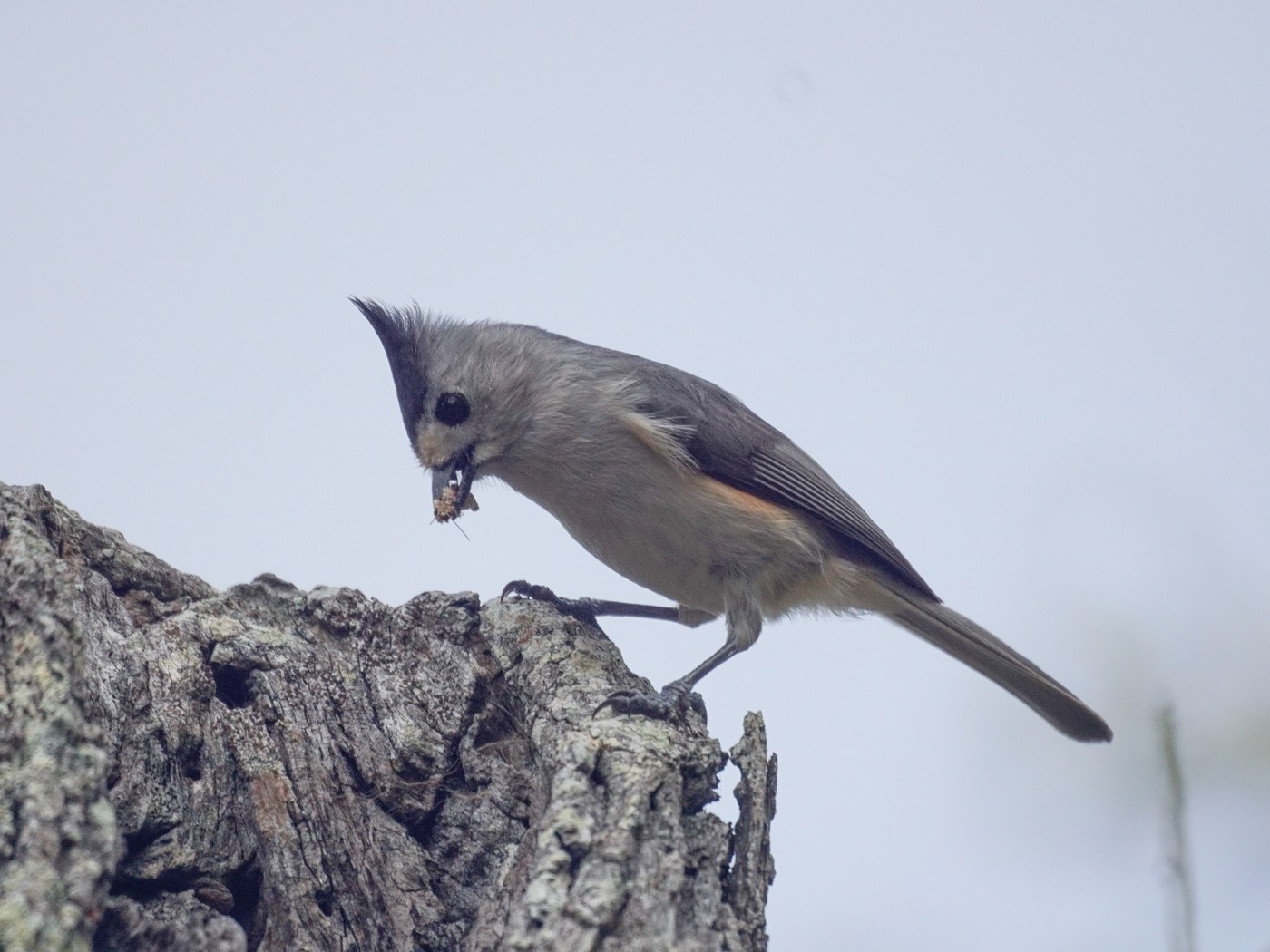
What Black-crested Titmouse's Feathers Look Like
Black-crested Titmouse is a small, crested songbird, and its feathers show the soft, dense texture typical of chickadees and titmice. Body feathers are a plain soft gray above, with whitish underparts and a warm peachy-buff wash along the flanks, a subtle but useful color to check. The defining feature is the crest: narrow, slightly elongated feathers on the crown that are solid black, forming a pointed crest distinct from the plain gray of the rest of the head — a black crest feather, notably narrower and stiffer than typical body contour feathers, is the single best diagnostic. The forehead, just below the black crest, is pale/whitish, creating a contrast band between the black crest and the gray face — worth checking if a small cluster of head feathers is found together. Wing and tail feathers are plain gray with no bold pattern, typical of titmice generally.
Step-by-Step: Is This Feather From a Black-crested Titmouse?
- Check for a narrow, elongated black crest feather. A stiffer, pointed black feather distinct from rounder gray body feathers is the top diagnostic clue.
- Look for a pale forehead patch. A whitish feather from just above the bill, contrasting with the black crest behind it, supports the identification.
- Confirm plain gray body with peachy flanks. Soft gray upperparts and whitish underparts with a peach-buff wash on the sides fit this species.
- Rule out streaking or barring. Titmouse feathers are plain and unmarked; any streaked or barred feather points to a different family.
- Factor in Texas/south-central range context. A gray, crested songbird feather found in central and southern Texas or northeastern Mexico strongly supports this specific titmouse over its more northerly relative.
Similar Species & How to Tell Them Apart
Tufted Titmouse, the closest relative and main confusion species, shows a gray (not black) crest and a small rufous-orange patch on the flanks near the wing, generally more vivid than Black-crested's subtler peachy wash — the crest color is the fastest and most reliable single distinction between the two species. The two forms hybridize in a narrow zone across central Texas, so intermediate birds with partially dark or mixed crest coloring can occur there, making crest color alone occasionally ambiguous within that hybrid belt. Bridled Titmouse, found farther west in Arizona/New Mexico, shows a much more boldly patterned black-and-white face with a black throat bib, quite different from the plainer gray face of Black-crested Titmouse. If the crest feather is unambiguously black rather than gray, and the location is within the core Texas/Mexico range rather than the eastern Tufted Titmouse range, Black-crested Titmouse is the better call.
Where & When You'll Find Them
Black-crested Titmouse is a year-round resident of central and southern Texas and adjacent northeastern Mexico, favoring oak woodland, mesquite brushland, and riparian corridors, and it readily visits backyard feeders within its range. Being non-migratory, feathers can be found in any season, with the most reliable finding spots near feeders, nest boxes, and brushy woodland edges. As with other small resident songbirds, feather turnover peaks during the late-summer post-breeding molt (roughly July-September), when adults replace their full set of body and flight feathers before winter.
Frequently asked questions
What is the fastest way to separate this species from Tufted Titmouse?
Check crest color — Black-crested Titmouse has a black crest, while Tufted Titmouse has a gray crest with a more vivid rufous-orange flank patch.
Is there a zone where the two species can be confused?
Yes, they hybridize across a narrow band of central Texas, where intermediate crest coloring can occasionally make identification less clear-cut.
What does the forehead look like on this species?
Pale to whitish, creating a contrast band just in front of the solid black crest — a useful secondary clue alongside crest color.
Where should I look for this species' feathers?
Oak woodland, mesquite brushland, and riparian corridors in central/southern Texas and northeastern Mexico, including backyard feeders within that range.
Is this species migratory?
No, it's a non-migratory year-round resident, so feathers can be found in any season within its range.