
How to Identify Black-capped Vireo Feathers
A guide to the black-hooded, white-spectacled feathers of the Black-capped Vireo and how to separate them from other vireos.
Read the full Black-capped Vireo encyclopedia entry →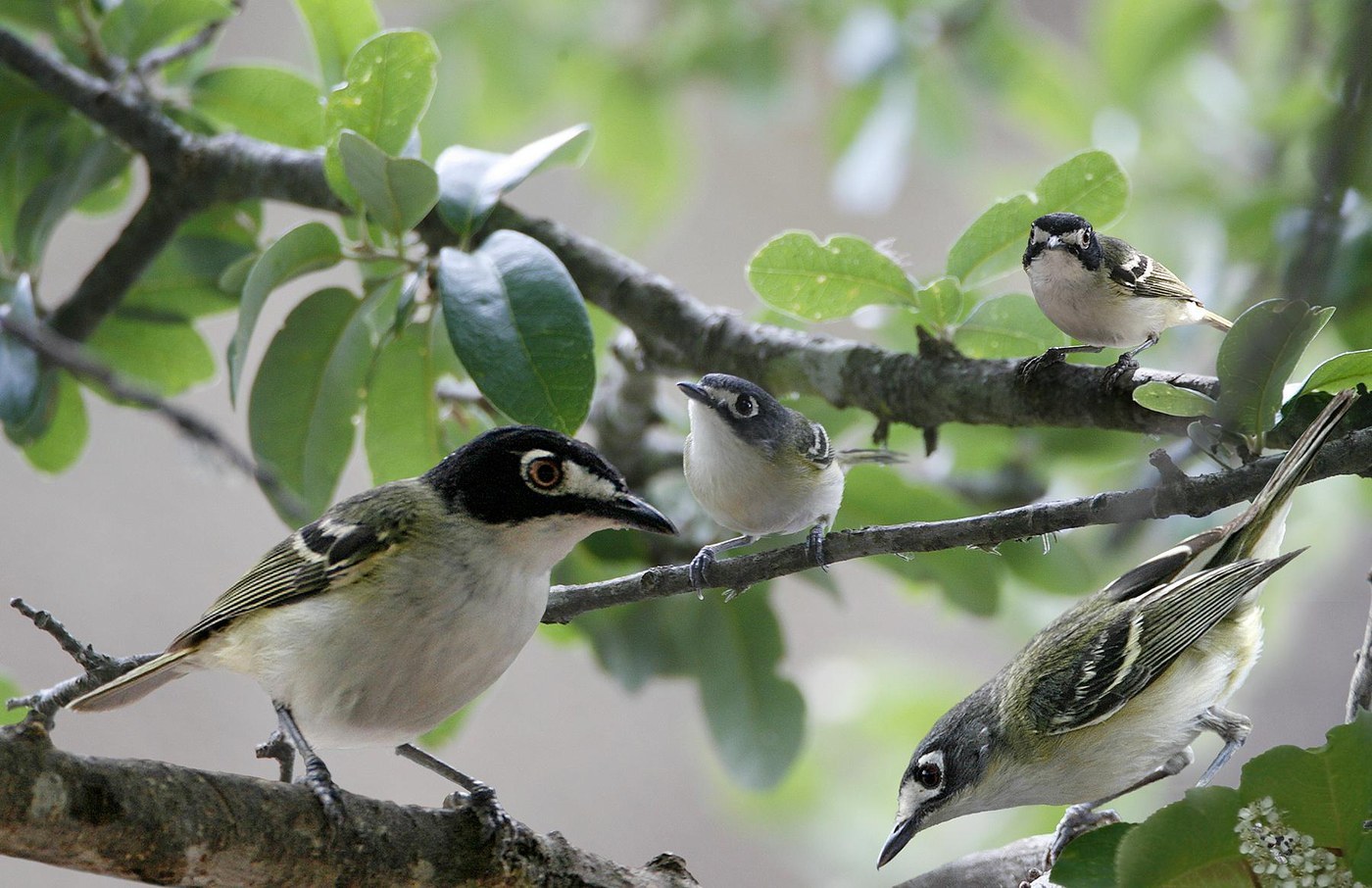
What Black-capped Vireo's Feathers Look Like
Black-capped Vireo is a small songbird with a very distinctive head pattern that carries through to individual feathers. Adult males show a solid black cap and face interrupted by bold white "spectacles" — a white ring around the eye connected by a white line across the base of the bill (the lores) — so a black head feather with an adjoining crisp white patch is a strong clue. Body feathers on the back are olive-green, while the underparts are whitish with a faint yellow-green wash along the flanks. Wing feathers show two pale, yellowish wing bars across otherwise dark olive-gray flight feathers, a useful secondary mark. Females and immatures show a more subdued, grayish (not solid black) cap, so a gray-headed feather with the same white spectacle pattern can still belong to this species. Feathers overall are tiny, typical of a small vireo — body feathers around 1.5-2.5 cm.
Step-by-Step: Is This Feather From a Black-capped Vireo?
- Check for a black or dark gray cap with white spectacles. The combination of a dark crown/face feather adjoining a crisp white eye-ring/lores patch is the core diagnostic for this species.
- Confirm small size and stout, slightly hooked bill build if any partial specimen is present — vireos have a small hook at the bill tip, unlike similarly-sized warblers.
- Look for double pale wing bars. Two whitish-yellow bars across dark olive wing feathers support the identification.
- Assess underparts wash. A faint yellow-green tint along the flanks, with a whiter center, is typical of this species.
- Consider habitat and range context. A small vireo feather with this head pattern found in Texas/Oklahoma scrubland habitat strongly supports this identification given the species' very restricted range.
Similar Species & How to Tell Them Apart
White-eyed Vireo, which overlaps in range, shows yellow "spectacles" rather than white, along with a pale iris and yellow-tinged flanks that are typically more saturated — the spectacle color is the fastest way to separate the two. Bell's Vireo lacks the bold black/gray cap and white spectacle combination entirely, showing a much plainer grayish-olive head with only a faint, incomplete eye-ring. Blue-headed Vireo, found farther east and north, has a distinctly blue-gray (not black) head with bold white spectacles, and a much cleaner white breast — the blue-gray tone rather than true black or dark gray is the key difference. Because Black-capped Vireo has an unusually small range, any feather matching this pattern found within its known Texas/Oklahoma range deserves careful note.
Where & When You'll Find Them
Black-capped Vireo breeds in a narrow band of shrubby, low, patchy oak scrub habitat in Texas and Oklahoma (with small populations in northern Mexico), specifically favoring early-successional scrub maintained by fire or disturbance — dense, uniform woodland is unsuitable habitat for this species. It winters along the Pacific coast of Mexico. Because it is migratory and has a very restricted breeding range, feathers are essentially only findable in its specific breeding habitat during spring and summer (April-August), with the post-breeding molt in mid-to-late summer being the most likely window for fresh feather loss before birds depart for wintering grounds in the fall.
Frequently asked questions
What is the key facial feature to look for?
White 'spectacles' — a white eye-ring connected to a white line across the lores — set against a black (male) or gray (female) cap and face.
How do I tell it apart from White-eyed Vireo?
White-eyed Vireo has yellow, not white, spectacles and a pale iris, along with more saturated yellow flanks.
Does the female show the same black cap as the male?
No, females and immatures show a duller grayish cap rather than solid black, though the white spectacle pattern remains similar.
What habitat is essential for finding this species' feathers?
Shrubby, low, patchy oak scrub maintained by fire or disturbance in Texas and Oklahoma — dense uniform woodland does not support this species.
When is the best window to find feathers?
Spring through summer (April-August) on the breeding grounds, especially during the mid-to-late summer post-breeding molt.
Black-capped Vireo identified by the community
Recent Black-capped Vireo feathers identified with Feather Identifier.
