
How to Identify Amazonian Motmot Feathers
How to spot the racket-tipped tail feathers and green-and-rufous body plumage that set the Amazonian Motmot apart.
Read the full Amazonian Motmot encyclopedia entry →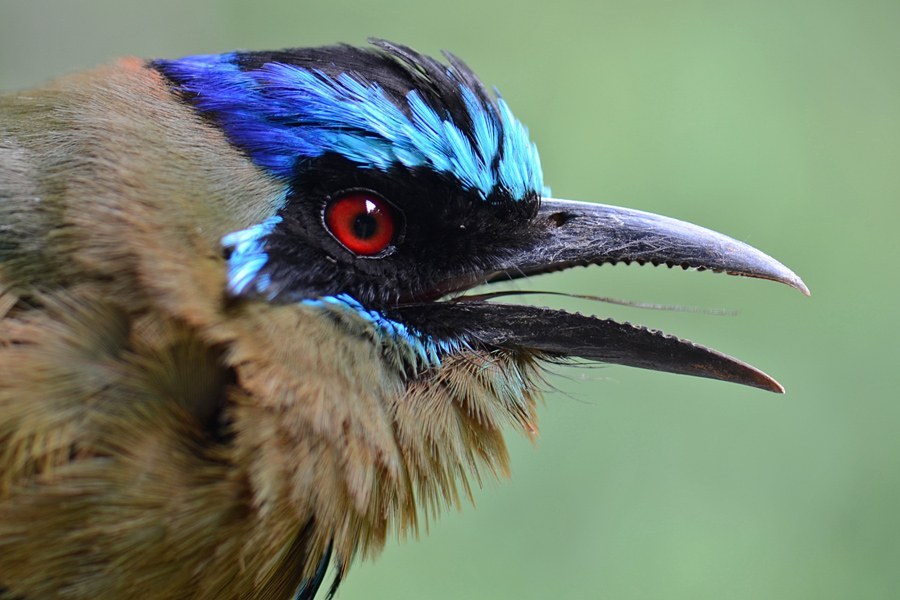
What Amazonian Motmot's Feathers Look Like
The single most recognizable feather from this species is the central tail feather, which is dramatically elongated and ends in a bare shaft topped by a small oval "racket" of feather webbing. This isn't a special growth — the barbs along that section of the shaft are weakly attached and simply wear away or get preened off, leaving the bare stem and the racket-shaped tip intact. If you find a long, otherwise unremarkable green feather with a bald stretch of shaft partway down ending in a paddle-shaped tip, it is almost certainly a motmot tail feather. Body feathers are soft and rounded, colored grass-green on the back and wings, with a turquoise-blue border around the crown and a black mask through the eye bordered above by more turquoise. Underparts feathers are rufous to cinnamon-orange, sometimes with a small dark spot on the breast. Wing covert feathers are green with a subtle turquoise wash near the bend of the wing.
Step-by-Step: Is This Feather From an Amazonian Motmot?
- Look first for the racket tail. A very long feather (up to 20 cm or more) with bare shaft and a spoon-shaped tip is the clearest single clue.
- Check color on body feathers. Grass-green above and rufous-orange below, with any hint of turquoise blue, fits this species well.
- Feel the texture. Body feathers are soft and rounded, typical of a forest bird that spends most of its time perched rather than in fast flight.
- Note feather size. This is a mid-sized bird (body around 38–43 cm including tail), so flight feathers are moderate, 8–10 cm.
- Rule out songbirds. True songbird green feathers (like some tanagers) are much smaller and lack the racket-tail possibility entirely.
Similar Species & How to Tell Them Apart
Several other motmot species share the racket-tailed tail plan, so the tail feather alone confirms "motmot" but not necessarily this exact species. The Blue-crowned Motmot complex, from which Amazonian Motmot was split, looks nearly identical in feather; range is the main separator, with Amazonian Motmot restricted to the Amazon basin rather than Central America or the Andes. The Broad-billed Motmot is smaller with a more rufous face and less green on the crown border. The Whooping Motmot and Trinidad Motmot, close relatives, differ mainly in subtle crown color and range rather than obvious feather traits. If the feather lacks a racket tip and is a shorter tail feather, compare rufous tone: motmots generally show a warmer, more saturated cinnamon than most other rainforest birds with green backs.
Where & When You'll Find Them
Amazonian Motmots live in the understory and edges of lowland and foothill rainforest across the Amazon basin, perching quietly on low branches while scanning for insects and small prey. They are non-migratory, so feathers turn up year-round, but molt is typically tied to the end of the breeding season in each local wet/dry cycle. Because the racket tail feathers are shed and regrown gradually and the birds spend long periods perched in one spot, look on the forest floor beneath favored low perches near forest edges, streamsides, or shaded understory rather than in open canopy.
Frequently asked questions
Why does the tail feather have a bare section near the tip?
The barbs along that stretch of shaft are weakly attached and wear away naturally through preening and use, leaving a bare stem that ends in the intact racket-shaped tip.
Can I identify the exact motmot species from a body feather alone?
Not reliably. Most motmot species share a similar green-and-rufous plumage, so the tail's racket shape confirms the genus while range and precise crown color help narrow the species.
How long is a typical racket tail feather?
Central tail feathers can reach 20 cm or more, much longer than the surrounding tail feathers, making them easy to pick out even among mixed forest-floor litter.
Does the turquoise color fade in old feathers?
Yes, structural blue tones can look duller or grayer on weathered feathers found long after molting, so fresher feathers show the brightest turquoise crown border.