
How to Identify Yellow-collared Lovebird Feathers
A guide to the green body plumage, dark head, and distinctive yellow collar feathers of the Yellow-collared Lovebird, a small African parrot.
Read the full Yellow-collared Lovebird encyclopedia entry →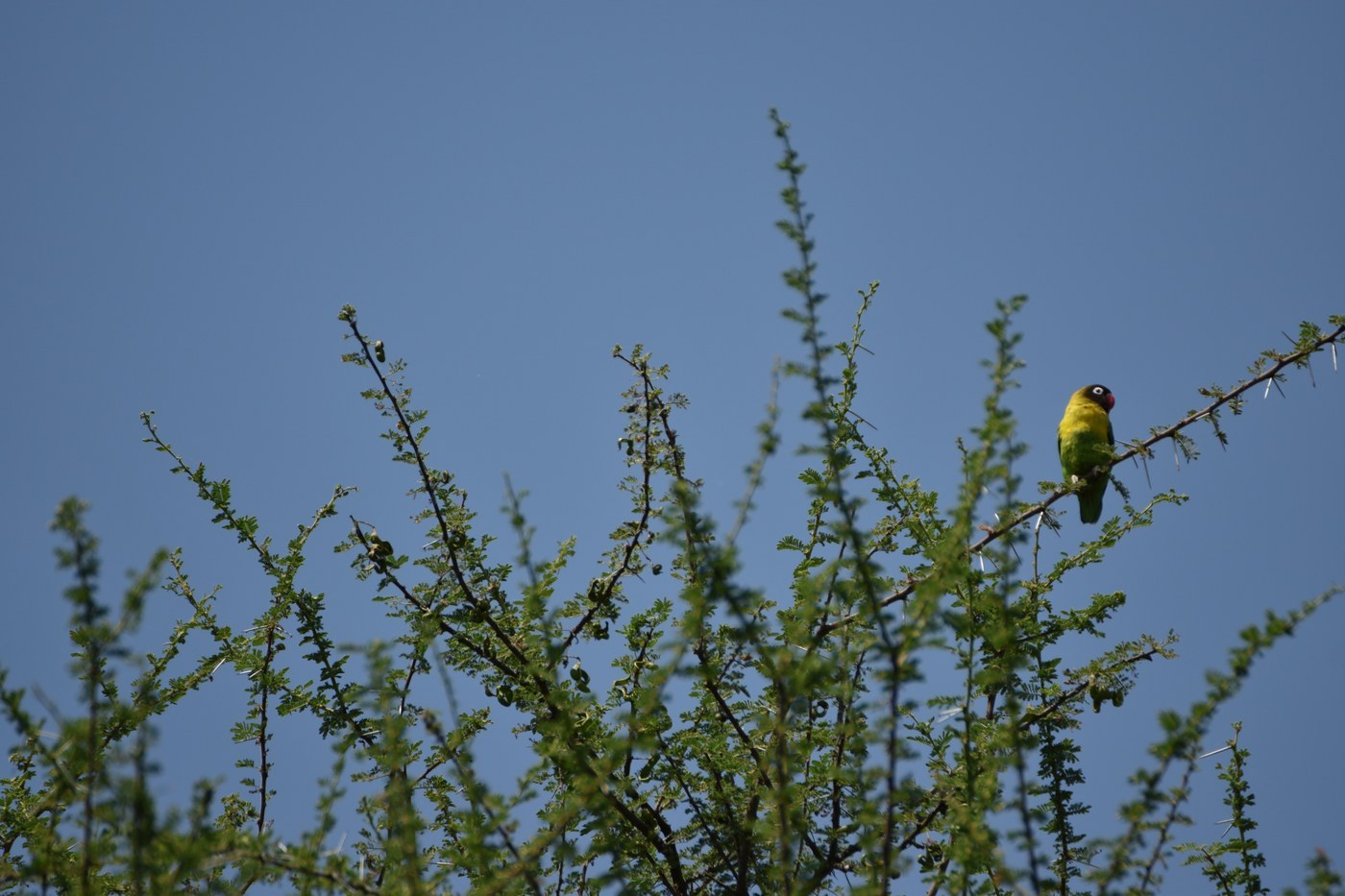
What Yellow-collared Lovebird's Feathers Look Like
The Yellow-collared Lovebird is a small, stocky parrot, and its feathers show the thick, waxy structure typical of parrots. Flight feathers measure 8-11 cm, solid grass-green with darker, almost blackish tips on the outer primaries, and a stiff, slightly glossy vane. Body feathers on the back, wings, and belly are a uniform bright green, while the head and upper neck feathers are a blackish-brown to dark gray-brown, sharply demarcated from the body color. The namesake feature is a band of feathers across the upper breast and hindneck that are bright yellow, forming a distinct collar between the dark head and green body — these collar feathers are noticeably brighter and cleaner yellow than the surrounding green. The bill and eye-ring area produce small, stiff whitish feathers around a bare white eye-ring, and the underwing coverts are a slightly yellow-green tone. Overall feather texture is dense and somewhat waxy to the touch, characteristic of parrot plumage.
Step-by-Step: Is This Feather From a Yellow-collared Lovebird?
- Check for the dark head-to-green body transition: a feather that is blackish-brown on part of its length and green on another suggests it comes from the head/neck border area.
- Look for a pure yellow band feather: bright yellow feathers from the upper chest or hindneck, distinct from the green body, indicate the collar region.
- Assess texture: thick, slightly glossy, waxy-feeling feathers point to a parrot rather than a softer-feathered songbird.
- Measure size: 8-11 cm flight feathers fit a small parrot roughly 14-15 cm long.
- Note the white eye-ring feathers: small stiff whitish feathers near a bare skin patch support this identification.
- Consider captive context: as a popular cage bird, feathers are often found indoors or near aviaries rather than in the wild outside its native range.
Similar Species & How to Tell Them Apart
The closely related Fischer's Lovebird shows a similar dark head but with more orange-red on the face and a less crisp yellow collar, blending more gradually into the green body. Masked Lovebird, sometimes confused due to a similarly dark head, typically shows a more solid black head color rather than dark brown, with the yellow collar band tending to be broader. Peach-faced Lovebird, the most common pet lovebird, lacks the dark head entirely, showing a rosy-peach face and forehead instead of brown or black, making head feather color the fastest way to separate it from Yellow-collared Lovebird.
Where & When You'll Find Them
In the wild, Yellow-collared Lovebirds are native to a limited range in north-central Tanzania, favoring dry acacia woodland and savanna near water. As a widely kept aviary and pet species, however, most feather finds occur near homes, aviaries, and bird shows rather than in native habitat. Molting occurs gradually throughout the year in captivity without a sharply defined season, so feathers may turn up at any time, while wild populations molt following the breeding season tied to the regional wet-dry cycle.
Frequently asked questions
What is the clearest single feature to look for?
A feather that is bright, clean yellow and distinct from the surrounding green — coming from the collar band across the upper chest and hindneck — is the most diagnostic single clue.
How do I tell this from a Peach-faced Lovebird feather?
Peach-faced Lovebird lacks any dark head feathers, showing rosy-peach tones on the face instead, while Yellow-collared Lovebird has a clearly blackish-brown head.
Why do the feathers feel waxy or glossy?
This is typical of parrot plumage in general, which tends to be denser and slightly glossier than the feathers of softer-feathered songbirds.
Is it more likely I found this feather from a pet bird than a wild one?
Very likely, since this species is a popular cage bird kept far outside its small native range in Tanzania, so most finds occur near homes or aviaries.
Do lovebirds molt on a fixed schedule?
Captive birds tend to molt gradually year-round without a strict season, while wild birds molt more predictably after breeding, tied to the local wet and dry seasons.