
How to Identify Worm-eating Warbler Feathers
How to identify Worm-eating Warbler feathers by their plain unstreaked olive-brown and buffy tones and the bold black stripes across an otherwise buffy head.
Read the full Worm-eating Warbler encyclopedia entry →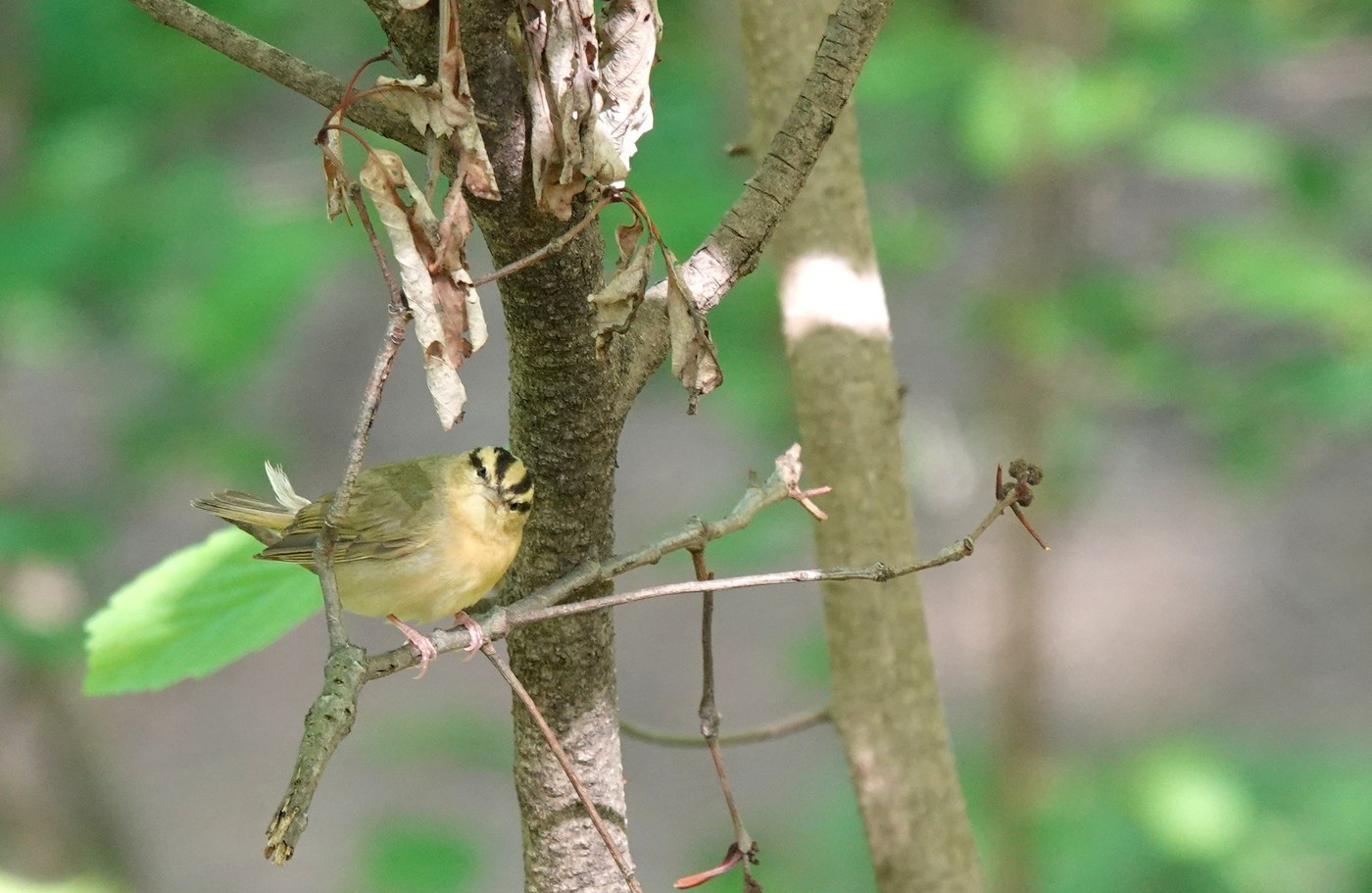
What Worm-eating Warbler's Feathers Look Like
Worm-eating Warbler stands out among wood-warblers for being almost entirely unmarked across the body — a rare trait that itself becomes a diagnostic clue. Back and wing feathers are a plain, uniform olive-brown, with no wingbars, no streaking, and no spotting anywhere. Underparts are a warm buffy-tan, again entirely plain, lacking the streaks or spots common to most other warblers. All of the species' pattern is concentrated on the head: bold black stripes run through the crown (two black crown stripes flanking a paler buffy central stripe) and through the eye, standing out sharply against the otherwise buffy-tan face. A small cluster of head feathers showing these crisp black stripes on buff is highly distinctive even without any other context. The bill is notably long, straight, and pointed relative to the bird's small size (though this is a bill trait, not feather), an adaptation for probing curled dead leaves. Legs are pinkish, another non-feather clue useful if soft tissue remains.
Step-by-Step: Is This Feather From a Worm-eating Warbler?
- Check underparts and back for total lack of pattern. A plain, unstreaked, unspotted olive-brown-and-buff combination is the single strongest clue, since most other warblers show at least some streaking.
- Look for bold black head stripes on a buffy background. Distinct dark crown stripes bordering a pale central stripe, plus a stripe through the eye, is the species' signature feature.
- Confirm no wingbars are present on wing covert feathers — their complete absence supports this species over many similarly plain-bodied warblers that do show faint wingbars.
- Judge overall tone. The buffy-tan wash (rather than bright yellow or white) on the underparts is a helpful color cue.
- Consider size. At about 12–13 cm, feathers should be small, consistent with other wood-warblers.
Similar Species & How to Tell Them Apart
Swainson's Warbler is similarly plain-bodied and buffy but has a plain, unstriped crown with only a faint eye-stripe and a more prominent pale eyebrow, lacking Worm-eating Warbler's bold two-stripe crown pattern. Louisiana Waterthrush and Northern Waterthrush both show heavily streaked underparts, immediately ruling them out against Worm-eating Warbler's plain buffy belly. Pine Warbler shows olive-yellow tones with faint wingbars and some breast streaking, distinct from Worm-eating Warbler's unmarked buffy-brown body and bold head stripes. The bold black-striped head paired with an entirely unmarked body is the most reliable combination for confirming this species.
Where & When You'll Find Them
Worm-eating Warbler breeds in mature deciduous forest with steep, shrubby slopes and dense understory across the eastern and mid-Atlantic United States, foraging low in dead leaf clusters for insect larvae — the "worms" of its name, despite the misleading title. It winters in Central America and the Caribbean. Feathers are most likely found on wooded hillsides with dense understory during the breeding season, when adults molt after nesting in mid-to-late summer, and along forested migration corridors in spring and fall as the species moves between its breeding and wintering grounds.
Frequently asked questions
What's the most reliable single clue for this species?
A completely unmarked, plain olive-brown-and-buff body combined with bold black crown stripes on an otherwise buffy head — few other warblers combine total body plainness with such a striking head pattern.
How does Worm-eating Warbler differ from Swainson's Warbler?
Swainson's Warbler has a plain, unstriped crown with only a faint eye-stripe, while Worm-eating Warbler shows two bold black crown stripes.
Can streaked underparts still belong to this species?
No, Worm-eating Warbler's underparts are always plain and unstreaked; streaked underparts point to a different species such as a waterthrush.
Where is this species' habitat typically found?
Mature deciduous forest on steep, shrubby slopes with dense understory, where it forages low among dead leaf clusters.