
How to Identify Woodhouse's Scrub-Jay Feathers
How to identify Woodhouse's Scrub-Jay feathers by their blue head, wings, and tail, grayish-brown back, and pale underparts with a faint blue necklace streaking.
Read the full Woodhouse's Scrub-Jay encyclopedia entry →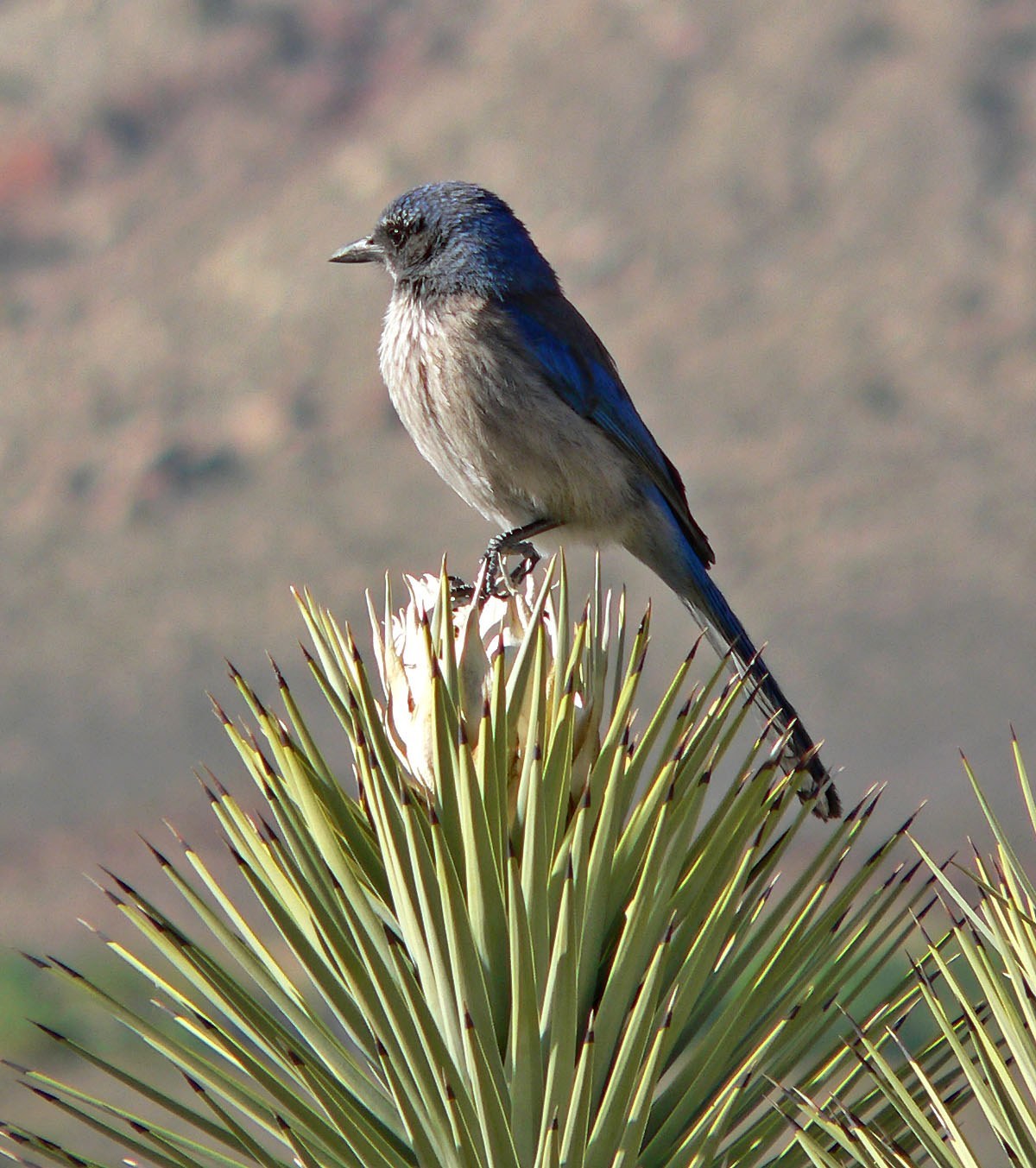
What Woodhouse's Scrub-Jay's Feathers Look Like
Woodhouse's Scrub-Jay is a crestless jay of the interior West, and its feathers show a duller, less saturated blue than many other jays. Head, wing, and tail feathers are blue, but a somewhat muted, grayish-blue rather than the deep, glossy blue of Blue Jay or the brighter, more saturated blue of California Scrub-Jay. The back (mantle) is grayish-brown, creating a contrast between the blue head/wings and the drab back — a two-toned combination useful if you find connected feathers from both regions. The throat and underparts are pale grayish-white, with a faint, somewhat indistinct blue-gray streaking or "necklace" across the upper breast, less sharply defined than the necklace shown by California Scrub-Jay. There is no crest, so head feathers should lie relatively flat and smooth rather than forming a peaked tuft. Tail feathers are long and blue with little additional patterning, and wing feathers show plain blue without strong barring.
Step-by-Step: Is This Feather From a Woodhouse's Scrub-Jay?
- Check the blue tone. A somewhat muted, dusty blue rather than a vivid, saturated blue supports Woodhouse's over its brighter Pacific relative.
- Confirm the back is grayish-brown, not blue. A contour feather from the mantle should be brownish-gray, distinct from the blue head/wing/tail feathers.
- Look for faint breast streaking. A subtle, poorly defined blue-gray necklace on pale underparts (rather than a bold, crisp one) fits Woodhouse's Scrub-Jay.
- Rule out a crest. Smooth, flat crown feathers (not forming a peak) support a scrub-jay rather than a crested jay like Steller's Jay or Blue Jay.
- Consider range/habitat, since this species occupies interior piñon-juniper and scrub-oak habitats rather than coastal chaparral.
Similar Species & How to Tell Them Apart
California Scrub-Jay is very similar but shows a brighter, more saturated blue, a more sharply defined blue-gray breast necklace, and often a whiter belly contrasting more crisply with the necklace — Woodhouse's is duller and less contrastingly marked throughout. Steller's Jay has a prominent black crest and much darker, almost blackish head and breast, easily ruling it out. Blue Jay shows bold black-and-white wingbars and a crest, both absent in Woodhouse's Scrub-Jay. Pinyon Jay is entirely blue-gray with no contrasting brown back and no pale belly, lacking the two-toned blue-head/brown-back pattern that defines scrub-jays.
Where & When You'll Find Them
Woodhouse's Scrub-Jay lives in piñon-juniper woodland, scrub oak, and dry montane habitats of the interior western United States and northern Mexico, largely a non-migratory, resident species. Feathers can be found year-round near favored caching and foraging sites, since the species is well known for its habit of caching acorns and piñon nuts, but are most abundant following the late-summer post-breeding molt, when adults replace worn feathers before winter.
Frequently asked questions
What's the main color clue distinguishing this species from California Scrub-Jay?
Woodhouse's Scrub-Jay shows a duller, more muted blue and a less sharply defined breast necklace, compared to California Scrub-Jay's brighter blue and crisper necklace.
How do I rule out Steller's Jay or Blue Jay?
Both of those species have a prominent crest and additional bold patterning (black crest, or black-and-white wingbars) that Woodhouse's Scrub-Jay entirely lacks.
Is the brown back a useful clue?
Yes, a grayish-brown mantle feather paired with blue head/wing/tail feathers is a good match for any scrub-jay, distinguishing it from the all-blue-gray Pinyon Jay.
Where should I look for these feathers?
In interior piñon-juniper or scrub-oak woodland, especially around favored caching sites, since the species is a year-round resident there.