
How to Identify Wilson's Plover Feathers
A field approach to identifying Wilson's Plover feathers by their sandy brown tones, single dark breast band, and the species' distinctive heavy bill for context.
Read the full Wilson's Plover encyclopedia entry →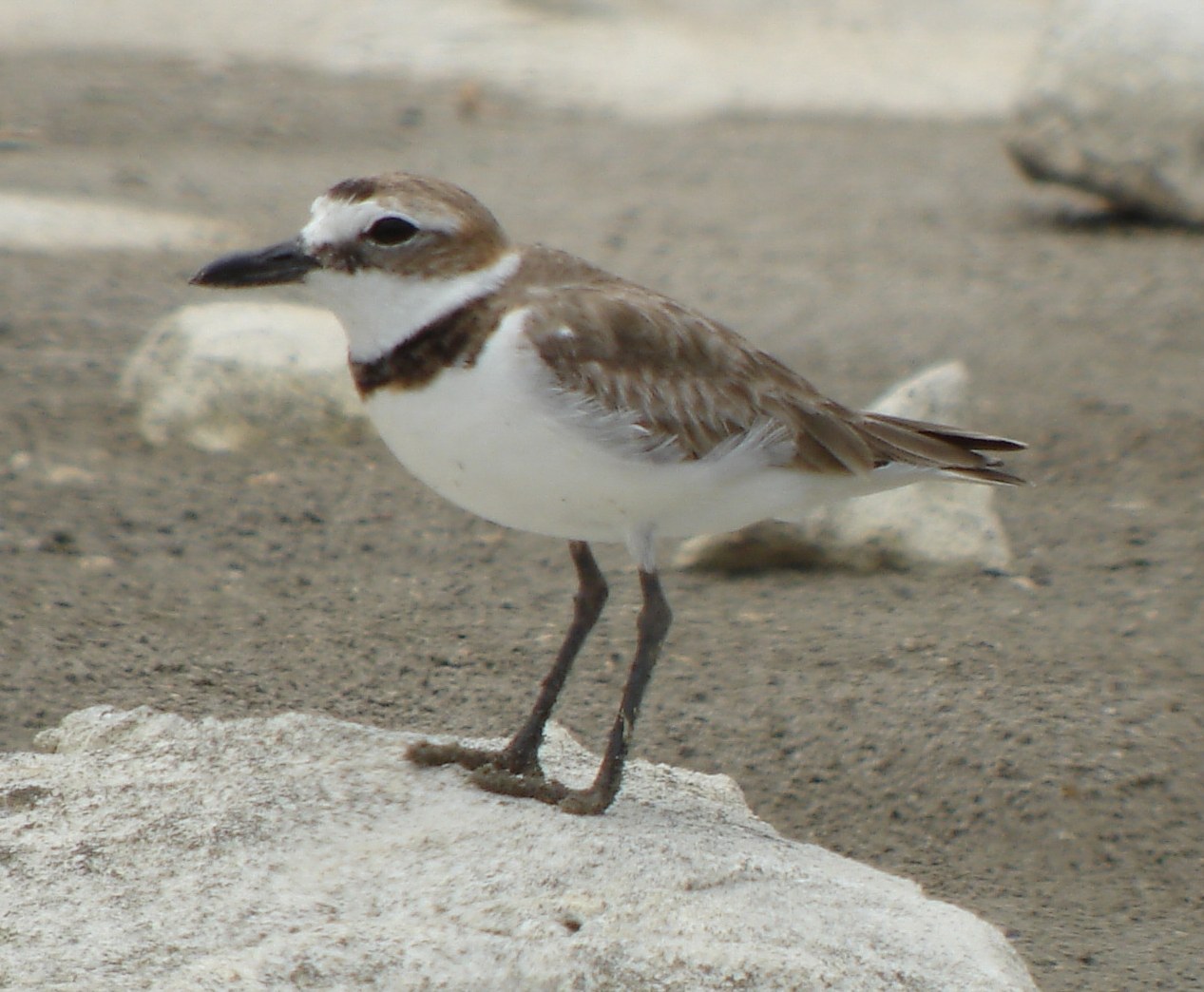
What Wilson's Plover's Feathers Look Like
Wilson's Plover is a stocky, sandy-colored shorebird, and its feathers mirror that beach-camouflage look. Upperpart (back, mantle, and wing covert) feathers are a plain sandy grayish-brown, evenly colored with no spotting or barring — built to disappear against dry sand and shell hash. Underparts are clean white, and across the breast sits a single solid band: black in males, often a warmer brown or dusky tone in females. This single breast band, rather than a double band or scaled pattern, is a useful clue if you have a small cluster of connected breast feathers. The forehead has a white patch bordered by a dark line in front of the eye. Flight feathers are dark brownish-gray with limited white in the wing — Wilson's Plover shows only a faint, narrow white wingstripe, much less bold than in many other plovers. The tail is brownish-gray with a darker subterminal band and narrow white edges on the outer feathers. Overall, feathers are broad and rounded, consistent with the plump, front-heavy build of the species.
Step-by-Step: Is This Feather From a Wilson's Plover?
- Start with color, not pattern. A plain sandy-brown feather with no dark centers, spots, or streaks is consistent with Wilson's Plover's minimalist camouflage.
- Check for a breast band fragment. A short run of solid black (or dusky brown) feathers transitioning abruptly to white below suggests the single breast band typical of this species.
- Look at the wingstripe on any flight feather. Only a faint pale stripe should be visible — a bold, wide white bar suggests a different plover species.
- Consider feather size. Body length runs about 17–18 cm, giving proportionally broad, moderately sized contour feathers rather than tiny ones.
- Factor in habitat context. A sandy-brown shorebird feather found on a coastal beach, tidal flat, or shell-covered barrier island strongly favors Wilson's Plover over inland plover species.
Similar Species & How to Tell Them Apart
Semipalmated Plover and Piping Plover are similarly small and banded but are noticeably paler and smaller overall, and both show a brighter, more defined white wingstripe than Wilson's. Killdeer has two black breast bands rather than one, and a longer, more strongly banded tail with a bright rufous-orange rump patch — a color Wilson's Plover never shows. Snowy Plover is paler and sandier still, with only a partial or broken breast band (a smudge on each side rather than a full band), and finer, thinner-billed proportions. The clearest single tell for Wilson's Plover among its relatives is the single complete band paired with sandy (not pale gray) upperparts and only a weak wingstripe.
Where & When You'll Find Them
Wilson's Plover is a bird of sandy and shelly beaches, dredge-spoil islands, and coastal tidal flats along the Atlantic and Gulf coasts of the Americas, rarely straying far inland. Feathers are most likely to turn up on nesting beaches from spring through summer, when adults are molting body feathers around breeding territories, and again in late summer as juveniles fledge and molt into their first full set of feathers. In winter, look along the same coastal flats farther south, including Caribbean and Central/South American shorelines, where the species remains resident or short-distance migratory.
Frequently asked questions
What's the most reliable single feather clue for Wilson's Plover?
A solid single breast band (not double) combined with sandy-brown, unmarked upperparts and only a faint wingstripe.
How can I tell a male's breast band feather from a female's?
Males typically show a solid black band; females show the same band shape but in a softer brown or dusky tone.
Does Wilson's Plover show a rufous rump like Killdeer?
No — that bright orange-rufous rump patch is diagnostic of Killdeer and is not present in Wilson's Plover.
Where are feathers most likely to be found?
On sandy or shelly ocean beaches and coastal tidal flats, rarely at inland wetlands, reflecting the species' strictly coastal habits.