
How to Identify White-winged Chough Feathers
How to identify the all-black body feathers with a hidden white wing patch that reveal a White-winged Chough, an Australian ground-foraging corvid relative.
Read the full White-winged Chough encyclopedia entry →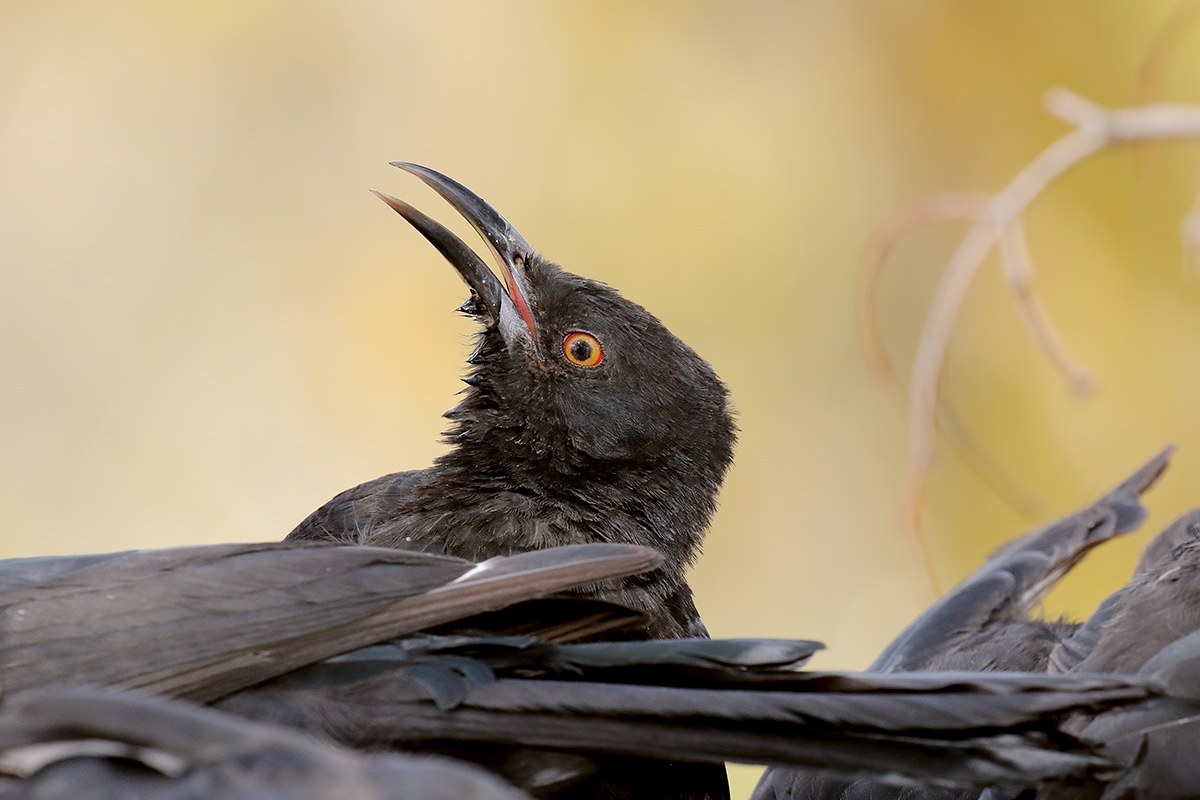
What White-winged Chough's Feathers Look Like
White-winged Chough is a distinctive Australian bird (not a true crow, but in its own family, Corcoracidae) that forages in noisy family groups on the ground, and its feathers combine deep black with a surprising flash of white.
- Body/contour feathers: uniform glossy black, covering the head, back, breast, and belly, with a slight sheen in good light.
- Primary flight feathers: mostly black, but with a bold white patch at the base of the primaries, normally hidden when the wing is folded and only visible in flight or when a shed primary is examined directly — a white base fading to black toward the tip is the standout clue.
- Tail feathers: long, black, and slightly graduated, without any white markings.
- Bill/face note: while not a feather, the strongly decurved black bill and reddish eye are useful if found with attached feathers.
- Leg feathering: none notable, but overall build is heavier and more thrush-like than a true crow.
- Size: contour feathers 3-5 cm, flight feathers 10-14 cm, reflecting a medium-large, crow-sized bird.
Step-by-Step: Is This Feather From a White-winged Chough?
- Look for a white base on a black primary feather. A flight feather that's white at the base and black toward the tip is the most diagnostic single clue, since the white patch is normally concealed at rest.
- Check overall gloss. A body feather with an even, all-black glossy surface (without any white body patches) supports this species, since the white is restricted to the wing.
- Assess feather size. Contour feathers in the 3-5 cm range and flight feathers 10-14 cm fit a crow-sized bird.
- Rule out other patterning. No streaking, spotting, or pale fringing should be present on body feathers — this species is uniformly black apart from the wing patch.
- Consider habitat. Feathers found on the ground in open eucalypt woodland or forest with a leaf-litter floor in eastern Australia fit this cooperatively breeding, ground-foraging species.
Similar Species & How to Tell Them Apart
- Australian Raven/Crow species: lack any white wing patch at all, showing entirely black flight feathers from base to tip.
- Apostlebird: a close relative with similar black-gray plumage and cooperative breeding habits, but lacks the white wing patch, instead showing plain gray-black feathers throughout.
- Pied Currawong: shows white patches on the wing tips and tail corners rather than at the base of the primaries, along with white undertail coverts absent in White-winged Chough.
- Magpie-lark: much smaller with a bold black-and-white body pattern (not concealed), including a white face and breast that White-winged Chough entirely lacks.
Where & When You'll Find Them
White-winged Chough inhabits open eucalypt woodland and forest across much of eastern and southeastern Australia, foraging on the ground in cooperative family groups that turn over leaf litter for invertebrates. It is a non-migratory resident, so feathers can be found year-round in its woodland range, with the best chances near communal mud nests and foraging areas during the spring-to-summer breeding and molt period.
Frequently asked questions
What's the clearest sign this feather belongs to a White-winged Chough?
A black primary flight feather with a white patch at its base — this patch is hidden at rest but is very diagnostic on a shed feather.
Why don't I see any white on the body feathers?
The white in this species is restricted entirely to the wing (primary bases); body, head, and tail feathers are uniformly glossy black.
How do I rule out a currawong feather?
Currawongs show white at the wing tips and tail corners along with white undertail coverts, a different pattern from the concealed white primary base of White-winged Chough.
Would I find this feather in open grassland with no trees?
Unlikely — this species needs open eucalypt woodland or forest with leaf litter for foraging, not treeless grassland.