
How to Identify White-tipped Dove Feathers
How to identify the white-tipped outer tail feathers and iridescent nape sheen that distinguish a White-tipped Dove from other Neotropical doves.
Read the full White-tipped Dove encyclopedia entry →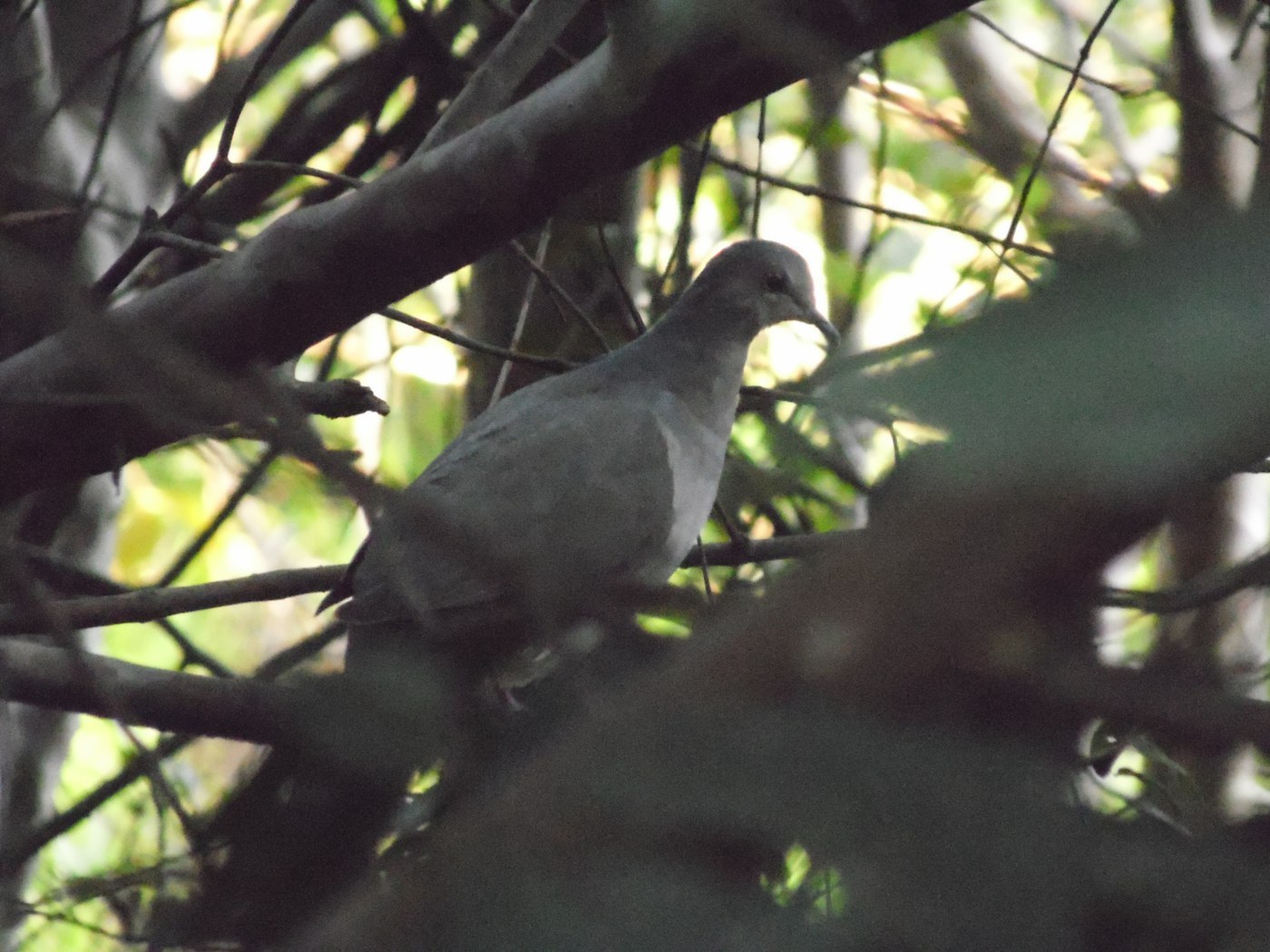
What White-tipped Dove's Feathers Look Like
White-tipped Dove is a common, ground-foraging Neotropical dove whose plain coloring makes one feature especially important for identification: the tail.
- Tail feathers: the key diagnostic. Outer tail feathers are grayish-brown with bold white tips, clearly visible as a pale terminal band on an isolated feather; central tail feathers lack the white tip and are plain gray-brown throughout.
- Body/contour feathers: overall grayish-brown to olive-brown above, with a pale pinkish-gray to buffy wash on the breast and underparts — muted and unmarked compared to more patterned doves.
- Nape feathers: show a subtle iridescent purple-to-green sheen in good light, most visible on fresh feathers from the back of the neck.
- Face feathers: pale, with a whitish to pale buff forehead and a thin reddish eye-ring skin (not feather) framing the eye.
- Wing feathers: plain brown, unmarked, without wingbars or spots.
- Size: contour feathers 2-3 cm, tail feathers 8-10 cm, flight feathers 9-11 cm, consistent with a medium-sized dove close to a Mourning Dove in bulk but with a shorter, more rounded tail.
Step-by-Step: Is This Feather From a White-tipped Dove?
- Check outer tail feathers for a white tip. A grayish-brown feather with a clean, bold white terminal band is the most reliable single clue for this species.
- Compare with central tail feathers. If you have multiple tail feathers, the central pair should be plain gray-brown without white tips, while only the outer feathers show the white — this graduated pattern supports the ID.
- Look for nape iridescence. A feather from the back of the neck showing a faint purple-green sheen in the light adds supporting evidence.
- Assess overall plainness. Unmarked, muted brown-and-pinkish-gray body feathers without spots or bars fit this ground-dwelling dove.
- Consider habitat. Feathers found on the ground in Neotropical woodland edges, brushy scrub, or gardens from southern Texas through much of Mexico, Central America, and parts of South America support this species.
Similar Species & How to Tell Them Apart
- Mourning Dove: has a long, sharply pointed tail with white-edged (not white-tipped) outer feathers and black spots on the wing coverts, both absent in White-tipped Dove.
- Common Ground Dove: much smaller, with scaly-patterned breast feathers and rufous wing-patch flight feathers, unlike White-tipped Dove's plain brown wings.
- Ruddy Ground Dove: shows warmer rufous-chestnut body feathers overall, lacking the muted grayish-brown tone and white tail tips of White-tipped Dove.
- White-winged Dove: shows a bold white wing stripe on the folded wing, a feature entirely absent in White-tipped Dove, whose wings are plain.
Where & When You'll Find Them
White-tipped Dove ranges from the southernmost United States (south Texas) through Mexico, Central America, and into much of South America, favoring woodland edges, brushy thickets, and increasingly gardens and parks. It is largely non-migratory across most of its range, so feathers can be found year-round, with a modest increase during the breeding season molt, which in much of its range runs from spring into summer.
Frequently asked questions
What's the single best clue for identifying this species' feather?
A grayish-brown outer tail feather with a bold, clean white tip — the feature that gives the species its name.
How is this different from a Mourning Dove tail feather?
Mourning Dove's outer tail feathers are pointed with white along the edges, not a clean white terminal tip, and its wings show black spotting that White-tipped Dove lacks.
Does the nape sheen help confirm the ID?
Yes, a subtle purple-green iridescence on nape feathers supports the identification, though it's a secondary clue compared to the white tail tips.
Would this feather be found in open desert?
Less likely — White-tipped Dove favors woodland edges, brushy thickets, and garden habitat rather than open arid desert.