
How to Identify White-throated Kingfisher Feathers
How to recognize the turquoise-blue back and wing feathers paired with a chocolate-brown body and white throat patch that mark a White-throated Kingfisher.
Read the full White-throated Kingfisher encyclopedia entry →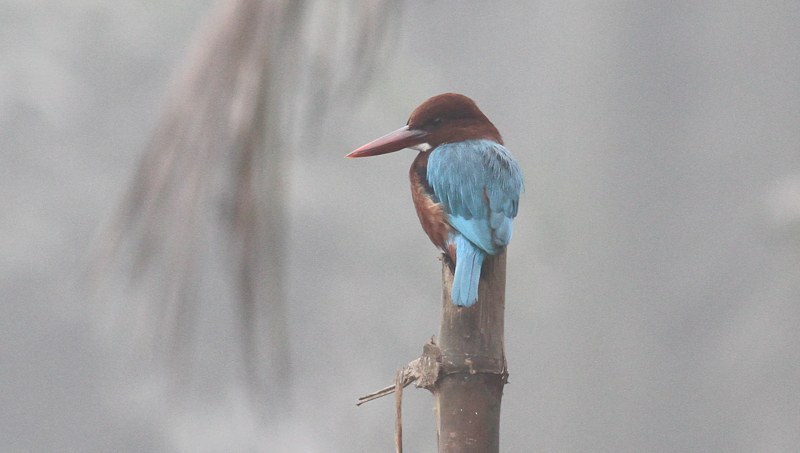
What White-throated Kingfisher's Feathers Look Like
White-throated Kingfisher is a large, generalist kingfisher found across South and Southeast Asia and the Middle East, and its color combination is unlike almost any other bird sharing its range.
- Back and wing covert feathers: brilliant turquoise to cobalt-blue, glossy and iridescent in good light, covering the mantle, rump, and upper wing coverts.
- Flight feathers (primaries/secondaries): mostly blackish with a turquoise-blue sheen restricted to the outer edges near the base; in flight this creates a large pale-blue wing flash that isn't visible on a single isolated flight feather, which instead reads mostly dark.
- Head and breast feathers: rich chocolate-brown, covering the crown, nape, and upper breast, with a sharp break to a white throat and upper breast patch — this brown-and-white combination on body feathers is a strong diagnostic.
- Belly feathers: brown like the breast, sometimes with a warmer rufous cast on the flanks.
- Tail feathers: deep turquoise-blue above, shorter and more squared than the wing feathers.
- Size: body/covert feathers 3-5 cm, flight feathers 8-12 cm, and tail feathers 6-8 cm, consistent with a robust, pigeon-sized kingfisher.
Step-by-Step: Is This Feather From a White-throated Kingfisher?
- Look for turquoise-blue gloss. Any back, covert, or tail feather with a bright, glossy turquoise sheen is the fastest confirmation — few co-occurring species share this exact shade.
- Check for brown-and-white body feathers. A feather that's chocolate-brown grading to crisp white (from the throat/breast area) narrows things down further, since most true kingfishers sharing this range have blue-green backs paired with orange or white underparts, not solid brown.
- Assess flight feather darkness. A blackish primary or secondary with only a thin blue-tinged edge is consistent with this species; a feather that's entirely bright blue-green is more likely from the back/covert region, not a flight feather.
- Measure the feather. A 3-5 cm covert or 8-12 cm flight feather fits this mid-large kingfisher; much smaller feathers point to a different, smaller kingfisher species.
- Consider the setting. Feathers found well away from water — in gardens, farmland, roadsides, and open woodland — fit this species' unusually generalist habits compared to strictly water-associated kingfishers.
Similar Species & How to Tell Them Apart
- Collared Kingfisher: shows a white or pale collar around the neck and largely white or pale underparts, unlike White-throated Kingfisher's solid brown breast and belly.
- Common Kingfisher: much smaller overall, with orange-rufous underparts and a back that is greener-blue and finely speckled, versus White-throated's larger, plain chocolate-brown body feathers.
- Stork-billed Kingfisher: larger still, with a more orange-brown head and paler, buffier underparts rather than the crisp brown-to-white break seen in White-throated Kingfisher.
- Blue-eared Kingfisher: tiny by comparison, with deep cobalt (not turquoise) upperparts and bright orange underparts throughout, lacking any brown.
Where & When You'll Find Them
White-throated Kingfisher ranges from the Middle East and the Indian subcontinent through Southeast Asia, and unlike many kingfishers it thrives far from water — in open country, farmland, parks, and even urban gardens, as well as near rivers, ponds, and coasts. It is largely non-migratory across most of its range, molting on a continuous or loosely seasonal schedule, so feathers can be found year-round, with a modest increase after the breeding season when both adults and newly fledged young are actively molting body feathers.
Frequently asked questions
What's the fastest way to confirm a feather is from this species?
Look for a glossy turquoise-blue back or covert feather paired with a plain chocolate-brown body feather — that color combination is distinctive among kingfishers sharing its range.
Why does a flight feather look mostly black instead of blue?
The bright turquoise on the wings is concentrated near the feather bases and outer edges; an isolated primary or secondary reads mostly blackish with only a hint of blue sheen.
Could this be a Collared Kingfisher feather instead?
Check the underparts — Collared Kingfisher shows white or pale underparts with a neck collar, while White-throated Kingfisher has solid brown breast and belly feathers.
Would I find this feather away from water?
Yes — White-throated Kingfisher is unusually generalist for a kingfisher and commonly forages in gardens, farmland, and open country far from any pond or river.
Is there a season when feathers are more common?
Feathers turn up year-round since the species is largely resident, but numbers rise somewhat after the breeding season during the post-fledging molt.