
How to Identify White-headed Woodpecker Feathers
A guide to identifying the jet-black body feathers, snow-white head, and red nape patch that make White-headed Woodpecker feathers unmistakable in western pine forests.
Read the full White-headed Woodpecker encyclopedia entry →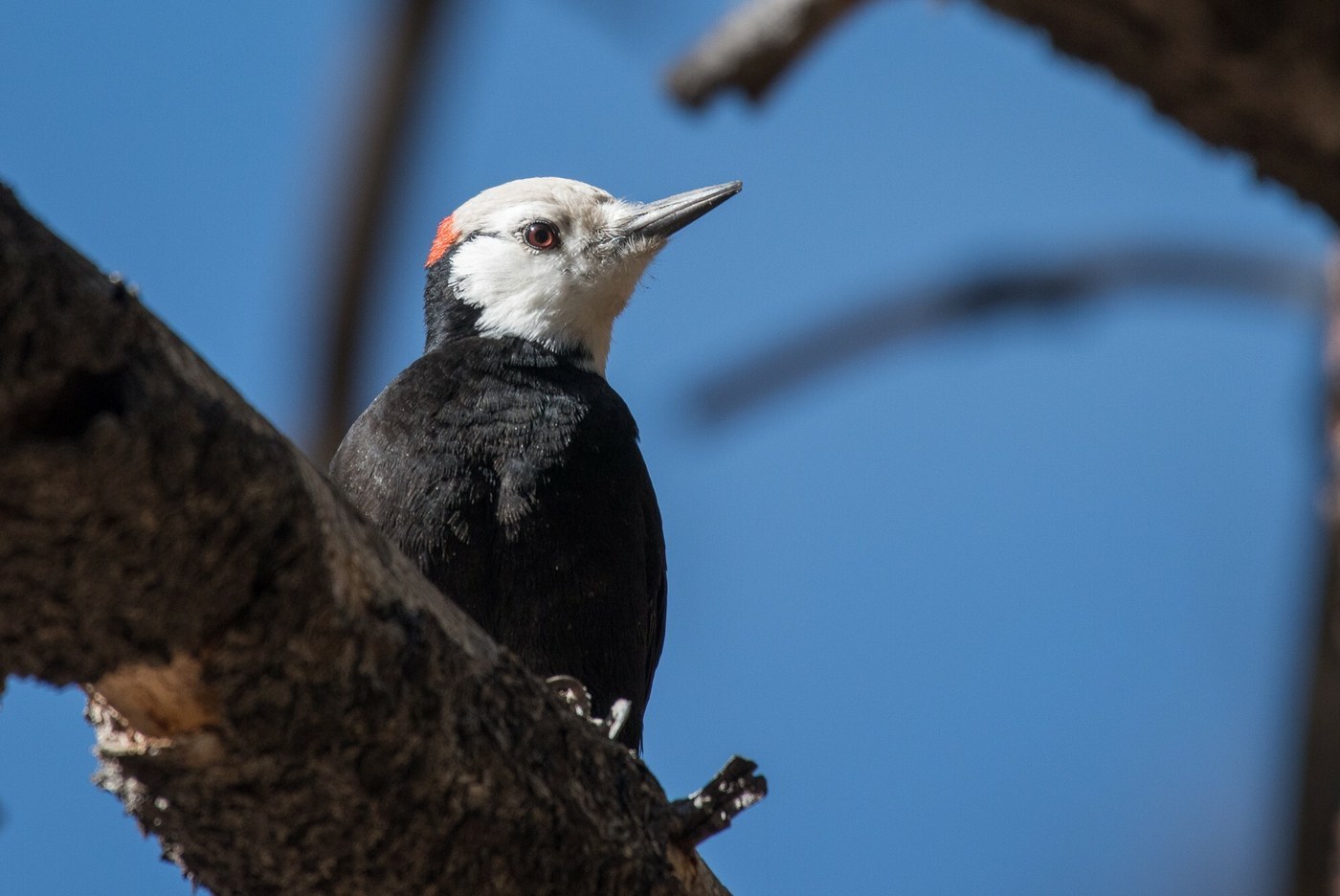
What White-headed Woodpecker's Feathers Look Like
White-headed Woodpecker is a striking, mid-sized woodpecker (about 20-23 cm) of western North American pine forests, and its feathers are essentially solid black body plumage combined with a completely white head — a combination shared by no other North American woodpecker. Back, wing, and belly contour feathers are deep, glossy black with almost no barring or spotting, stiff and slightly glossy in the way typical of woodpecker body feathers, built to withstand life clinging to and hammering on tree bark. The head feathers, by contrast, are pure white from forehead back through the crown and down onto much of the face — a white head feather this clean and unmarked, combined with black body feathers, is close to a guaranteed identification within its range.
Males show a small patch of red feathers on the nape (back of the head), bright and contrasting sharply against the surrounding white — females lack this red patch entirely, so its presence or absence can help estimate sex from a feather cluster. Flight feathers show the species' other key field mark: a bold white patch at the base of the primaries, visible as a flash of white against otherwise black wings both at rest and in flight — a feather from this patch is white at the base transitioning to black toward the tip. Tail feathers are black, stiff, and pointed at the tip (typical of woodpeckers, which use the tail as a brace against tree trunks).
Step-by-Step: Is This Feather From a White-headed Woodpecker?
- Check for a pure white head feather. An unmarked white feather combined with solid black body feathers is the strongest possible clue for this species in western pine forest.
- Look for red on the nape only. If a feather cluster shows a small red patch confined to the back of the head amid white, this points to a male White-headed Woodpecker.
- Inspect wing feathers for a white base patch. A primary feather that's white near the base and black toward the tip matches this species' wing patch.
- Feel the stiffness. Firm, stiff-shafted feathers with pointed tail feathers are typical of the woodpecker family generally.
- Rule out barring. This species shows no black-and-white barring anywhere on the body, unlike several other North American woodpeckers.
Similar Species & How to Tell Them Apart
No other North American woodpecker combines an all-white head with an all-black body, which makes confusion relatively unlikely, but Hairy Woodpecker and Downy Woodpecker, found in the same pine forests, show heavily black-and-white barred wings and a black-and-white striped face rather than a solid white head — a barred wing feather rules out White-headed Woodpecker immediately. Three-toed and Black-backed Woodpeckers, also sharing western conifer forest, have solid black backs but barred flanks and a black-and-white face pattern without the extensive white head, again distinguished by the barring.
Where & When You'll Find Them
White-headed Woodpeckers are non-migratory residents of open, mature pine forest (especially ponderosa and Jeffrey pine) in the mountains of the western United States, from Washington and Oregon south through California to parts of Nevada. Because they don't migrate, feathers can be found across all seasons, but the main annual molt follows the breeding season, roughly mid-to-late summer, when worn feathers are most likely to be replaced and dropped. Look for feathers around large, old-growth pines with flaking bark and beneath cavity nest trees, since this species forages heavily on pine seeds and bark crevices in mature stands rather than dead snags alone.
Frequently asked questions
What's the single fastest way to confirm this species from a feather?
A pure white head feather paired with solid black body feathers is essentially unique among North American woodpeckers in this range.
Does every White-headed Woodpecker have a red patch?
No, only males show the small red nape patch; females have an all-white head without red.
How is this different from a Hairy or Downy Woodpecker feather?
Those species show black-and-white barred wings and a striped black-and-white face, while White-headed Woodpecker has an unbarred solid black body and pure white head.
What does the wing feather look like specifically?
Primaries show a white patch at the base transitioning to black toward the tip, visible as a flash of white on the closed wing.
When is molt most active for this species?
Mid-to-late summer, following the breeding season, is when most worn feathers are replaced and shed.