
How to Identify White-faced Heron Feathers
How to identify the slate-blue-grey body plumes and distinctive white face of the White-faced Heron, Australia and New Zealand's most common heron.
Read the full White-faced Heron encyclopedia entry →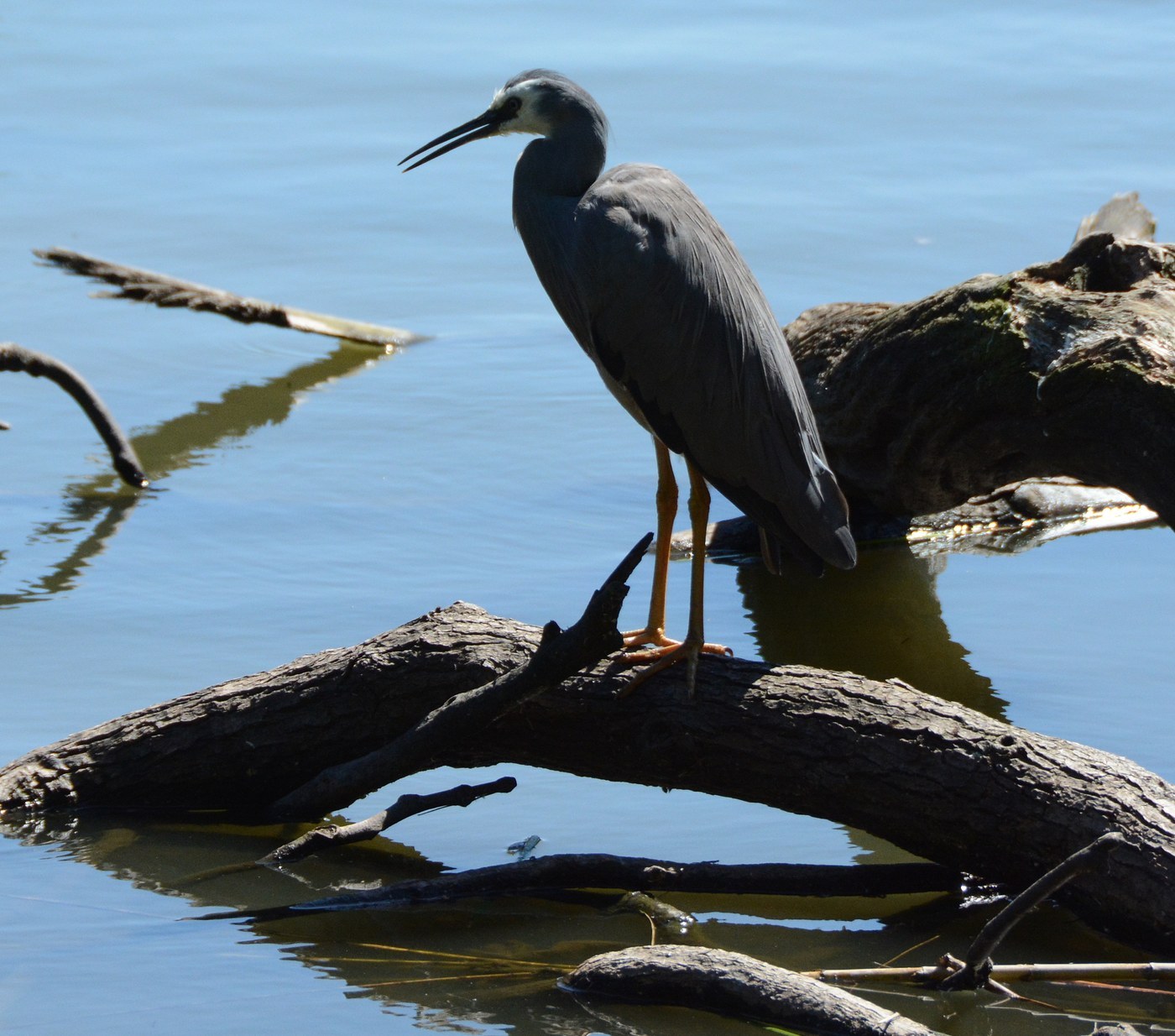
What White-faced Heron's Feathers Look Like
The White-faced Heron is a medium-large wading bird (roughly 60-70 cm tall) common across Australia, New Zealand, and nearby islands, and its feathers are dominated by a soft, even blue-grey to slate-grey tone throughout the body. Contour feathers from the back and breast are elongated and somewhat lax-webbed, especially during the breeding season when herons grow ornamental plume feathers on the back, lower neck, and chest — these are thin, wispy, elongated grey feathers quite different from ordinary body feathers, and they're one of the most distinctive heron feather types you can find.
The single most diagnostic feather (or cluster of feathers) is from the face: this species is named for the crisp white feathering that covers the entire face, from the chin up around the eyes, sharply contrasting with the grey neck and crown. A small cluster of pure white feathers found alongside grey body feathers is a strong sign of this species specifically. Neck feathers show a subtle vinous-grey to pale purplish-brown wash on the foreneck in breeding condition. Flight feathers (wings) are slate-grey with darker grey tips, long and only softly graduated, while the legs (visible as bare parts, not feathers) are yellowish and the feet often duller — not directly useful for feather ID but helpful if found alongside a carcass or track.
Step-by-Step: Is This Feather From a White-faced Heron?
- Check the size. Herons produce large feathers — body contour feathers can run 8-15 cm, and flight feathers can exceed 20-25 cm, much bigger than typical songbird feathers.
- Confirm the grey tone. An even, soft blue-grey to slate-grey color across the feather, without barring, is consistent with this species.
- Look for the white face cluster. If several small white feathers are found together with larger grey ones, and the location is Australia, New Zealand, or nearby, White-faced Heron is a strong match.
- Feel for plume feathers. Long, thin, loosely barbed ornamental feathers found near grey body feathers point to breeding-season plumage from a heron or egret — combined with the overall grey color, this fits White-faced Heron specifically.
- Rule out barring or bold patterning. This species shows no barred or spotted feathers at any age, which helps separate it from immature bitterns or night-herons.
Similar Species & How to Tell Them Apart
In Australia and New Zealand, the main confusion is with Pacific Reef Heron (dark morph), which is overall sooty grey without a white face and has shorter, stockier body feathers. Nankeen Night-Heron shows rich chestnut-brown upperparts and heavy dark streaking on immature birds, quite different from White-faced Heron's uniform slate-grey. Egrets found in the same wetlands (Great Egret, Little Egret) are entirely white-bodied, so an all-white feather is more likely from an egret, while a grey feather with a separate white face patch is the hallmark of White-faced Heron specifically.
Where & When You'll Find Them
White-faced Herons are widespread and adaptable, found in wetlands, tidal mudflats, farmland, urban parks, and even suburban lawns across Australia, New Zealand, and nearby Pacific islands — they are non-migratory over most of their range, though some local movement occurs. Because they breed opportunistically depending on local conditions rather than a single fixed season, plume feathers and body feathers can be found across much of the year, with a general peak in spring and summer breeding activity. Look near shorelines, drainage channels, wet paddocks, and the base of nesting trees in loose colonies, where preening and chick-rearing activity leaves the most feather debris.
Frequently asked questions
Is the white face made of feathers or bare skin?
It's feathers — a distinct patch of white plumage covering the face, unlike some herons where facial color comes from bare skin, making it a genuinely useful feather clue.
What are those long, wispy grey feathers I found near sturdier ones?
Those are breeding-season plume feathers, ornamental and loosely barbed, grown on the back and chest during the breeding period.
How do I tell this from an egret feather?
Egret feathers are entirely white; White-faced Heron feathers are grey overall with only the face showing white, so an all-white feather points to an egret instead.
Does this species show any barring on immature feathers?
No, White-faced Herons lack barring or heavy streaking at any age, unlike species such as Nankeen Night-Heron.
Is there a strong seasonal pattern to when feathers appear?
Feathers can be found nearly year-round since the species doesn't strictly migrate, but spring and summer breeding activity tends to produce the most plume and body feather debris.