
How to Identify White-eyed Vireo Feathers
A guide to the small olive-green body feathers, yellow spectacles, and white iris that mark a feather as belonging to a White-eyed Vireo.
Read the full White-eyed Vireo encyclopedia entry →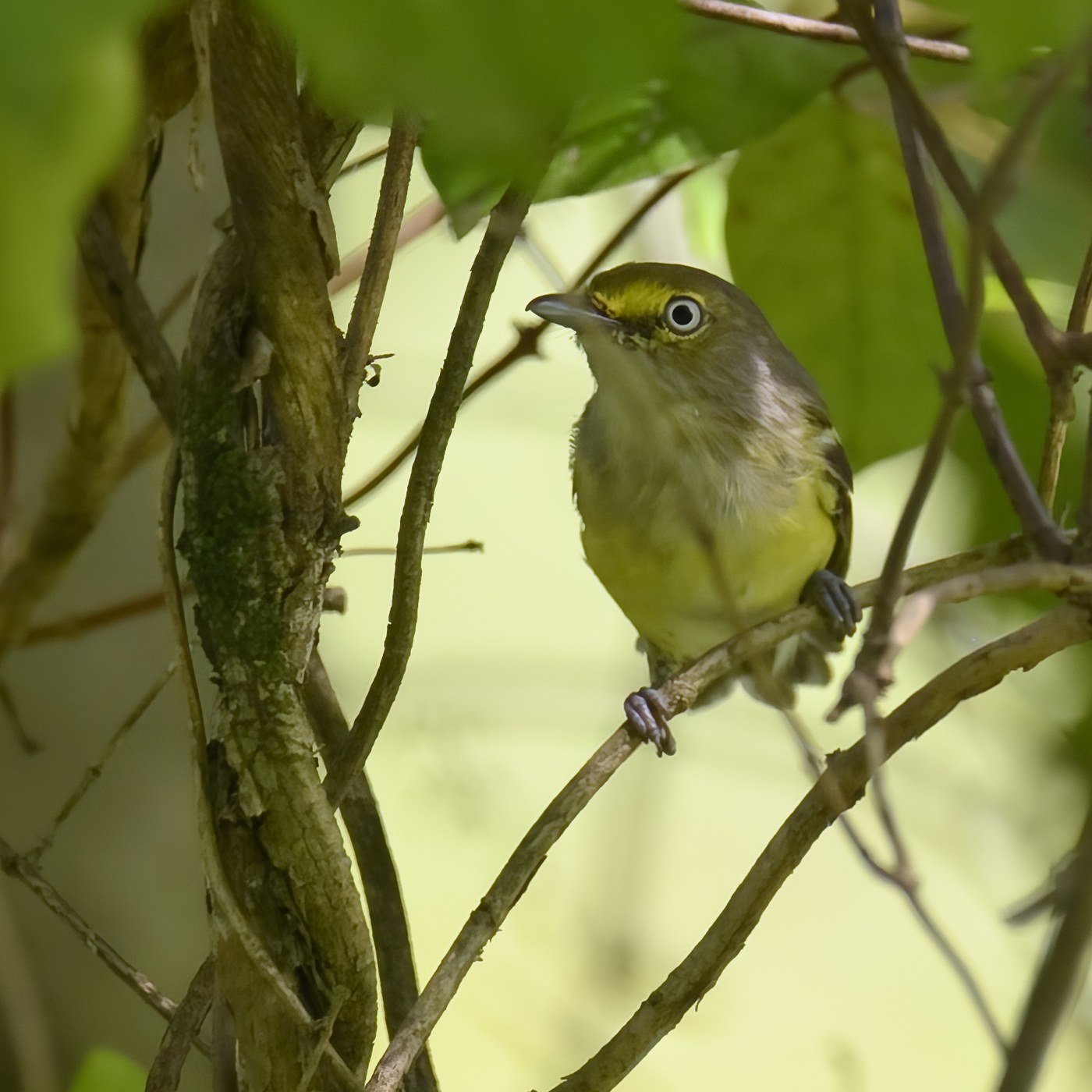
What White-eyed Vireo's Feathers Look Like
White-eyed Vireos are small songbirds, about 12-13 cm long, and their feathers reflect a bird built for skulking through dense tangles rather than showing off in the open. Back and crown contour feathers are a soft olive-green to greyish-olive, with underparts fading to pale grey-white on the throat and belly and a wash of pale yellow along the flanks and sides. The feathers are soft, loosely webbed, and typically show little to no gloss — classic understory songbird texture.
The wings carry the species' most useful diagnostic marks: two crisp white (sometimes faintly yellow-tinged) wingbars formed by pale tips on the greater and median wing coverts, standing out against otherwise dark olive-brown flight feathers. Primary and secondary flight feathers are dusky olive-brown with narrow yellowish-green edging, giving a subtly two-toned look when the wing is spread. The tail feathers are similarly dusky olive-brown, unbarred, and moderate in length relative to the small body size.
While feathers themselves can't show eye color, a genuine White-eyed Vireo skull or head-adjacent feather cluster may include the small feathers forming the yellow "spectacles" — a ring of yellow feathers around the eye extending to a short line toward the bill — which is a helpful clue if found still attached to a partial head or cap of feathers.
Step-by-Step: Is This Feather From a White-eyed Vireo?
- Measure it. Contour feathers run about 2-4 cm and flight feathers about 4-6 cm; anything much larger belongs to a bigger bird.
- Look for two white wingbars on a wing feather cluster — a strong sign of the vireo family generally, and combined with olive-green body color and range, points to this species.
- Check the color wash. Pale yellow flanks fading into a whitish throat and belly is a specific pattern worth comparing against other small greenish songbirds.
- Feel the texture. Soft, loosely webbed, non-glossy feathers are typical of skulking understory birds like this vireo.
- Look for yellow spectacle feathers if any facial feathers are attached — a ring of yellow around a feather cluster near the head is a useful confirming detail.
Similar Species & How to Tell Them Apart
The most common confusion is with other small vireos and warblers sharing olive-green plumage and wingbars. Bell's Vireo is a close relative but shows duller, less contrasting wingbars and a plainer face without the bold yellow spectacles. Yellow-throated Vireo has a much more saturated, bright yellow throat and breast (not just a flank wash), making its feathers noticeably yellower overall. Warblers such as Pine Warbler can show similar wingbars but typically have streakier body feathers and a different overall shape to the flight feathers. The pale yellow flank plus whitish throat plus white double wingbar combination is the best overall match for White-eyed Vireo specifically.
Where & When You'll Find Them
White-eyed Vireos breed across the southeastern and south-central United States in brushy thickets, overgrown fields, and forest edges, and winter from the Gulf Coast south into Mexico and Central America and the Caribbean. Because they migrate, feather finds shift seasonally: breeding-ground feathers turn up from spring through late summer, especially during the post-breeding molt in July and August, while wintering-ground feathers appear from fall through early spring. Look for feathers caught low in thorny scrub, brambles, and dense shrub tangles, the dense low cover this species strongly prefers over open woodland.
Frequently asked questions
Can a feather actually show the vireo's white eye color?
No, iris color isn't reflected in feathers — the 'white-eyed' name refers to the living bird's eye, and feather identification instead relies on the yellow spectacle feathers, wingbars, and body color.
What's the easiest single clue to spot?
A pair of crisp white wingbars on an otherwise dusky olive-brown wing feather, paired with pale yellow flanks, is the quickest positive sign.
How does this differ from a Bell's Vireo feather?
Bell's Vireo shows duller, less distinct wingbars and lacks the bold yellow spectacle feathers around the eye that White-eyed Vireo has.
Are the flight feathers barred or patterned?
No, they're plain dusky olive-brown with narrow yellowish-green edges, without barring or spotting.
When is the best time to find molted feathers?
July and August on the breeding grounds during post-breeding molt, or fall through early spring on the wintering grounds farther south.