
How to Identify White-eared Bulbul Feathers
A guide to recognizing the soft brown-grey body feathers and bright white ear patch of the White-eared Bulbul, a common Middle Eastern and South Asian garden songbird.
Read the full White-eared Bulbul encyclopedia entry →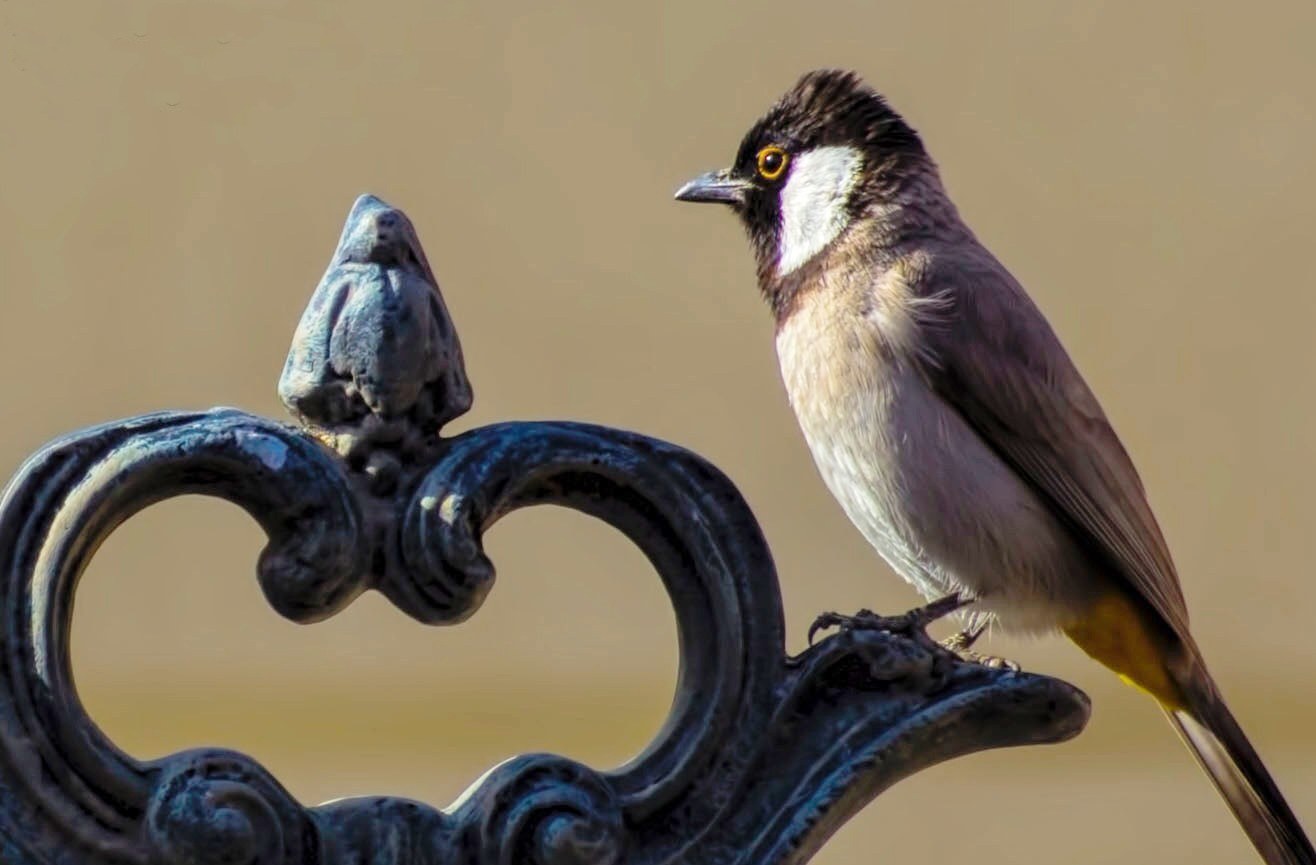
What White-eared Bulbul Feathers Look Like
The White-eared Bulbul is a small, chunky songbird (about 18-20 cm long) common in gardens, scrub, and city parks from the Arabian Peninsula to Pakistan and northwest India. Its body feathers are a soft, matte brown-grey with no bold patterning — this is a quiet, understated feather set built for blending into thorny scrub rather than standing out. Contour feathers from the back and mantle are a warm greyish-brown, while breast and belly feathers lighten to pale grey-buff, sometimes with faint dusky scalloping on the throat.
The single most useful feather to find is a head or cheek feather showing crisp white — the bulbul's namesake white ear patch is made of stiff, almost silky white feathers that contrast sharply with the black-brown cap and grey-brown nape around them. Undertail covert feathers (the small feathers under the base of the tail) are a soft lemon-to-sulfur yellow, a key diagnostic patch shared with several other bulbul species. Flight feathers (wings and tail) are plain sooty brown-grey with narrow pale edges, unmarked and unbarred. Tail feathers are moderately long, softly graduated, and dark brown-grey with faint pale tips.
Step-by-Step: Is This Feather From a White-eared Bulbul?
- Measure it. Body contour feathers run 3-6 cm; flight feathers 6-9 cm; tail feathers up to 9-10 cm. Anything larger belongs to a bigger bird.
- Check for white on a head feather. A small, stiff, pure white feather from the cheek/ear region is the strongest single clue — few other backyard songbirds in this range show a clean white ear patch.
- Look at the undertail. A soft yellow fluff feather points to the bulbul family; combined with brown-grey body feathers and the region, White-eared Bulbul is the likely source.
- Note the texture. Bulbul contour feathers are soft and slightly loose-webbed (typical of an omnivorous, fruit-and-insect-eating songbird), not stiff or glossy.
- Rule out barring. No feather from this species shows barring, spotting, or streaking — a barred or spotted feather is not from this bird.
Similar Species & How to Tell Them Apart
The closest look-alike is the Red-vented Bulbul, which overlaps in parts of the same range. Red-vented Bulbul lacks the white ear patch entirely and instead has a scaly, dark-edged breast pattern and red (not yellow) undertail coverts — the undertail color is the fastest way to separate the two species from loose feathers alone. The White-cheeked Bulbul is another relative with a similar white face patch, but its undertail coverts are yellow like White-eared Bulbul's, and its cap is glossier black with a short crest; White-cheeked Bulbul feathers tend to look slightly darker and richer brown overall. Common Mynas, which share the same gardens, have much larger, glossier brown feathers with a bold white wing patch, not a white ear patch.
Where & When You'll Find Them
White-eared Bulbuls are non-migratory residents of arid and semi-arid scrub, gardens, oases, and urban parks across the Arabian Peninsula, Iraq, Iran, Afghanistan, and Pakistan into northwest India. Because they don't migrate, feathers can be found near nesting and roosting sites year-round rather than in a seasonal pulse. The main molt follows the breeding season (roughly after spring nesting), so worn body feathers and dropped flight feathers are most common in late summer. Look under dense hedges, thorny acacia, and garden shrubs where these birds roost communally and preen — feather finds cluster around these regular perches rather than in open ground.
Frequently asked questions
Why does my feather have white on part of it but brown-grey everywhere else?
That's typical of a bulbul cheek/ear feather — the white ear patch is a small, localized patch, so a feather from right at its edge can show both white and brown-grey in one feather.
Is a yellow fluffy feather always from a bulbul?
Not always, but soft yellow undertail down combined with brown-grey body feathers in the Middle East/South Asia region strongly points to a bulbul, most likely White-eared or White-cheeked Bulbul.
Could this feather be from a Common Myna instead?
Check size and gloss — myna feathers are notably larger and glossier, and mynas show a white wing patch rather than a white ear patch, so a small matte feather with white confined to the head area is more consistent with a bulbul.
Do White-eared Bulbul feathers show any barring?
No. This species has plain, unbarred body and flight feathers, so a barred or spotted feather is not from a White-eared Bulbul.
What time of year will I find the most feathers?
Late summer, right after the breeding season, when the annual post-breeding molt is underway.