
How to Identify Western Screech-Owl Feathers
How to recognize Western Screech-Owl feathers by their fine gray bark-like vermiculation, cryptic barring, and ear-tuft feather shape, and how to separate them from Eastern and Whiskered Screech-Owls.
Read the full Western Screech-Owl encyclopedia entry →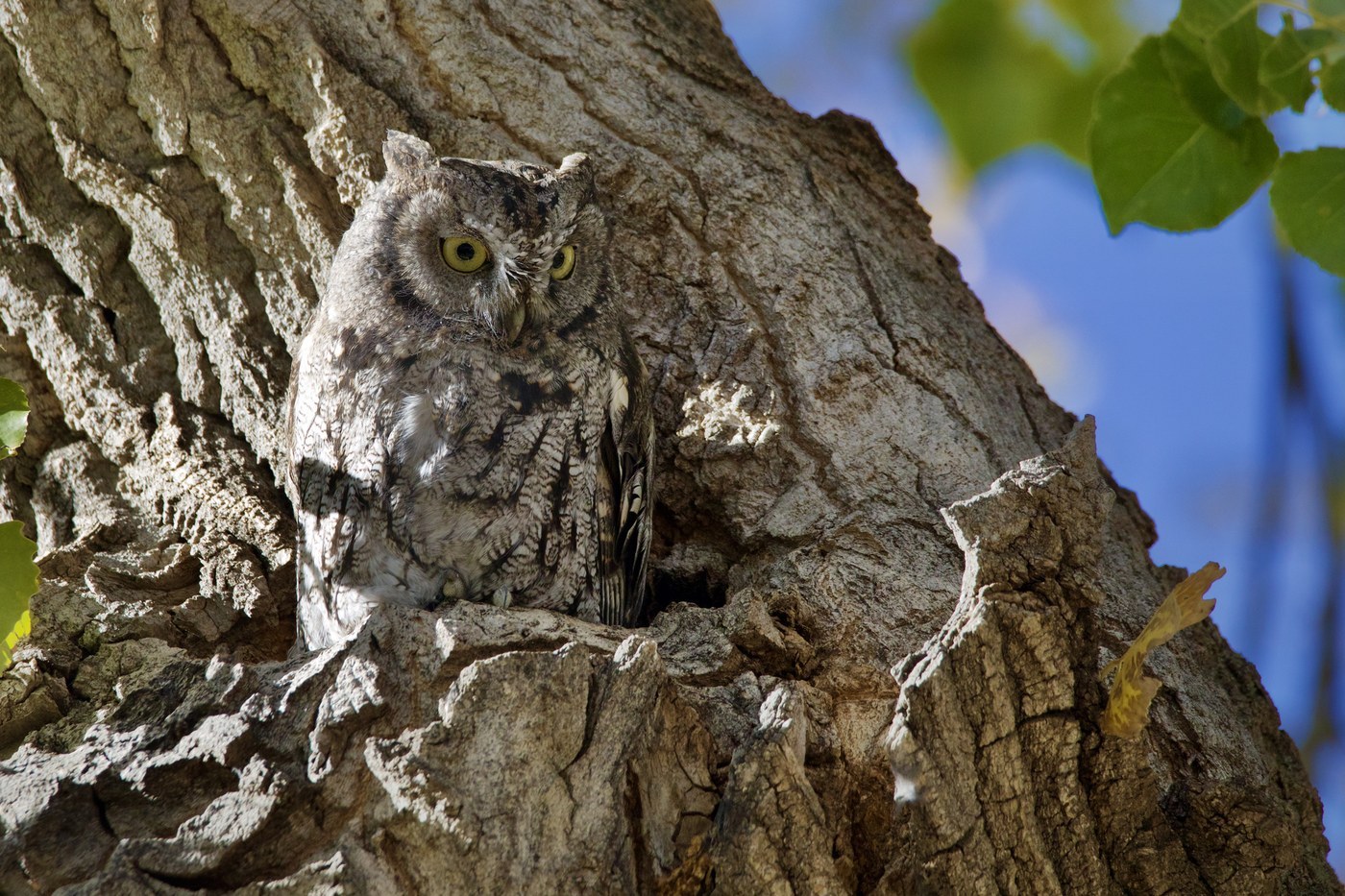
What Western Screech-Owl Feathers Look Like
Western Screech-Owl is a small (7.5–10 inch) owl whose feathers are a masterclass in camouflage against tree bark. Most body (contour) feathers are gray-brown (occasionally a rufous morph occurs, though less common than in Eastern Screech-Owl) with fine, dense vermiculations — thin, wavy, irregular dark lines — overlaid with bolder dark shaft streaks and cross-bars. Held up to light, the pattern looks like tree bark, which is exactly its function.
Flight feathers (primaries/secondaries) show alternating light and dark bands (barring) across their width, typical of owls, with soft, fringed edges on the leading vane of the outer primaries — this fringing is what gives owls silent flight and is a strong clue that a feather belongs to an owl at all, before you even get to species.
Facial disc feathers are grayish, fine-textured, and rimmed with a darker border. Ear-tuft feathers are elongated, blackish-brown with paler edges, and stand apart from ordinary contour feathers by their length and stiffness relative to width.
Step-by-Step: Is This Feather From a Western Screech-Owl?
- Confirm it's an owl feather first. Soft, fringed leading edges on a flight feather and a fine, mottled bark-like pattern point to the owl family broadly.
- Check overall size. Feathers in the 3–5 inch range for primaries fit a small owl like this species — much smaller than a Great Horned Owl feather, larger than the tiny feathers of an Elf Owl.
- Assess the pattern density. Western Screech-Owl vermiculation is relatively coarse compared to some smaller owls — moderately fine but not razor-thin.
- Look for gray tones dominating. While a rufous morph exists, most Western Screech-Owls are gray-brown; strongly rufous overall coloring should raise suspicion of Eastern Screech-Owl instead (where range overlaps).
- Note the habitat where found. Western woodlands, desert riparian corridors, and suburban areas with mature trees in the western US, Mexico, and western Canada fit this species.
Similar Species & How to Tell Them Apart
- Eastern Screech-Owl — extremely similar feather structure and pattern; ranges barely overlap, and Eastern shows a more frequent, often more saturated rufous morph. In practice, location is usually the deciding factor since feather-level differences are subtle.
- Whiskered Screech-Owl — smaller overall with noticeably finer, more delicate vermiculation and barring; found at higher elevations in oak-pine canyons where the two species' ranges meet in the southwestern US and Mexico.
- Flammulated Owl — smaller still, with more contrasting rufous-and-gray streaking rather than fine overall vermiculation, and dark (not yellow) eyes — though eye color isn't visible from feathers alone.
- Northern Saw-whet Owl — smaller, with bold white spotting on a rich brown background rather than screech-owl's finer gray vermiculation.
Where & When You'll Find Them
Western Screech-Owls are year-round residents across a wide swath of western North America, from desert washes and riparian cottonwood groves to oak woodlands and even shaded suburban yards, nesting in tree cavities and nest boxes. Because they're non-migratory, feathers can turn up at any time of year near roost and nest cavities. Adults undergo a complete molt after the breeding season, typically through summer, so the freshest, crispest feathers are most likely found in late summer near nest cavities, while worn feathers accumulate through the rest of the year at regular roost sites.
Frequently asked questions
How can I tell a feather is from an owl before narrowing down the species?
Look for soft, comb-like fringing along the leading edge of a flight feather — this muffles wingbeats for silent flight and is unique to owls among most common backyard birds.
Is a rufous-colored feather automatically ruled out for Western Screech-Owl?
Not automatically — a rufous morph does occur — but rufous is far more common in Eastern Screech-Owl, so a strongly reddish feather should prompt a closer look at range before concluding species.
What separates this species from Whiskered Screech-Owl feather-wise?
Whiskered Screech-Owl feathers show finer, more delicate vermiculation and barring, and the bird itself is smaller; the two overlap only in higher-elevation oak-pine canyons of the southwestern US and Mexico.
Where around a yard or park would I find these feathers?
Near tree cavities, nest boxes, or regular daytime roost sites in mature trees, since screech-owls don't wander far and use consistent perches.
When are feathers freshest?
Late summer, following the complete post-breeding molt; feathers found earlier in the year are more likely to be worn from months of use.
Western Screech-Owl identified by the community
Recent Western Screech-Owl feathers identified with Feather Identifier.
