
How to Identify Wattled Crane Feathers
How the long drooping plume feathers and contrasting black belly set Wattled Crane apart from Africa's other large cranes.
Read the full Wattled Crane encyclopedia entry →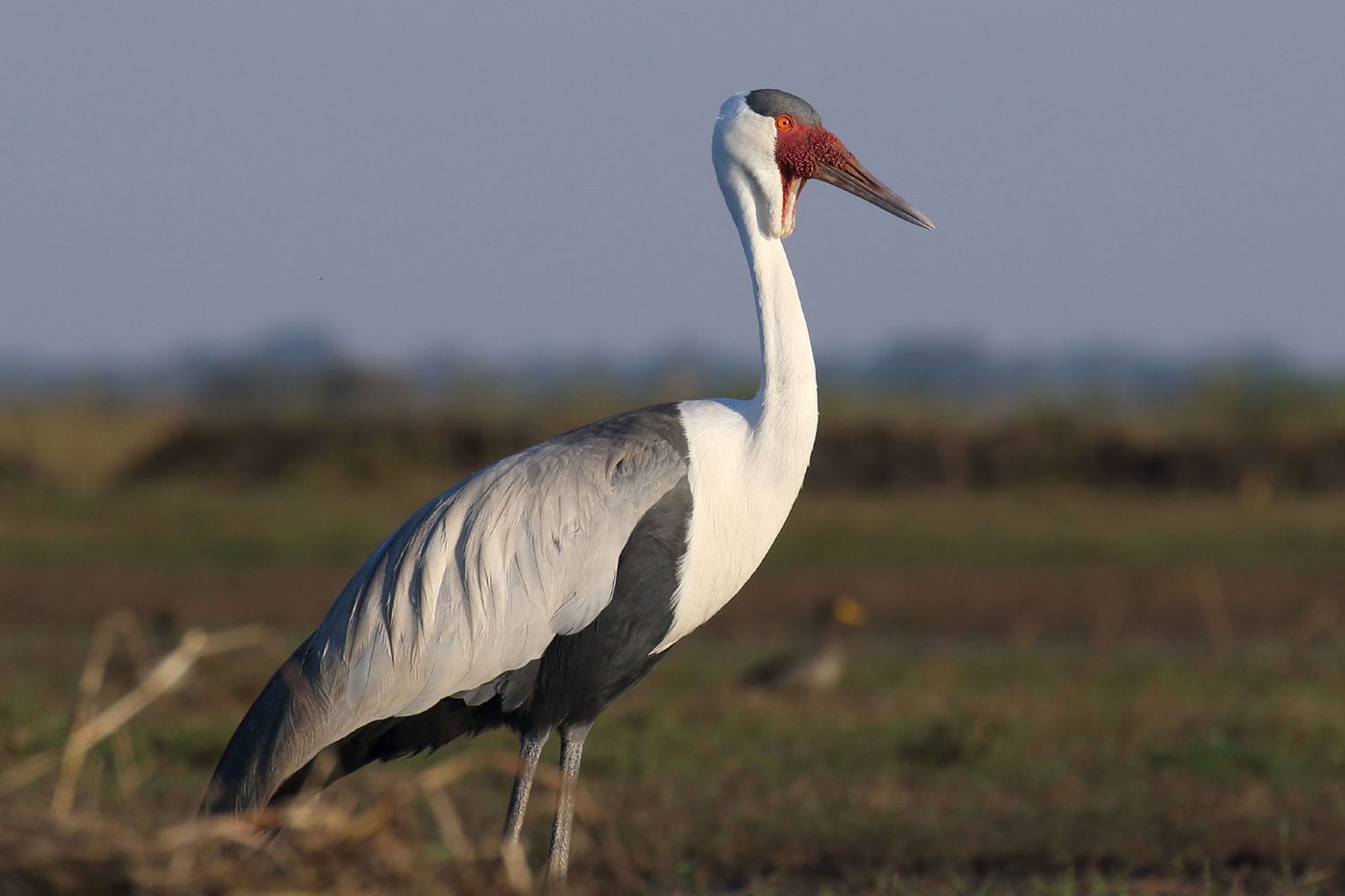
What Wattled Crane Feathers Look Like
Wattled Crane is Africa's tallest crane and among its most elegant, with elongated ornamental plumes and a striking two-tone body pattern that make its feathers distinctive.
- Tertial/ornamental plume feathers: exceptionally long, drooping, and loosely textured, cascading over the tail to form a "bustle" — grayish-white and notably fluffier than typical flight or contour feathers.
- Body/contour feathers: pale slate-gray overall, providing a soft, understated base color across the back and wings.
- Belly/thigh feathers: contrastingly black, a sharp two-tone pattern (pale gray body, black lower body) not seen in most other crane species, many of which are more uniformly gray.
- Neck/head feathers: mostly white or very pale gray toward the front of the neck, with the face itself covered in bare reddish skin rather than feathers.
- Flight feathers: primaries blackish, contrasting with the pale gray body.
- Size: as Africa's largest crane, feathers — especially the ornamental plumes — run notably long, some of the longest ornamental crane plumes found in the region.
Step-by-Step: Is This Feather From a Wattled Crane?
- Look for extremely long, drooping plume feathers. Loosely textured, grayish-white tertial plumes far longer than typical contour feathers are a strong first clue for a crane, and their sheer length fits this species particularly well.
- Check for a black belly feather. A black feather paired with otherwise pale gray body feathers supports Wattled Crane's distinctive two-tone pattern over more uniformly colored cranes.
- Assess overall body tone. Pale slate-gray (not deep blue-gray) body feathers fit this species.
- Rule out crest/head ornamentation. No stiff golden crest feathers should be present — those belong to a different African crane species instead.
- Consider size and habitat. Very large feathers found near African wetlands or floodplains support this being Africa's largest crane species.
Similar Species & How to Tell Them Apart
- Grey Crowned Crane: has a stiff, golden bristly crest of feathers on the crown and a white wing patch, both absent in Wattled Crane, and its body is more uniformly gray without the black belly contrast.
- Blue Crane: overall blue-gray with no black belly patch and much shorter neck plumes, lacking the long drooping "bustle" of Wattled Crane.
- Demoiselle Crane: smaller, with elongated black plumes hanging from the head/neck region rather than the belly/tail area, and lacks the bold gray-and-black two-tone body.
- Common/Eurasian Crane: grayer overall with a red crown patch (skin, not feathers) and black-and-white head/neck pattern, lacking Wattled Crane's black belly and long tertial bustle.
Where & When You'll Find Them
Wattled Cranes inhabit large wetlands, floodplains, and shallow marshes in southern and eastern Africa, including the Okavango Delta, Zambian floodplains, and Ethiopian highlands, where they forage on aquatic vegetation and tubers. Because cranes molt their flight feathers during a flightless period tied to the breeding cycle, feathers — including the long ornamental plumes — are most likely to be found near wetland breeding and foraging sites, with the flightless molt period offering the best window for finding a full range of feather types in one place.
Frequently asked questions
What's the most distinctive single feature to look for?
An extremely long, loosely textured, drooping plume feather (grayish-white) is one of the most distinctive traits, since Wattled Crane's ornamental bustle plumes are especially long even among cranes.
How does the black belly feather help confirm identification?
A black feather paired with pale gray body feathers reflects Wattled Crane's unusual two-tone body pattern, which most other crane species lack.
How is this different from Grey Crowned Crane?
Grey Crowned Crane has a stiff golden crest and a white wing patch, both absent in Wattled Crane, which instead shows a black belly and long drooping tertial plumes.
Why would I find many feathers in one spot?
Cranes go through a flightless period during molt tied to their breeding cycle, so feathers can accumulate near wetland breeding and foraging sites during that window.
What habitat should I search for these feathers in?
Large African wetlands, floodplains, and shallow marshes in southern and eastern Africa, such as the Okavango Delta or Zambian floodplains.