
How to Identify Warbling Vireo Feathers
How the plain, unmarked wings and subtle pale eyebrow help confirm a Warbling Vireo feather among North America's vireos.
Read the full Warbling Vireo encyclopedia entry →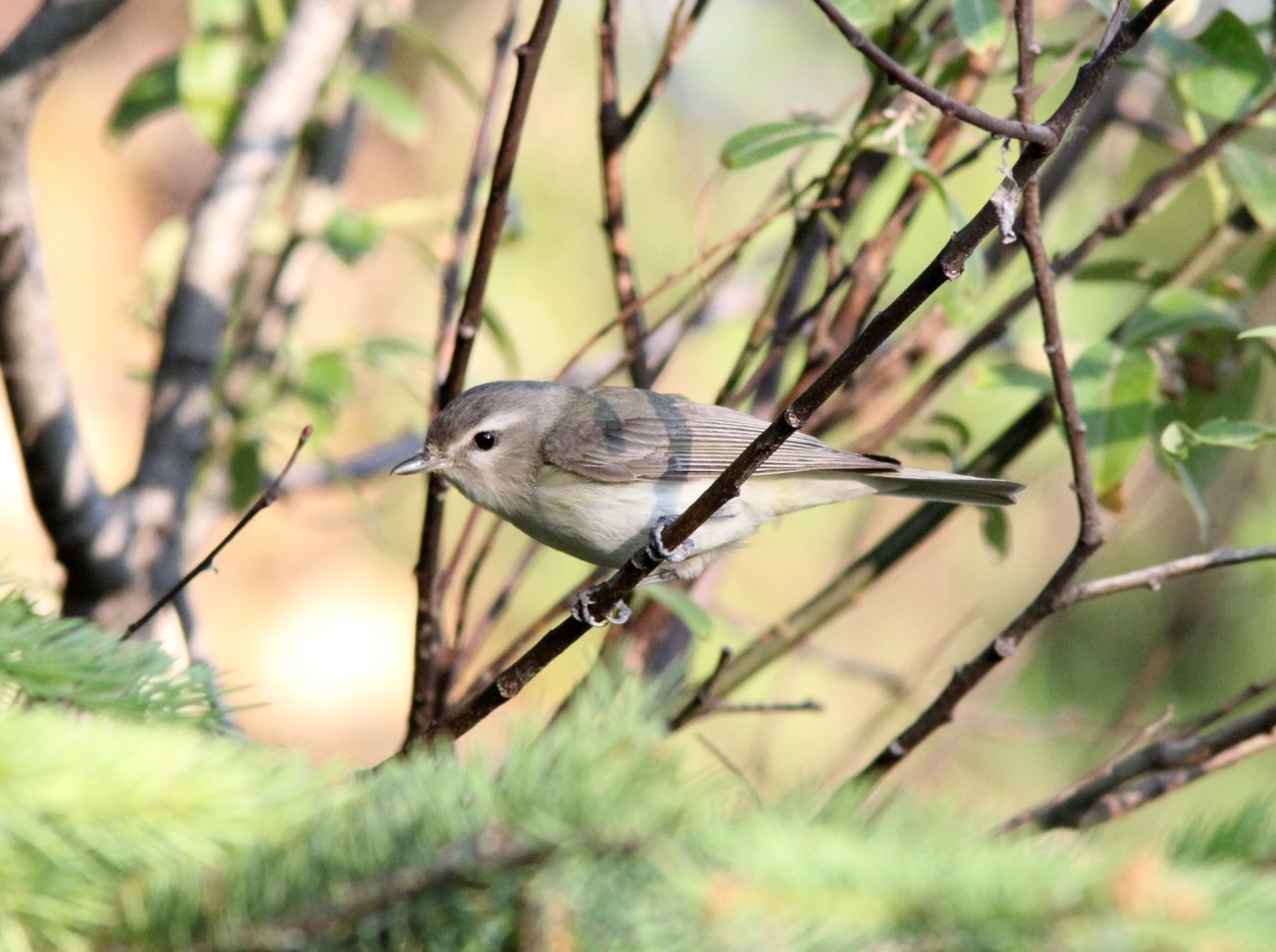
What Warbling Vireo Feathers Look Like
Warbling Vireo is one of the plainest vireos in North America, and that very plainness — especially the total absence of wingbars — is the key to identifying its feathers correctly.
- Body/contour feathers: plain grayish-olive above, whitish below with a faint pale yellow wash on the flanks and undertail — an overall subdued, unmarked color scheme.
- Wing feathers: plain, with no white wingbars at all, a key negative clue since many other vireos and warblers show distinct pale wing markings.
- Face feathers: a faint pale supercilium (eyebrow stripe) bordered by only a subtly darker line through the eye, lacking the bold black-bordered look of some other vireos.
- Undertail covert feathers: pale yellowish, a subtle but useful accent color against the otherwise gray-olive body.
- Head feathers: slightly grayer than the more olive back, creating gentle rather than sharp contrast.
- Size: small vireo feathers, body contours around 1-2 cm, consistent with a roughly 12 cm bird.
Step-by-Step: Is This Feather From a Warbling Vireo?
- Check the wing for bars first. If wing covert feathers are entirely plain with no pale bars, that fits Warbling Vireo well and rules out species with bold wingbars.
- Assess the face pattern. A faint, unbordered pale eyebrow without strong black lines above and below is consistent with this species' subtle facial pattern.
- Look at overall color balance. Gray-olive above with pale, faintly yellow-washed underparts (not bright yellow) fits Warbling Vireo rather than more colorful vireos.
- Compare head-to-back contrast. A subtle gray-headed, olive-backed look (rather than a sharply contrasting crown stripe) supports this species.
- Consider habitat. Feathers found in deciduous woodland edges, riparian corridors, or shade trees across North America fit this widespread species' habitat preference.
Similar Species & How to Tell Them Apart
- Philadelphia Vireo: shows a more extensively yellow wash across the entire underside (not just flanks/undertail) and a darker, more contrasting line through the eye.
- Red-eyed Vireo: has a bold gray crown bordered by black lines and a more sharply defined white eyebrow, plus a red eye — all more strongly patterned than Warbling Vireo's subtle face.
- Tennessee Warbler: superficially similar plain greenish coloring, but has a thinner, more pointed warbler-type bill impression and typically a more contrasting eyeline.
- Blue-headed Vireo: shows bold white spectacles (a complete pale eye-ring connected to the supercilium) and white wingbars, both absent in Warbling Vireo.
Where & When You'll Find Them
Warbling Vireos breed across a huge swath of North America, from southern Canada through much of the U.S., favoring deciduous woodland edges, riparian groves, and shade trees, including in parks and residential areas. They winter in Mexico and Central America, so feathers in northern breeding range are most likely from late spring through summer, with an additional batch appearing after the post-breeding molt in late summer before birds depart on migration.
Frequently asked questions
What's the most useful negative clue for identifying this species?
The complete absence of white wingbars on the wing covert feathers is one of the most useful clues, since it rules out many other vireos and warblers that show wingbars.
How does the face pattern help confirm identification?
A faint, unbordered pale eyebrow without strong black lines fits Warbling Vireo, as opposed to species like Red-eyed Vireo that show a more boldly bordered face pattern.
How do I tell this apart from Philadelphia Vireo?
Philadelphia Vireo shows more extensive yellow across the whole underside and a darker eyeline, while Warbling Vireo's yellow is limited mostly to the flanks and undertail.
Could this be confused with a warbler feather?
It's possible with species like Tennessee Warbler, but a slightly heavier bill impression and more contrasting eyeline in the warbler can help separate the two if those features are visible.
What habitat is typical for finding these feathers?
Deciduous woodland edges, riparian corridors, and shade trees across a broad swath of North America during the breeding season.