
How to Identify Virginia's Warbler Feathers
How the plain gray body, yellow rump, and yellow breast patch (with no wingbars) help identify a Virginia's Warbler feather.
Read the full Virginia's Warbler encyclopedia entry →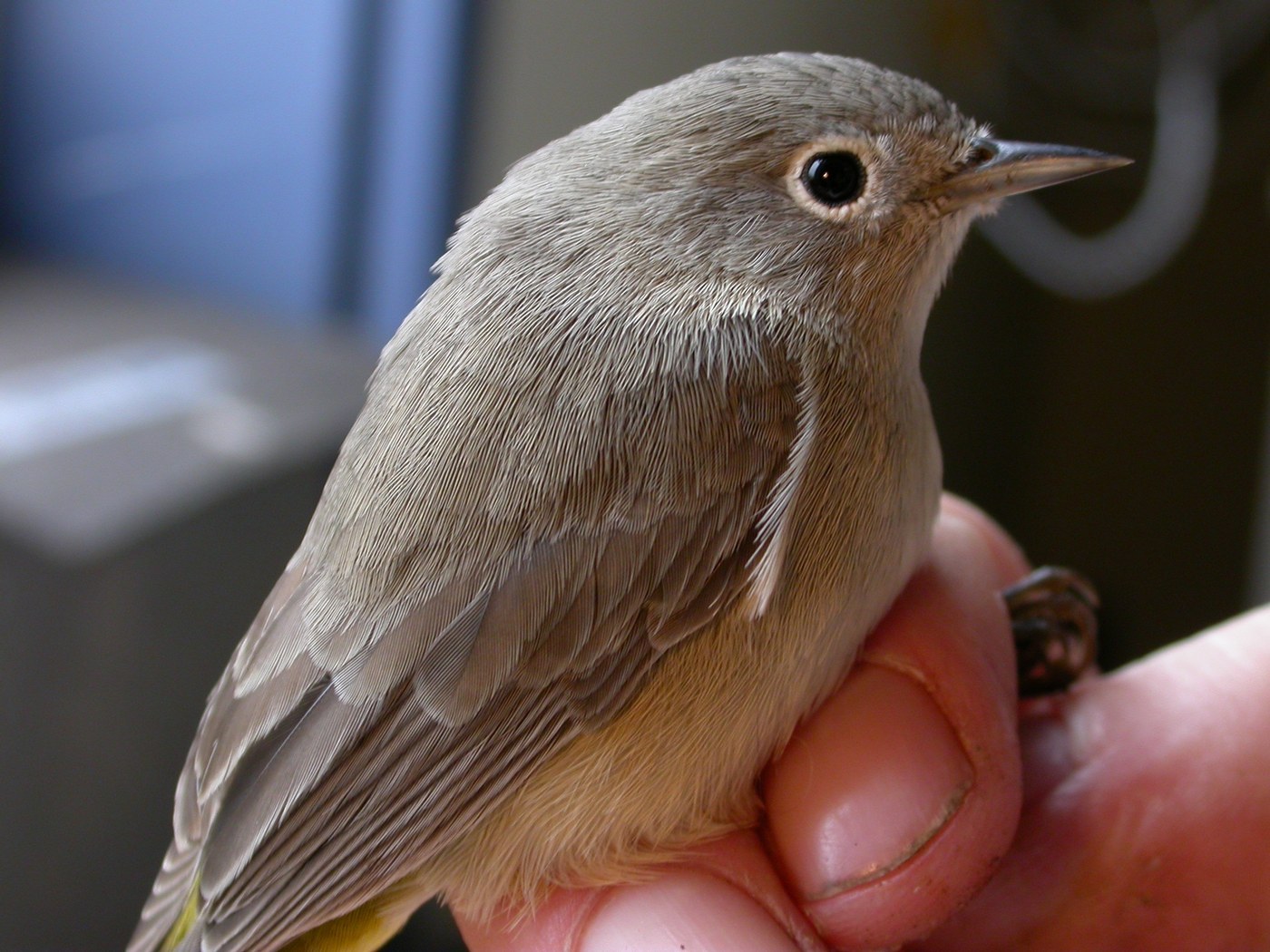
What Virginia's Warbler Feathers Look Like
Virginia's Warbler is a small, plain-looking warbler of the southwestern U.S. mountains, and its lack of bold markings is itself a useful identification clue once you know what to expect.
- Body/contour feathers: mostly plain, unmarked gray, without streaking, spotting, or wingbars — a notably clean, minimal pattern compared to many other warblers.
- Rump feathers: bright yellow, sharply contrasting with the gray back — one of the most useful single feathers for this species.
- Breast feathers: pale gray overall, with a small patch of yellow at the center of the breast.
- Undertail covert feathers: yellow, matching the rump in tone.
- Eye-ring feathers: fine white feathering forms a distinct pale eye-ring on the face.
- Wing feathers: plain gray-brown with no wingbars — an important negative clue, since many similar warblers show pale wing markings.
- Size: tiny warbler feathers, body contours around 1-2 cm, consistent with an 11-12 cm bird.
Step-by-Step: Is This Feather From a Virginia's Warbler?
- Check for wingbars first. Plain gray wing feathers with no pale bars are consistent with this species; bold wingbars point elsewhere.
- Look for a yellow rump. A bright yellow rump feather set against otherwise plain gray plumage is one of the best diagnostic clues for this species.
- Check the breast for a yellow patch. A small, localized yellow patch on an otherwise gray breast feather (rather than an all-yellow throat/breast) fits Virginia's Warbler.
- Confirm the undertail is yellow, matching the rump — this combination (yellow rump + yellow undertail + limited yellow breast patch) is a strong overall match.
- Consider elevation and habitat. Feathers found in dry montane scrub, oak, or pinyon-juniper habitat in the southwestern U.S. mountains fit this species' preferred breeding range well.
Similar Species & How to Tell Them Apart
- Nashville Warbler: shows yellow across the entire throat and breast (not just a small patch), with a more extensively yellow underside overall.
- Colima Warbler: larger overall, with more extensive yellow on the undertail coverts, and restricted to the Chisos Mountains of Texas rather than the broader Virginia's Warbler range.
- Lucy's Warbler: has a rufous (not yellow) rump and a rufous crown patch, quite different in color from Virginia's Warbler's yellow rump.
- MacGillivray's Warbler: shows a gray hood and yellow underparts but with a bolder, more extensively yellow belly and a broken white eye-arc rather than a full eye-ring.
Where & When You'll Find Them
Virginia's Warbler breeds in dry montane scrub, oak thickets, and pinyon-juniper woodland across the mountains of the southwestern United States, from the Great Basin south into Arizona, New Mexico, and adjacent Mexico. It winters in Mexico, so feathers in U.S. breeding habitat are most likely from late spring through summer, with another wave of molted feathers appearing in late summer after breeding, just before birds move south for the winter.
Frequently asked questions
What is the best single clue for identifying this species from a feather?
A bright yellow rump feather against otherwise plain gray plumage is one of the clearest single indicators for Virginia's Warbler.
Why does the absence of wingbars matter?
Many similar small warblers show pale wingbars, so plain, unmarked gray wing feathers with no bars help narrow the identification toward Virginia's Warbler.
How do I tell this apart from Lucy's Warbler?
Check the rump color — Virginia's Warbler has a yellow rump, while Lucy's Warbler has a rufous rump and a rufous crown patch instead.
Does the yellow breast patch cover the whole underside?
No, it's typically a small, localized patch at the center of an otherwise pale gray breast, unlike Nashville Warbler's more extensively yellow throat and breast.
What habitat should I expect to find these feathers in?
Dry montane scrub, oak thickets, or pinyon-juniper woodland in the mountains of the southwestern United States during the breeding season.