
How to Identify Violet Sabrewing Feathers
How the deep violet body color, large white tail corners, and stiff bowed wing feathers set the Violet Sabrewing apart from other hummingbirds.
Read the full Violet Sabrewing encyclopedia entry →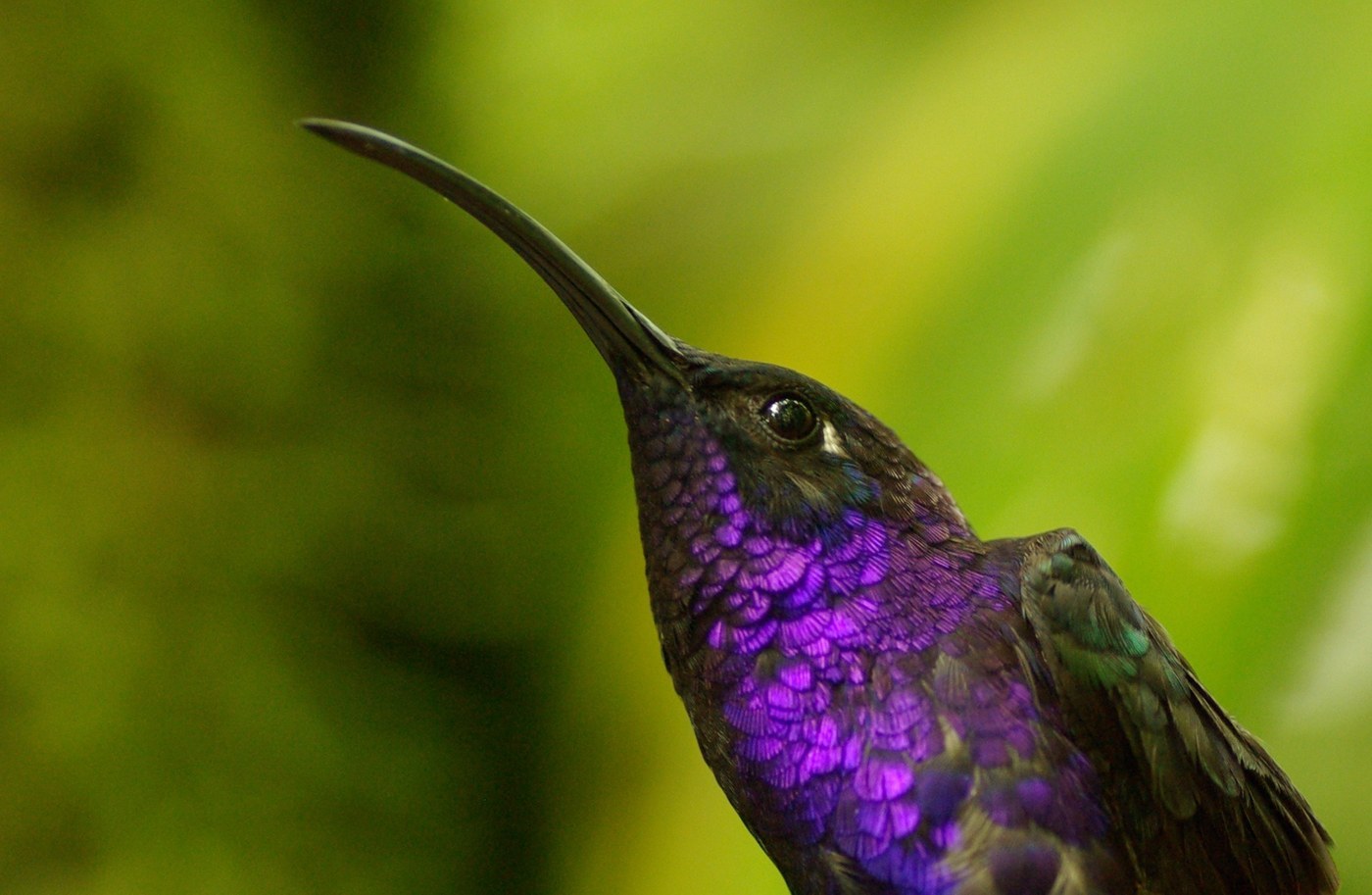
What Violet Sabrewing Feathers Look Like
Violet Sabrewing is one of the largest hummingbirds in its Central American range, and both its size and its uniquely modified wing feathers make it identifiable even from a single feather.
- Body/contour feathers (male): deep, rich violet-blue, iridescent and glossy across the head, throat, and underparts — one of the most saturated violet tones among hummingbirds.
- Back feathers: greenish, contrasting with the violet body color.
- Outer primary shafts: distinctly thickened and slightly bowed or curved, a structural trait unique to sabrewing hummingbirds and a strong diagnostic if you have an intact outer wing feather.
- Tail feathers: dark, with prominent white corners/tips on the outer rectrices, visible as a bold white patch when the tail is fanned.
- Female feathers: green above, gray below, with white tips on the outer tail feathers but lacking the violet body color of the male.
- Size: notably large for a hummingbird — body around 14 cm, with flight and tail feathers correspondingly longer and more substantial than typical hummingbird feathers.
Step-by-Step: Is This Feather From a Violet Sabrewing?
- Check the size first. This species produces some of the largest feathers of any hummingbird in its range — if a "hummingbird-type" feather seems unusually large, consider this species early.
- Examine an outer wing feather's shaft. A thickened, stiff, slightly bowed shaft on an outer primary is a hallmark of sabrewing hummingbirds and not shared by most other species.
- Look for deep violet coloring. Rich violet-blue body feathers (male) are distinctive; if the feather is green above and gray below with white tail tips, it may be a female of this species instead.
- Check tail corners. Bold white tips on dark outer tail feathers support this species, especially combined with the large size.
- Factor in habitat. Feathers found in humid cloud forest understory from Mexico through Panama fit this species' typical range and habits.
Similar Species & How to Tell Them Apart
- Green Violetear: violet color is restricted to an ear patch rather than covering the whole body, and it lacks the bowed/thickened outer primary shaft of true sabrewings.
- Rufous Sabrewing: shares the modified outer primary shaft trait but shows rufous rather than violet body tones, and occurs in a more restricted range.
- Long-tailed Hermit or other large hummingbirds: generally brownish or bronzy rather than violet, and lack both the bowed wing feather and white tail corners together.
- Female Violet Sabrewing vs. other large green hummingbirds: the combination of large size, gray underparts, and white-tipped tail corners is the best way to separate her from similarly plain green hummingbird females.
Where & When You'll Find Them
Violet Sabrewings inhabit humid cloud forest and forest edge understory from central Mexico south through Panama, often visiting flowering shrubs at low and mid-level heights. Feathers are most likely to be found in these forest habitats year-round, since the species is largely resident, though local movements tied to flowering cycles and the wet season can shift where individuals — and their molted feathers — concentrate at any given time.
Frequently asked questions
What makes a Violet Sabrewing wing feather physically unusual?
The outer primary feathers have a thickened, stiff, slightly bowed shaft, a trait shared only by other sabrewing hummingbirds and not seen in most other hummingbird species.
How can I tell a male from a female by feather alone?
Male body feathers are rich violet-blue, while female feathers are green above and gray below, though both sexes show white-tipped outer tail feathers.
How is this different from Green Violetear?
Green Violetear's violet coloring is limited to a patch on the ear region rather than covering the whole body, and it lacks the bowed outer primary shaft of true sabrewings.
Is size a reliable clue for this species?
Yes — Violet Sabrewing is notably large for a hummingbird, so unusually large hummingbird-type feathers are a good starting clue.
In what habitat are these feathers typically found?
Humid cloud forest and forest-edge understory from Mexico to Panama, where the species forages at flowering shrubs.