
How to Identify Ural Owl Feathers
How to identify the pale gray-brown, long-tailed feathers of a Ural Owl and separate them from Tawny Owls and Great Grey Owls.
Read the full Ural Owl encyclopedia entry →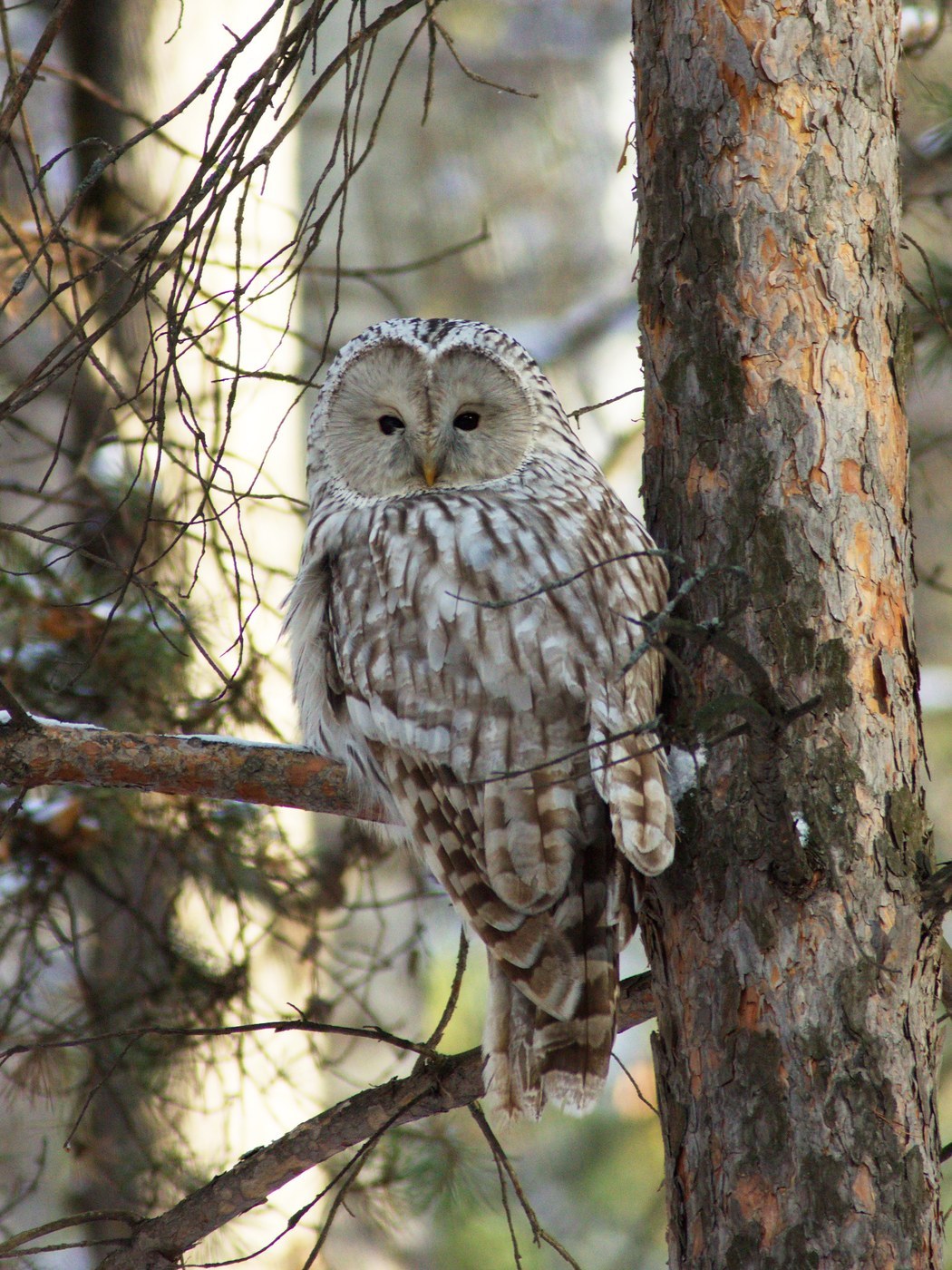
What Ural Owl's Feathers Look Like
Ural Owl is a large Eurasian forest owl, and its feathers combine classic silent-flight owl structure with a distinctly pale, long-tailed look.
- Body/contour feathers: pale grayish-brown to buffy-gray with fairly bold dark shaft streaks running down the center of each feather, giving a streaky rather than barred appearance overall.
- Flight feathers: broad, soft-edged primaries and secondaries showing pale gray-brown ground color with darker barring; the leading edge of the outer primary has a comb-like fringe of soft, serrated barbs — a structural feature found across owls that enables silent flight.
- Tail feathers: notably long relative to body size, pale grayish-brown with distinct dark barring across the length — Ural Owl's tail is proportionally longer than many other owls its size.
- Facial disc feathers: fine, hair-like, pale gray-white feathers that form the rounded facial disc, softer and less structured than body contour feathers.
- Size: this is a large owl, so flight feathers can reach 25-32 cm and body feathers 6-9 cm, with the long tail feathers sometimes exceeding 20 cm.
- Texture: exceptionally soft and fluffy overall, typical of owls, with dense down at the feather base for silent, insulated flight.
Step-by-Step: Is This Feather From a Ural Owl?
- Check for the silent-flight fringe. A comb-like, serrated edge along one side of a primary feather confirms an owl in general — a useful first step before narrowing to species.
- Assess the overall color. Pale grayish-brown with bold dark shaft streaks (rather than heavy overall barring or strong rufous tones) fits Ural Owl.
- Measure the tail feather. An unusually long, barred tail feather (potentially 20+ cm) fits this species' long-tailed proportions better than shorter-tailed owls.
- Compare density and softness. Extremely soft, fluffy texture with substantial down at the base is consistent with a large forest owl.
- Weigh the habitat and range. Feathers found in mature mixed or coniferous forest across northern/central Europe and Asia support this species over similar owls found only regionally.
Similar Species & How to Tell Them Apart
- Great Grey Owl: larger overall with a much more strongly marked, concentric facial disc pattern and an even longer tail; body feathers tend to look grayer and less warmly toned than Ural Owl's.
- Tawny Owl: notably smaller with a shorter tail and warmer, more rufous-brown overall coloring compared to Ural Owl's paler gray-brown tone.
- Long-eared Owl: shows more mottled, intricately patterned body feathers and prominent ear-tuft feathers, which Ural Owl lacks (Ural Owl has no visible ear tufts).
- Barred Owl (no range overlap but similar look): shows bold horizontal barring on the upper breast transitioning to vertical streaking below, a more complex pattern than Ural Owl's simpler streaked look.
Where & When You'll Find Them
Ural Owls are year-round residents of mature mixed and coniferous forests across a broad swath of northern and central Europe through Russia and parts of East Asia, often nesting in large tree cavities or old raptor nests. Being non-migratory, feathers can be found in their territory at any time of year, but molt is concentrated in summer (roughly June through August) after the breeding season, making late summer and early autumn the best time to find freshly dropped feathers in mature forest.
Frequently asked questions
How can I tell this is an owl feather at all?
Look for a comb-like, serrated fringe along the leading edge of a flight feather — this soft-edged structure is a hallmark of owls that enables silent flight.
What separates a Ural Owl feather from a Tawny Owl feather?
Size and tone — Ural Owl is notably larger with a longer tail and paler, grayer coloring, while Tawny Owl is smaller and warmer, more rufous-brown overall.
Could this be from a Great Grey Owl instead?
Check the facial disc pattern and overall size — Great Grey Owl is even larger with a much more strongly marked, concentric facial disc than Ural Owl.
Why does the tail feather seem unusually long?
Ural Owl has a proportionally long tail compared to many owls its size, so an unusually long, barred tail feather fits this species well.