
How to Identify Tufted Duck Feathers
How to identify the black-and-white body feathers and drooping head-tuft of a male Tufted Duck.
Read the full Tufted Duck encyclopedia entry →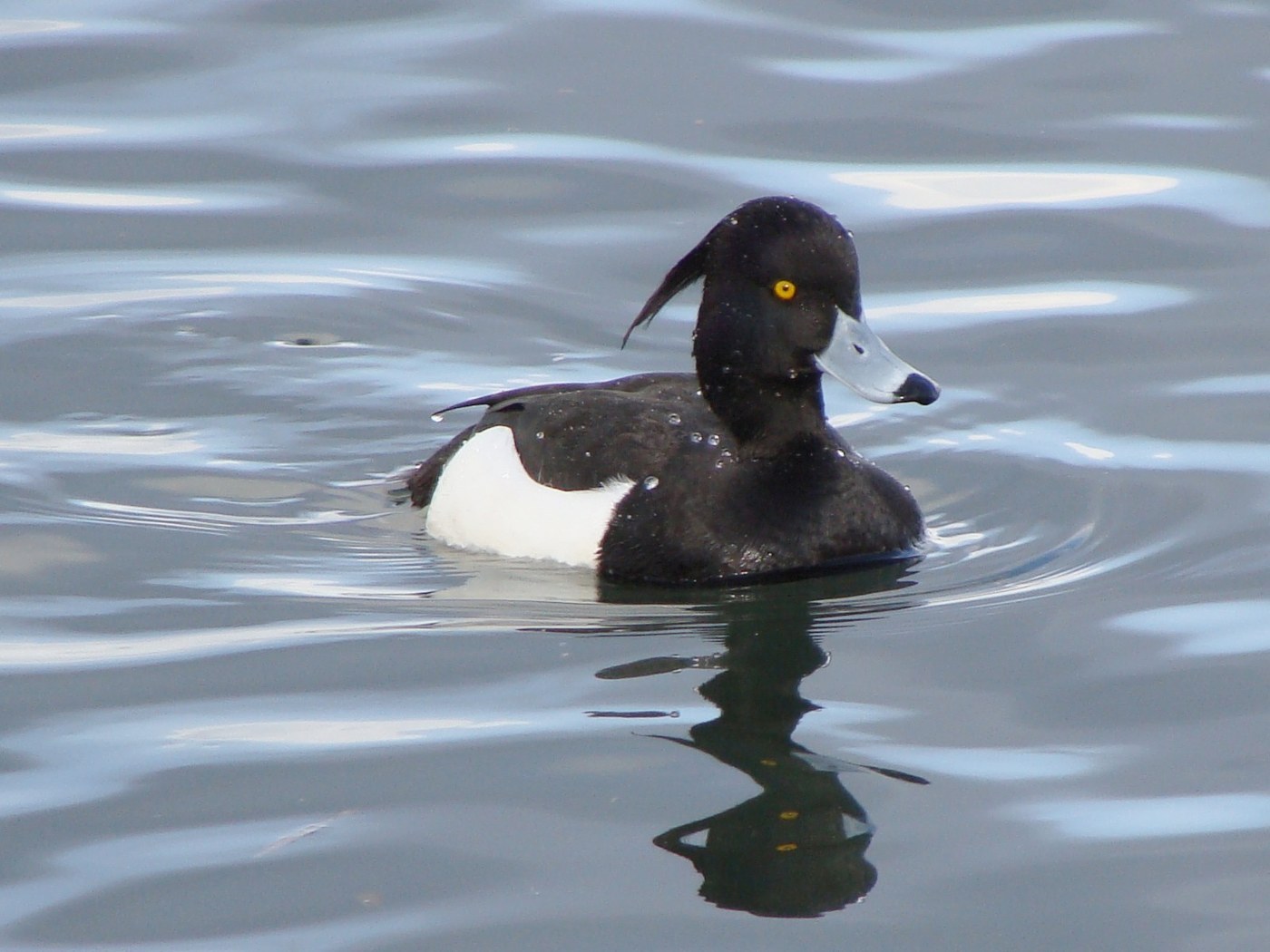
What Tufted Duck's Feathers Look Like
Tufted Duck is a compact diving duck widespread across Eurasia, easily recognized by the male's distinctive head tuft, with feathers that reflect strong sexual dimorphism.
- Male head feathers: glossy black with a purplish sheen, including a drooping tuft of elongated feathers at the back of the head — this loose, wispy tuft feather is one of the most diagnostic single-feather clues for this species among diving ducks.
- Male body feathers: bold black upperparts and breast contrasting sharply with clean white flanks, a strong two-tone pattern.
- Female head/body feathers: overall dark brown, with a small, much shorter head tuft than the male's, and often a small whitish patch at the base of the bill visible on nearby face feathers.
- Wing feathers: dark with a white wing stripe across the secondaries, visible as a flash in flight and identifiable on an isolated secondary feather as white with dark surrounding areas.
- Size: compact diving-duck feathers; contour feathers 2-3 cm, tuft feathers notably elongated at 4-6 cm on males.
Step-by-Step: Is This Feather From a Tufted Duck?
- Look for a wispy, elongated feather. An unusually long, thin, drooping feather (rather than a normal rounded contour feather) strongly suggests the male's head tuft.
- Check for black-and-white contrast. Sharp black upperparts/breast against clean white flanks fits an adult male; more uniform dark brown fits a female.
- Assess the wing stripe. A white band across an otherwise dark secondary feather supports this species, a trait shared with several diving ducks but useful in combination with other clues.
- Look for a small white face patch. On female-type feathers, a whitish patch near where the bill would attach supports Tufted Duck.
- Consider habitat. Feathers found on lakes, reservoirs, and slow rivers across Europe, Asia, and increasingly parts of North America (as a rare visitor) support this identification.
Similar Species & How to Tell Them Apart
- Greater/Lesser Scaup: lack any head tuft entirely and show a more uniformly rounded head profile; scaup flank feathers are white but without the sharply glossy black breast/back contrast of male Tufted Duck.
- Ring-necked Duck: shows a peaked (not tufted) head shape and a grayish rather than pure white flank, plus a different wing stripe pattern (grayer, less bright white).
- Ferruginous Duck: shows rich chestnut-brown body feathers rather than black-and-white, easily ruled out by color alone.
- Common Pochard: has a rufous-chestnut head (in males) rather than the glossy black tufted head of Tufted Duck.
Where & When You'll Find Them
Tufted Duck breeds across a broad swath of temperate and northern Eurasia, from the British Isles east through Russia, wintering on lakes, reservoirs, and coastal waters across Europe, the Middle East, and South and East Asia; it is a rare but regular visitor to North America. It favors open water with good invertebrate food supplies for diving. Molt occurs after breeding, with males undergoing a flightless eclipse period in mid-to-late summer, so feathers are most commonly found near breeding lakes in summer and on wintering lakes and reservoirs from fall through late winter.
Frequently asked questions
What's the single best clue for identifying a Tufted Duck feather?
An unusually long, wispy, drooping feather from the back of the head — the species' signature tuft, found on no similar diving duck.
How do I tell a male feather from a female's?
Males show sharp black-and-white contrast (black upperparts/breast, white flanks) while females are more uniformly dark brown with a smaller tuft.
Does this species occur in North America?
It's a rare but regular visitor there, though it's far more common and widespread across Europe and Asia.
Would I find this feather on a fast-flowing river?
Less likely — Tufted Duck favors calmer open water like lakes and reservoirs where it can dive for invertebrates.