
How to Identify Tawny Frogmouth Feathers
Identifying the bark-like mottled gray-brown feathers of this Australian nocturnal bird by their intricate camouflage pattern and stiff bristle feathers.
Read the full Tawny Frogmouth encyclopedia entry →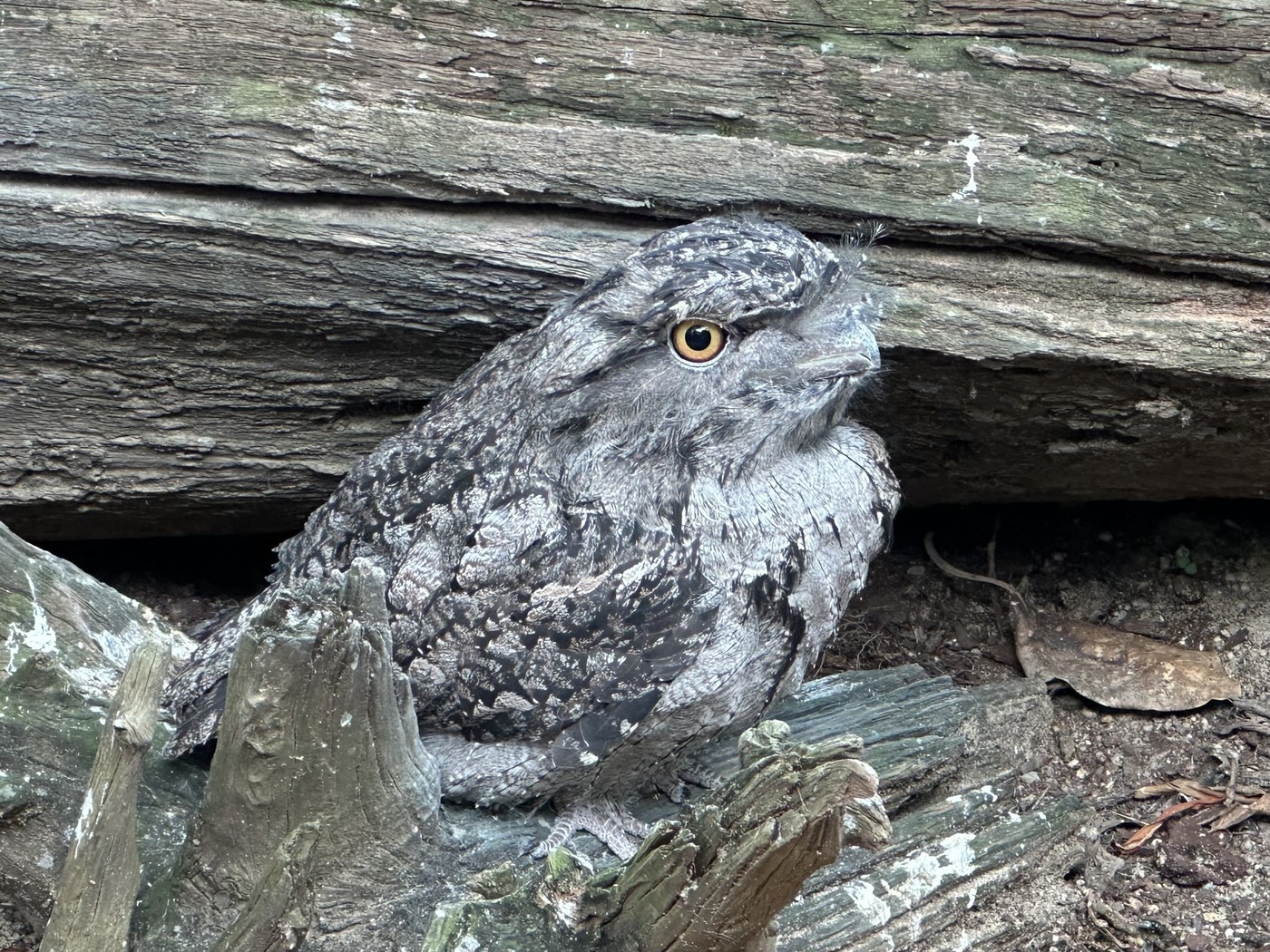
What Tawny Frogmouth's Feathers Look Like
Tawny Frogmouth is an Australian nocturnal bird whose entire plumage is built for one purpose: disappearing against tree bark, and the feathers show an extraordinary level of camouflage detail up close. Body feathers across the back, wings, and breast are a mottled mix of gray, brown, silver, and buff, covered in fine, intricate vermiculated streaking and speckling that closely mimics the texture of lichen-covered bark — this dense, irregular fine-line patterning (rather than clean bars or spots) is one of the most reliable clues that a feather belongs to a frogmouth rather than an owl. Some individuals run more rufous-brown overall, others more silvery-gray, reflecting natural color-morph variation, but all share this same cryptic mottled texture. Around the base of the bill, frogmouths grow stiff, hair-like bristle feathers, longer and coarser than the fine facial bristles found on owls, an adaptation thought to help sense prey or protect the eyes. Flight feathers are barred gray-brown, softer-edged than a typical hawk's for silent flight, similar in this respect to owl feathers, but the overall body feather pattern remains far busier and more finely mottled than the plainer or more boldly barred pattern typical of most owls.
Step-by-Step: Is This Feather From a Tawny Frogmouth?
- Check for fine, bark-like mottling. Dense, irregular gray-brown-silver vermiculation resembling tree bark or lichen, rather than clean spots or bold bars, is the primary clue.
- Assess overall color range. Gray, brown, silvery, or rufous tones are all possible due to natural morph variation, so don't rule out a feather based on color alone if the mottled texture matches.
- Look for coarse bristle feathers. Stiff, hair-like feathers found near where the bill would be, coarser than typical facial bristles, support this species over an owl.
- Feel the feather edge. Softened, comb-like edges on flight feathers (for silent flight) are present but paired with the busier body pattern described above.
- Consider habitat and region. Found in Australian woodland, forest edge, or even suburban trees strongly supports this species, since it is common and widespread across much of the continent.
Similar Species & How to Tell Them Apart
Owls sharing similar habitat (such as Southern Boobook) show a generally less busy, more evenly barred or streaked pattern and a distinct facial disc formed of specialized feathers, which frogmouths lack — frogmouths have a flatter, less disc-shaped face. Papuan Frogmouth and Marbled Frogmouth, close relatives found in parts of Australia and New Guinea, share the same general cryptic bark-mimicking strategy but tend to show somewhat different color balances (more rufous overall in Marbled Frogmouth, for instance) and are geographically more restricted, so range narrows the choice in most cases.
Where & When You'll Find Them
Tawny Frogmouth is widespread across most of Australia, from woodland and forest edge to parks and suburban gardens with mature trees, where it roosts motionless by day pressed against a branch to enhance its bark-like camouflage. Feathers are most likely to be found beneath roost trees or nest sites year-round, since this species is largely non-migratory, with molt occurring gradually and feather turnover most noticeable after the breeding season in spring and early summer when adults have raised and are provisioning young.
Frequently asked questions
How can I tell a Tawny Frogmouth feather from an owl feather?
Look for fine, bark-like mottling and vermiculation rather than clean bars or spots, plus coarser bristle feathers near the bill area — owls tend to show more evenly barred or streaked patterns and a distinct facial disc.
Why do Tawny Frogmouth feathers vary so much in color?
The species has natural color morphs ranging from gray to rufous-brown to silvery, all sharing the same fine, irregular mottled texture that mimics bark regardless of the base color.
What are the stiff bristle feathers near the bill for?
These coarse, hair-like feathers are thought to help the bird sense nearby prey or objects and possibly protect the eyes, and they're noticeably coarser than the fine facial bristles found on many owls.
Where would I find a Tawny Frogmouth feather?
Beneath roost trees or nest sites in Australian woodland, forest edge, parks, or suburban gardens with mature trees, since the species is widespread and largely resident year-round.
Tawny Frogmouth identified by the community
Recent Tawny Frogmouth feathers identified with Feather Identifier.
