
How to Identify Superb Starling Feathers
How to identify the iridescent blue-green feathers and white breast band of the Superb Starling, and separate it from similar East African starlings.
Read the full Superb Starling encyclopedia entry →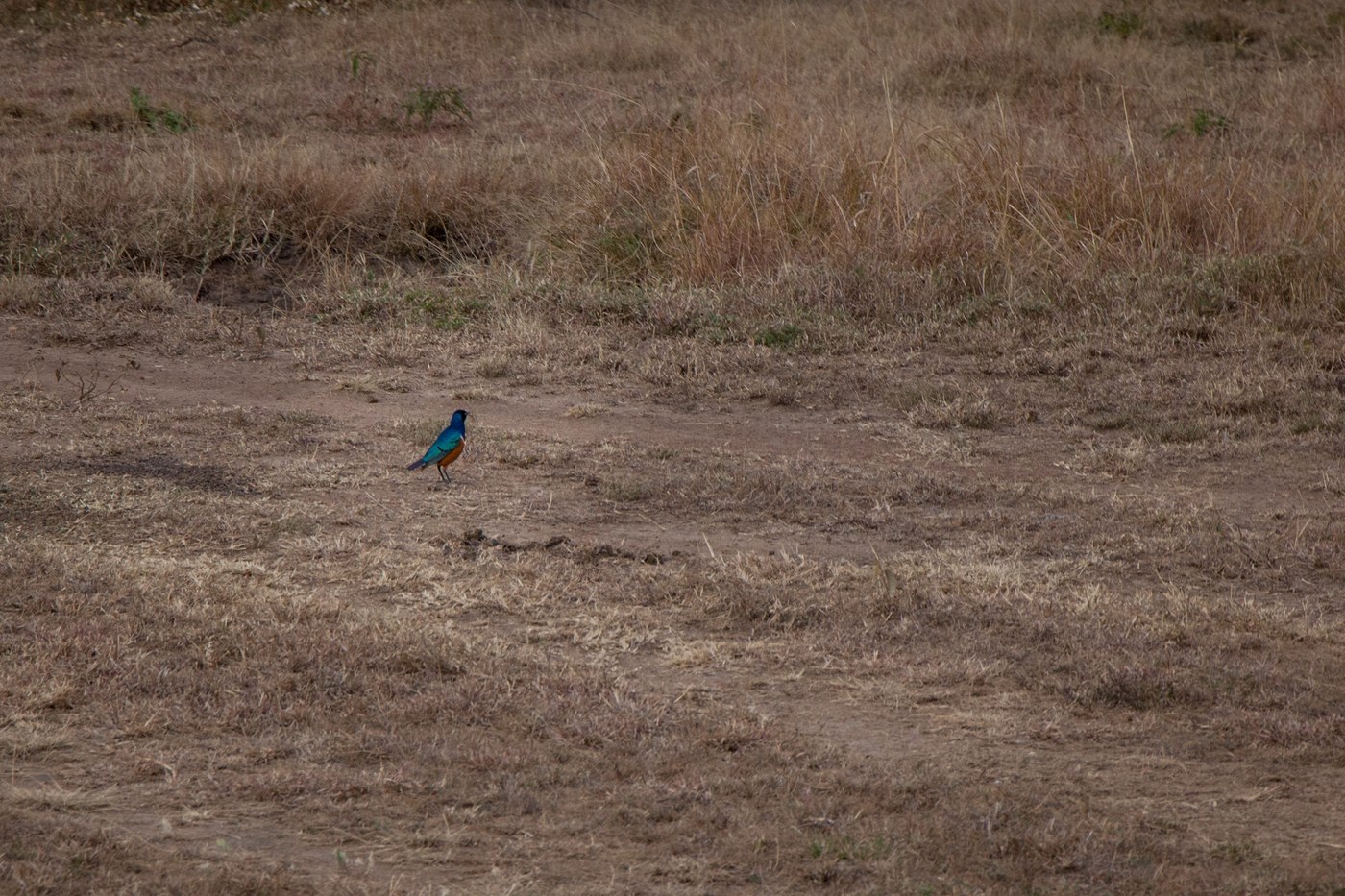
What Superb Starling Feathers Look Like
The Superb Starling is a bold, common bird of East African savanna and campsites, instantly recognizable in life for its glossy colors — and its feathers carry that same striking pattern.
- Head, throat, and mantle feathers: brilliant iridescent blue-green, with a metallic sheen that shifts between blue, green, and purple depending on the light.
- Breast band feathers: a sharply defined band of clean white feathers separating the iridescent chest from the belly — this white band is one of the most useful diagnostic features.
- Belly and undertail feathers: rich chestnut-orange, providing strong contrast against both the iridescent chest above and the white band between them.
- Wing feathers: iridescent blue-green like the mantle, glossy and fairly short, typical of starlings.
- Eye area: pale cream-white iris (not a feather trait, but useful if noted alongside a feather find).
Step-by-Step: Is This Feather From a Superb Starling?
- Check for a white breast-band feather. A crisp white feather positioned between iridescent blue-green chest feathers and chestnut belly feathers is the single best diagnostic clue.
- Confirm iridescence. Genuine metallic blue-green sheen (not flat blue or green) on head/mantle feathers supports the ID.
- Look at belly color. Rich chestnut-orange belly feathers, rather than plain orange or buff, fit this species.
- Rule out similar starlings lacking the white band. If the feather set shows iridescent blue-green transitioning directly into chestnut with no white band, reconsider Hildebrandt's or Rüppell's Starling.
- Factor in habitat. This species is bold and common around savanna, acacia woodland, and safari camps/lodges across East Africa — feathers are often found in exactly these settings.
Similar Species & How to Tell Them Apart
- Hildebrandt's Starling: extremely similar iridescent blue-green-and-chestnut pattern but lacks the white breast band, making this the single best separating feature.
- Rüppell's Starling: also similar in color pattern, but likewise lacks the white band and has a red (not pale cream) eye.
- Glossy Starlings elsewhere in Africa: generally more uniformly iridescent without the sharply contrasting chestnut belly and white band combination seen here.
Where & When You'll Find Them
Superb Starlings are common and highly visible across savanna, acacia woodland, and around human settlements and safari camps in Kenya, Tanzania, Ethiopia, Somalia, and neighboring East African countries. They are non-migratory and often quite bold around campsites and lodges, where dropped feathers are frequently found. Molt generally follows the local breeding season, so feathers turn up most often in the months just after breeding, though the species' year-round presence and boldness around people mean feathers can realistically be found at almost any time.
Frequently asked questions
What is the single best diagnostic feature for this species?
A crisp white breast-band feather positioned between iridescent blue-green chest feathers and chestnut belly feathers.
How do I tell this apart from Hildebrandt's Starling?
Hildebrandt's Starling lacks the white breast band that clearly separates the iridescent chest from the chestnut belly in Superb Starling.
Where are these feathers most commonly found?
Around East African savanna, acacia woodland, and especially safari camps and lodges where the birds are bold and common.
Is there a strict season for finding these feathers?
Feathers appear most often just after the local breeding season, but the species' year-round presence means they can be found at almost any time.
Superb Starling identified by the community
Recent Superb Starling feathers identified with Feather Identifier.
