
How to Identify Stitchbird Feathers
A guide to recognizing the Stitchbird's black-and-olive male plumage and streaky brown female feathers, and telling them apart from New Zealand's other honeyeater-like forest birds.
Read the full Stitchbird encyclopedia entry →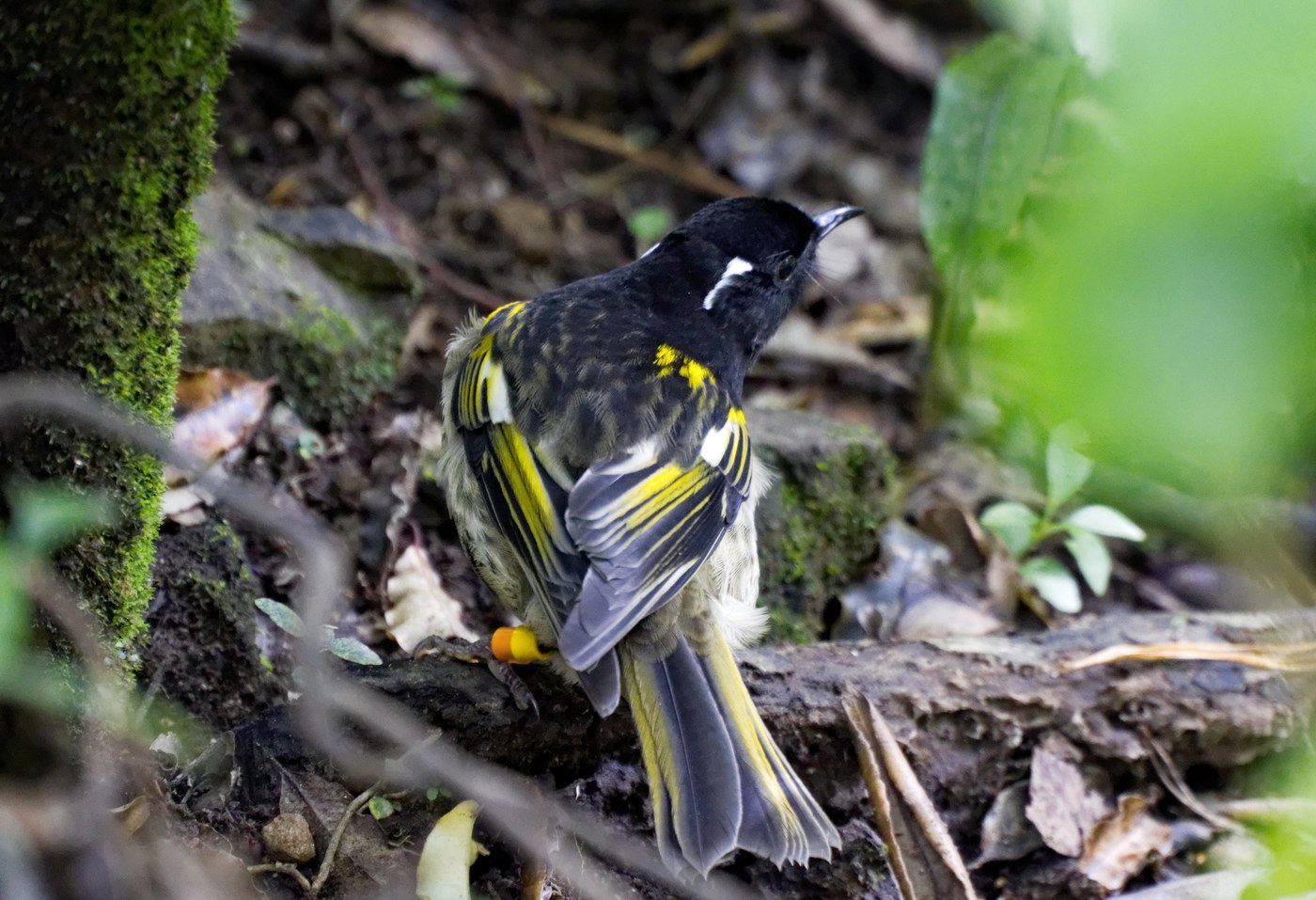
What Stitchbird Feathers Look Like
The Stitchbird (Hihi) is a small New Zealand forest bird, only about 18 cm long, so any feather you find will be modest in size — nothing over a few centimetres. The two sexes look so different that a single feather can point to either bird depending on color.
- Male body feathers: velvety black on the head, throat, and upper breast, giving way to olive-yellow on the back and a pale yellow band across the upper breast/nape.
- Male wing feathers: dark olive-brown with a bold white wing patch — this white patch is one of the most reliable single-feather clues to a male Stitchbird.
- Female/juvenile feathers: plain grey-brown, with two thin white wing bars and no black or yellow at all — much duller and easy to overlook.
- Tail feathers: short, dark, and rounded at the tip, not deeply notched or forked.
- Shaft color: pale on the underside, darker on top, consistent with a small forest passerine.
Step-by-Step: Is This Feather From a Stitchbird?
- Measure it. Body contour feathers should be under 4 cm; primary flight feathers rarely exceed 6-7 cm. Anything larger is not a Stitchbird.
- Check for black. A jet-black feather with an olive or yellow tinge at the base strongly suggests a male's head or throat.
- Look for the white wing patch. A small blackish or olive wing feather with a clean white block near the tip is highly diagnostic of the male.
- If it's plain grey-brown, look closely for a faint white wing bar — this points to a female or juvenile rather than another drab bush bird.
- Consider location. Stitchbirds now survive almost entirely on protected islands and fenced mainland sanctuaries (Tiritiri Matangi, Kapiti Island, Zealandia, and similar reintroduction sites). A feather found outside these areas is far more likely to belong to a look-alike species.
Similar Species & How to Tell Them Apart
- Bellbird: similar size but overall olive-green with no black head or white wing patch; lacks the male Stitchbird's sharp black-and-yellow contrast.
- Tui: much larger, glossy black-green with a white throat tuft — the white is a tuft of curled feathers at the throat, not a wing patch, and Tui feathers are noticeably bigger and more iridescent.
- Whitehead: pale creamy-white overall with no black or yellow, easily separated from a male Stitchbird but can resemble a very worn female.
Where & When You'll Find Them
Stitchbirds are confined to predator-free New Zealand islands and sanctuaries, nesting in tree cavities during the spring-summer breeding season. Most feathers turn up on the ground beneath nest trees or roost sites after the post-breeding molt in December to February (New Zealand summer), when adults replace worn flight and body feathers before winter.
Frequently asked questions
How can I tell a male from a female Stitchbird feather?
Male feathers show black on the head/throat with an olive-yellow back and a white wing patch, while female feathers are uniformly grey-brown with faint white wing bars and no black or yellow at all.
Could a Stitchbird feather turn up outside New Zealand?
No — Stitchbirds are endemic to New Zealand and now survive only on a handful of protected islands and fenced sanctuaries, so any genuine feather will be found in those specific locations.
What's the easiest single clue to check first?
Look for the male's white wing patch on an otherwise dark olive-brown wing feather; it's the fastest way to confirm a Stitchbird over similar-sized forest birds.
Why might a Stitchbird feather look worn or faded?
Feathers found after the December-February molt period are often worn from a full breeding season of activity, which can dull the black and yellow tones on males.