
How to Identify Sparkling Violetear Feathers
How to recognize a Sparkling Violetear's iridescent green body feathers with violet-blue ear and chest patches, and separate them from Green Violetear and Andean emeralds.
Read the full Sparkling Violetear encyclopedia entry →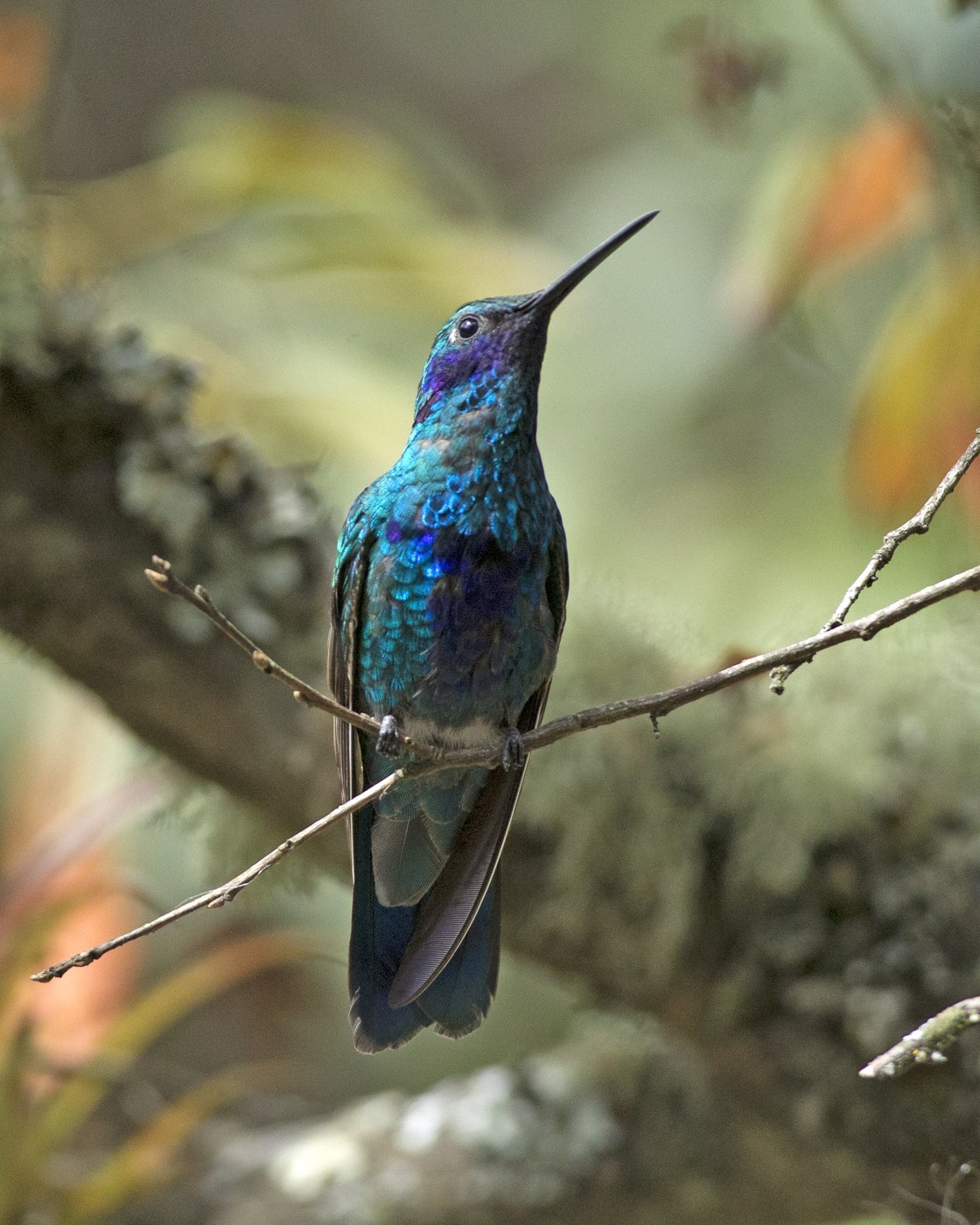
What Sparkling Violetear Feathers Look Like
The Sparkling Violetear is a common, vocal Andean hummingbird whose feathers rely heavily on structural iridescence, meaning their exact color shifts dramatically depending on the angle of light.
- Body feathers: Overall iridescent green, appearing anywhere from bright emerald to duller olive depending on the light angle — a hallmark of hummingbird structural color.
- Ear patch feathers: An elongated patch of violet-blue iridescent feathers extends from behind the eye, one of the species' most distinctive features — if you find tiny, intensely blue-violet feathers with a metallic sheen, they likely came from this "ear" region.
- Chest patch feathers: A separate, smaller patch of violet-blue iridescent feathers sits on the center of the chest, distinct from the surrounding green.
- Tail feathers: Green with a dark, blackish subterminal band near the tip, moderately forked.
- Feather size: Very small, typically under 2–3 cm even for the larger body feathers, consistent with the bird's medium-large hummingbird size (still tiny compared to non-hummingbird species).
Step-by-Step: Is This Feather From a Sparkling Violetear?
- Check for iridescence. Tilt the feather — genuine color-shifting shimmer (green shifting toward gold or blue) confirms a hummingbird origin.
- Look for violet-blue patches. Distinctly blue-violet iridescent feathers (as opposed to uniform green) suggest the ear or chest patch region specific to violetears.
- Inspect the tail. A green tail feather with a dark subterminal band and moderate fork fits this species.
- Measure it. Everything is tiny — feathers over 3 cm are unlikely to be from this or most other hummingbirds.
- Weigh the location. Found in Andean forest edge, gardens, or scrub from Venezuela to Bolivia/Argentina, the green-with-violet-patches combination strongly supports Sparkling Violetear over other regional hummingbirds.
Similar Species & How to Tell Them Apart
- Green Violetear (Lesser Violetear): Similar iridescent green base color and violet ear patch, but the chest patch is smaller or less developed, and the species is generally found at different (often lower or more northerly) elevations with limited range overlap.
- Brown Violetear: Overall brown rather than green body feathers, with a duller, less prominent violet ear patch — easily distinguished by the base body color alone.
- Andean emeralds and other green hummingbirds: Show iridescent green plumage but lack the distinct violet-blue ear and chest patches entirely, appearing uniformly green/gold without the violetear's specific two-patch pattern.
- Fawn-breasted Brilliant or other Andean hummingbirds: Larger overall with different underpart coloring (buffy/fawn rather than green) and no violet ear patch.
Where & When You'll Find Them
Sparkling Violetears are widespread across the Andes from Venezuela and Colombia south to Bolivia and northern Argentina, favoring forest edges, scrubland, and gardens at mid-to-high elevations, and are notably vocal and territorial around flowering shrubs. Because hummingbirds molt gradually and continuously rather than in one concentrated period, tiny feathers can be found near favored feeding territories (flowering bushes, feeders) at any time of year, though slightly more feathers may turn up during the breeding season when territorial chases and close physical contests between rival males are most frequent.
Frequently asked questions
Why does a Sparkling Violetear feather look different colors in different photos?
Its green and violet-blue coloring comes from structural iridescence, meaning the exact color you see shifts depending on the angle of light hitting the feather, not from fixed pigment.
What is the 'ear patch' feature people mention for this species?
It's an elongated patch of violet-blue iridescent feathers extending back from behind the eye, one of the species' most distinctive and named features.
How do I tell Sparkling Violetear from Green Violetear by feather?
Sparkling Violetear generally shows a more developed violet-blue chest patch in addition to the ear patch, while Green Violetear's chest patch is smaller or less pronounced; elevation and range also help separate the two.
Are hummingbird feathers hard to find because of their size?
Yes, most are only 1–3 cm long, so they're easy to overlook — check closely around flowering shrubs and hummingbird feeders where the birds spend the most time.