
How to Identify Southern Carmine Bee-eater Feathers
How to recognize a Southern Carmine Bee-eater's vivid pink-red body feathers, turquoise throat, and elongated blue-black tail streamers, and separate them from Northern Carmine and European Bee-eaters.
Read the full Southern Carmine Bee-eater encyclopedia entry →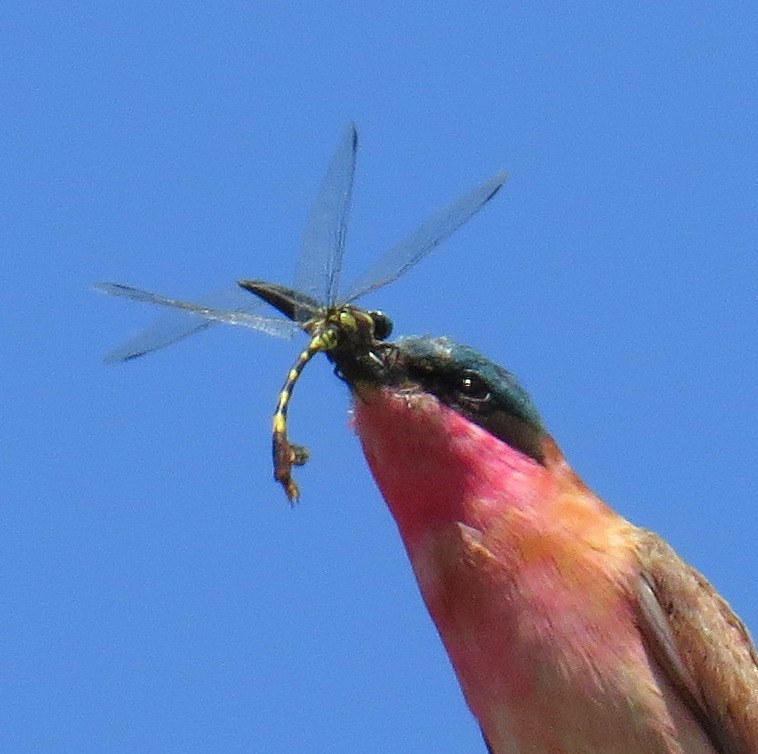
What Southern Carmine Bee-eater Feathers Look Like
Few feathers are as unmistakable as those of the Southern Carmine Bee-eater, a slender African bird whose plumage looks almost painted on. The body is a vivid carmine-pink to rose-red, while the throat and undertail area glow a contrasting turquoise-blue — a color pairing found in very few other birds anywhere.
- Body/contour feathers: Soft, silky-textured, saturated pink-red on the back, breast, and belly, with a sharply contrasting turquoise throat patch and turquoise-blue rump/undertail coverts.
- Flight feathers: Pointed and elongated like most bee-eaters, carmine-pink at the base shading to blackish tips, giving a two-toned look along the trailing edge of the wing.
- Tail: Central tail feathers are dramatically elongated into thin, wire-like blue-black streamers that extend well past the rest of the tail — if you find a long, narrow, dark blue-black feather with almost no vane near the tip, it's likely one of these central streamers.
- Head: A black mask feather line runs through the eye, with a greenish-blue crown crest.
Step-by-Step: Is This Feather From a Southern Carmine Bee-eater?
- Check for the pink-turquoise combination. Carmine-red body feathers paired with any turquoise-blue feathers (throat, rump, undertail) is the single most diagnostic sign — very few birds share this exact palette.
- Look at the tail shape. Elongated, narrow, blue-black central streamers with reduced vane near the tip point to a breeding-plumage adult.
- Inspect flight feather tips. Carmine at the base fading to blackish at the tip is typical of this species' primaries and secondaries.
- Measure it. Body feathers are modest (4–7 cm), but the tail streamers can add several extra centimeters of thin, nearly bare shaft.
- Weigh the location. Found in open savanna or riverine habitat in southern Africa, the pink-and-turquoise combination all but confirms the species over other regional bee-eaters.
Similar Species & How to Tell Them Apart
- Northern Carmine Bee-eater: Extremely similar carmine-pink body, but its throat is more greenish-blue rather than pure turquoise, and its crown is more blue overall; ranges mostly separate the two, with Northern Carmine found further north across the Sahel and Southern Carmine in southern Africa (a narrow overlap zone exists in East Africa).
- European Bee-eater: Shows a yellow throat, chestnut crown and back, and olive-green underparts — no carmine-red or turquoise at all, making confusion unlikely once you know the palette.
- White-fronted Bee-eater: Much smaller and duller, with a white forehead and red throat patch rather than an all-pink body.
- Rosy-patched Bushshrike or other pink-toned birds: Lack the turquoise throat/rump contrast and the elongated tail streamers unique to bee-eaters.
Where & When You'll Find Them
Southern Carmine Bee-eaters breed colonially in large numbers, excavating burrows in sandy riverbanks across southern Africa, and are famous for hawking insects flushed by grazing animals and even wildfires. Feathers are most likely to be found near these riverbank breeding colonies during the austral spring and summer breeding season, when molt and close nesting activity shed both body feathers and the fragile, easily broken tail streamers, as well as along open savanna flight paths where the birds forage in loose flocks.
Frequently asked questions
What is the most reliable field mark for a Southern Carmine Bee-eater feather?
The combination of vivid carmine-pink body feathers with contrasting turquoise-blue throat or rump feathers is essentially unique among African birds.
How do I tell Southern Carmine from Northern Carmine Bee-eater feathers?
Southern Carmine has a purer turquoise throat while Northern Carmine's throat leans more greenish-blue; geography (southern Africa vs. the Sahel, with a narrow overlap in East Africa) is the more reliable separator.
Why do some feathers look like thin blue-black wires with barely any vane?
Those are the elongated central tail streamers unique to breeding-plumage adults, which have reduced vane near the tip and a thin, wiry appearance.
Could a European Bee-eater feather be mistaken for this species?
No — European Bee-eater shows a yellow throat with chestnut and olive tones and no carmine-red or turquoise coloring, so the palettes don't overlap.