
How to Identify Southern Boobook Feathers
How to recognize a Southern Boobook's small, soft, mottled brown owl feathers with silent-flight fringing, and separate them from Barn Owl and Barking Owl feathers.
Read the full Southern Boobook encyclopedia entry →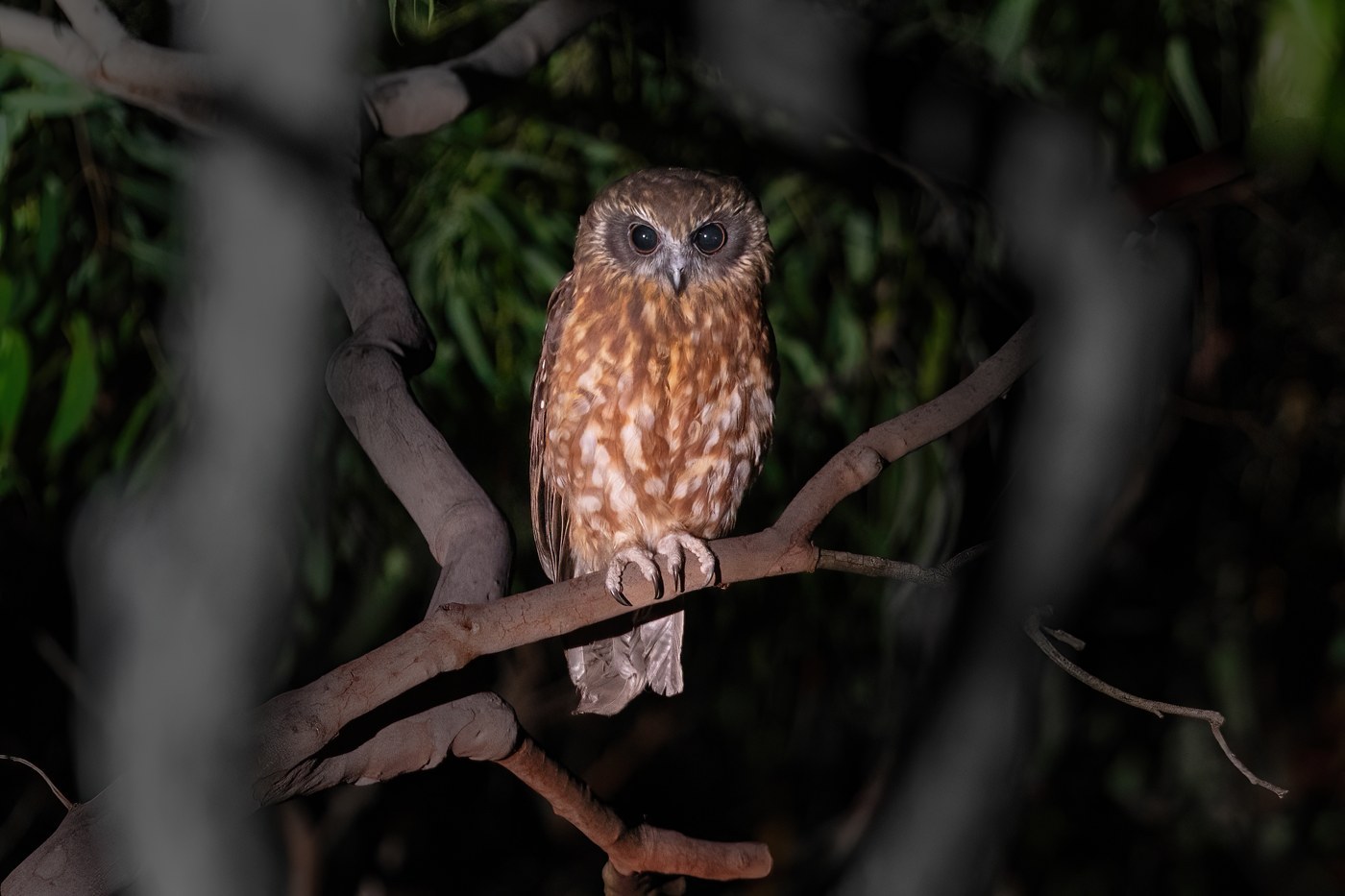
What Southern Boobook Feathers Look Like
The Southern Boobook is Australia's smallest and most common owl, and its feathers show the classic soft, sound-dampening structure of nocturnal owls scaled to a compact body. Overall coloring is a rich chocolate to olive-brown, densely marked with cream to white spotting on the wings, back, and crown.
- Flight feathers (primaries): relatively short and rounded for an owl this size, dark brown barred with paler brown or buff bands. The leading edge of the outermost primary has a soft, comb-like fringe (serrated barbs) that breaks up air turbulence for silent flight — run a finger along the edge and you'll feel a soft, velvety fray rather than a crisp edge.
- Tail feathers: brown with 4–6 evenly spaced pale bars, moderate length, rounded tip.
- Body/contour feathers: notably soft and downy-based, brown with bold, rounded cream spots — larger and more distinct on the scapulars and wing coverts than on the belly, where markings become finer streaking.
- Facial disc feathers: small, fine-barbed, brown, forming a subtle disc rather than the sharp heart shape of a Barn Owl.
Step-by-Step: Is This Feather From a Southern Boobook?
- Measure it. Southern Boobook primaries run about 12–16 cm — modest compared to larger owls, consistent with a bird only slightly bigger than a large thrush.
- Check for the silent-flight fringe. Owl flight feathers have velvety, comb-toothed leading edges; if your feather has a crisp, hard edge, it's not an owl at all.
- Look at barring vs. spotting. Flight and tail feathers should show even pale barring on brown, while body feathers show bold rounded spots rather than fine streaks.
- Feel the texture. Owl feathers are unusually soft and fluffy compared to similarly sized diurnal birds — Southern Boobook down is especially plush given its small size.
- Match the overall tone. A warm chocolate-brown base with buff-cream spotting, not gray, gold, or pure white, points to this species over most owl look-alikes in the region.
Similar Species & How to Tell Them Apart
- Barn Owl: Much paler overall, with golden-buff and gray upperparts finely peppered with tiny dark specks and a whitish, heart-shaped facial disc — Barn Owl feathers look "frosted" rather than boldly spotted.
- Barking Owl: Larger flight feathers, grayer-brown ground color, and bold vertical streaking on the underparts rather than the Boobook's rounder spots.
- Australian Masked Owl: Considerably larger feathers with a rufous-chestnut facial disc tone and finer, more scattered dark speckling rather than bold cream spots.
- Powerful Owl: Much bigger, heavier flight feathers with fine gray-brown barring throughout and no bold cream spotting.
Where & When You'll Find Them
Southern Boobooks are widespread across Australia (and as the closely related Morepork in New Zealand), occupying woodlands, forest edges, and even suburban parks and gardens. Because they roost by day in dense foliage or tree hollows and molt gradually, dropped feathers are most often found beneath regular daytime roost trees or near nest hollows during the late-winter to spring breeding season, when increased activity around the nest sheds more body and flight feathers than at other times of year.
Frequently asked questions
How do I know a feather is from an owl at all before narrowing it to Southern Boobook?
Check the leading edge of a flight feather for a soft, comb-like fringe rather than a crisp edge — this silent-flight adaptation is unique to owls among common backyard birds.
What color pattern separates Southern Boobook from Barn Owl feathers?
Southern Boobook shows warm chocolate-brown with bold, rounded cream spots, while Barn Owl is much paler golden-buff and gray with fine peppered speckling and a whitish facial disc.
Are Southern Boobook feathers unusually soft?
Yes, like all owls they have plush, downy-based feathers for silent flight, noticeably softer than similarly sized daytime birds such as thrushes or doves.
When are Southern Boobook feathers most likely to be found?
Beneath daytime roost trees year-round, with an uptick near nest hollows during the late-winter to spring breeding season when adults and growing owlets shed more feathers.