
How to Identify Satin Bowerbird Feathers
A guide to the glossy blue-black feathers of male Satin Bowerbirds and the scalloped olive-green feathers of females and young, plus how to rule out other Australian look-alikes.
Read the full Satin Bowerbird encyclopedia entry →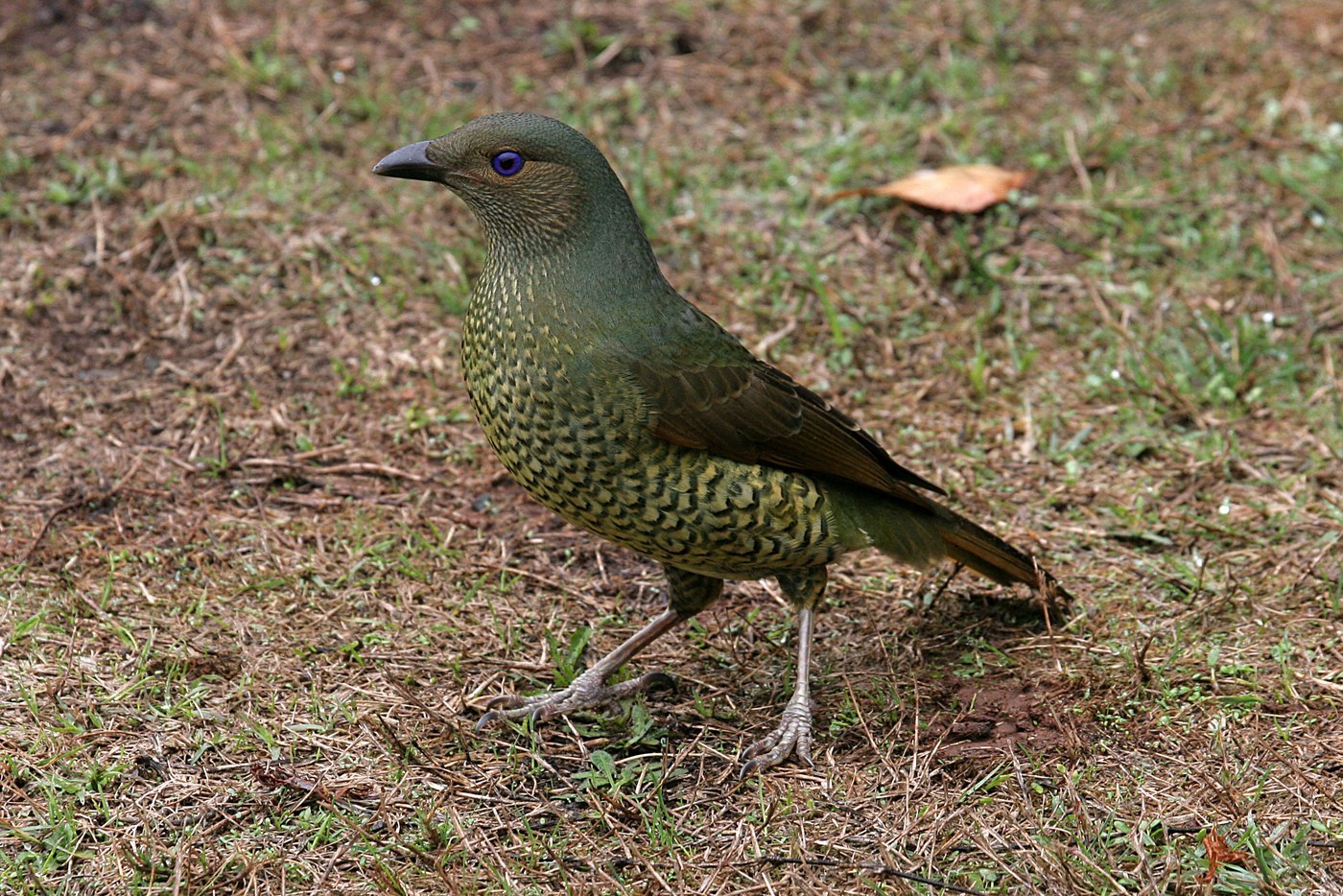
What Satin Bowerbird's Feathers Look Like
Satin Bowerbird shows one of the most dramatic sex differences in feather appearance of any common backyard bird, so identification starts with figuring out which plumage type you have. Adult male feathers — body, wing, and tail alike — are a deep, glossy blue-black with a distinctive satin sheen, shifting between blue and purple highlights depending on the angle of light, and lacking any streaking or spotting. Female and immature male feathers look entirely different: a soft olive-green above and pale buffy-yellow below, with bold dark scalloping or scaling across the breast and belly feathers, giving a distinctly patterned, almost fish-scale look under close inspection. Both sexes have a pale, somewhat ivory to lilac-tinted iris, though this isn't visible in feathers themselves. Feathers are moderately large and rounded, consistent with a robust, crow-sized songbird, generally 8-15 cm for wing feathers and 4-8 cm for body feathers.
Step-by-Step: Is This Feather From a Satin Bowerbird?
- Check for glossy blue-black sheen: if the feather shifts blue-to-purple in different light with no other markings, it's very likely an adult male.
- Look for olive-green with scalloped underparts: a feather showing dark crescent-shaped scaling on a pale buff-yellow background suggests a female or young male.
- Assess size: expect a medium-large songbird feather, notably bigger than a typical sparrow's.
- Rule out plain black without gloss: truly matte black feathers (no blue/purple shimmer) suggest a different species like a currawong or crow.
- Consider structure: body feathers should be dense and slightly stiff, in keeping with a bird that handles and arranges bower decorations.
- Check habitat: found in or near wet eucalypt forest or rainforest edge in eastern Australia, often near a cleared patch of ground (a male's bower).
Similar Species & How to Tell Them Apart
Male Satin Bowerbird can be confused with Australian Raven or currawongs, but those species lack the true iridescent blue-black satin sheen and are larger with heavier, coarser feathers; a genuine color-shifting blue-purple gloss is unique to the bowerbird among likely garden/forest black birds in its range. Female/immature Satin Bowerbird's scalloped olive-green pattern is similar to some female figbirds or orioles, but those species show finer, less bold scalloping and a different underlying color tone (more yellow-green than olive); the crisp, bold crescent scaling on Satin Bowerbird's underside is more strongly demarcated. Regent Bowerbird, which can share habitat, has a completely different pattern (males show bold black-and-gold), so any feather with a bright yellow patch points to that species instead.
Where & When You'll Find Them
Satin Bowerbird lives in wet forests and rainforest margins along the eastern coast of Australia, from far north Queensland down through New South Wales and Victoria, and is a regular visitor to gardens and forest-edge feeders in that range. Because males construct and maintain elaborate bowers decorated with blue objects, feathers (especially their own molted blue-black body feathers) are often found scattered around and inside an active bower site, which is typically a cleared patch of ground with two parallel walls of woven sticks. Molt in this species generally follows the breeding season, so late summer into autumn (roughly January through April in the Southern Hemisphere) tends to produce the most fresh feathers, while young birds retain their scalloped female-like plumage for several years before molting into full adult male color.
Frequently asked questions
Why do some Satin Bowerbird feathers look olive-green and scalloped instead of black?
Females and immature males (which can take several years to mature) wear an olive-green, scalloped plumage entirely different from the glossy blue-black of adult males.
How do I know a black feather is really iridescent and not just plain black?
Tilt it under different light — genuine Satin Bowerbird male feathers shift between blue and purple highlights, while plain black feathers from crows or currawongs show no such color shift.
Are bower sites a good place to look for feathers?
Yes, males decorate and maintain bowers on cleared ground, and their own molted body feathers often collect in and around the structure.
What time of year is molt most active?
Roughly January through April in the Southern Hemisphere, following the breeding season.
How long does it take males to get their black adult feathers?
Several years — young males resemble females with olive-green, scalloped plumage before gradually molting into full glossy blue-black.