
How to Identify Rufous-tailed Hummingbird Feathers
How to use the broad, chestnut-red tail feathers and bronze-green body feathers to confirm a Rufous-tailed Hummingbird feather.
Read the full Rufous-tailed Hummingbird encyclopedia entry →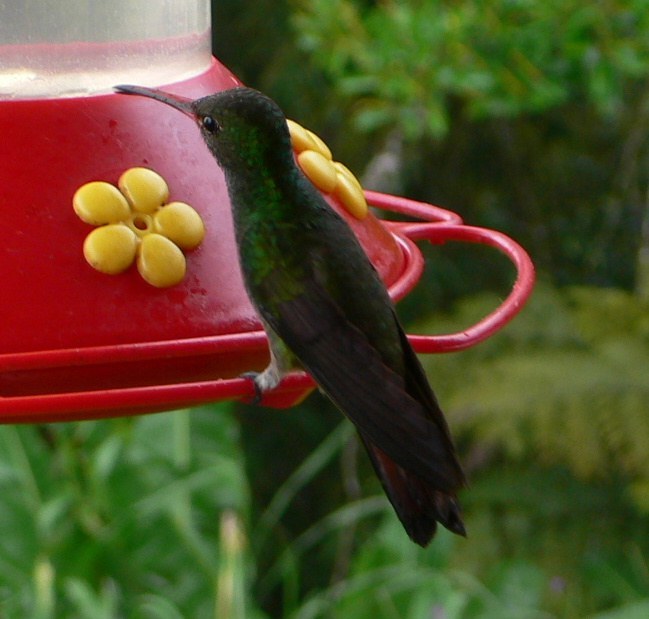
What Rufous-tailed Hummingbird Feathers Look Like
The Rufous-tailed Hummingbird is one of the most common hummingbirds of Central America and northern South America, easily told by its tail even among many other iridescent species. Its tail feathers are broad, rufous-chestnut, and conspicuously non-iridescent, standing out as a warm reddish-brown fan quite different from the sharply metallic body plumage — this is the single most useful feather for identification. Body contour feathers are iridescent bronze-green above, becoming grayer on the underparts, with a slightly duller, grayish-white throat and breast compared to more brilliantly colored hummingbirds. Wing (flight) feathers are dark, narrow, and stiff as in all hummingbirds, blackish-brown with little iridescence, typically 3–4 cm long. As with all hummingbirds, feathers are tiny overall — body feathers just a few millimeters, the longest tail feathers reaching perhaps 3 cm.
Step-by-Step: Is This Feather From a Rufous-tailed Hummingbird?
- Check for rufous-red, non-iridescent tail feathers — this is the most distinctive and easiest clue for this species.
- Confirm small size. Anything over about 4 cm is too large.
- Look at body feather color. Iridescent bronze-green above and pale grayish below fits.
- Test for iridescence. Tail feathers should look flat rufous from any angle, while back feathers shimmer green depending on the light.
- Feel the shaft stiffness. Hummingbird feathers are unusually rigid and narrow-webbed for their size.
- Weigh location. Feathers near gardens, forest edges, or flowering shrubs in Middle America or northwestern South America support this ID.
Similar Species & How to Tell Them Apart
Several related Amazilia-type hummingbirds share a bronze-green back, but few combine it with such a strongly rufous, non-iridescent tail. The Buff-bellied Hummingbird, found further north into Texas and Mexico, has a duller, less extensively rufous tail and a buffier belly. The Cinnamon Hummingbird shows cinnamon coloring across the whole underside, not just the tail, making its body feathers warmer overall than the grayer-breasted Rufous-tailed. Rufous Hummingbird, despite the similar name, is a very different bird — mostly orange-rufous over the entire body in males, not just the tail, and found much further north and west.
Where & When You'll Find Them
Rufous-tailed Hummingbirds are non-migratory tropical residents found from Mexico through Central America into Colombia, Ecuador, and Venezuela, inhabiting forest edges, gardens, plantations, and second growth at low-to-mid elevations. Because they live in a stable tropical climate, breeding and molting happen with less sharp seasonality than in temperate hummingbirds, so feathers can turn up in any month, though slightly more feathers tend to appear following the local rainy-season breeding peak, which varies by region.
This is one of the most frequently encountered hummingbirds across its range, aggressively defending flowering shrubs and feeders against other hummingbirds, so shed feathers often turn up directly beneath favored feeding perches or nearby fence lines and low branches used as lookout posts. Checking around known feeder territories or flowering hedgerows in gardens and forest-edge clearings is typically more productive than searching deep forest interior, since this species strongly favors semi-open, disturbed habitat over closed-canopy forest.
Frequently asked questions
What is the single best clue for this species?
Broad, rufous-chestnut tail feathers that appear flat and non-iridescent, unlike the shimmering bronze-green body feathers.
How does its tail differ from the Rufous Hummingbird's?
Rufous-tailed Hummingbird has rufous confined mainly to the tail with a bronze-green body, while Rufous Hummingbird males are orange-rufous over most of the entire body.
Are the body feathers iridescent?
Yes, the back and crown feathers are iridescent bronze-green, while the tail feathers are a flat, non-shimmering rufous-red.
Could this be confused with a Cinnamon Hummingbird feather?
Cinnamon Hummingbird has cinnamon coloring across its whole underside, whereas Rufous-tailed has a grayer breast with rufous limited mostly to the tail.
When are feathers most likely to appear?
Year-round given the tropical climate, with a slight increase following the local rainy-season breeding peak.