
How to Identify Rifleman Feathers
A guide to the tiny, greenish feathers of the Rifleman, New Zealand's smallest bird, distinguished by its minute size and almost tail-less body.
Read the full Rifleman encyclopedia entry →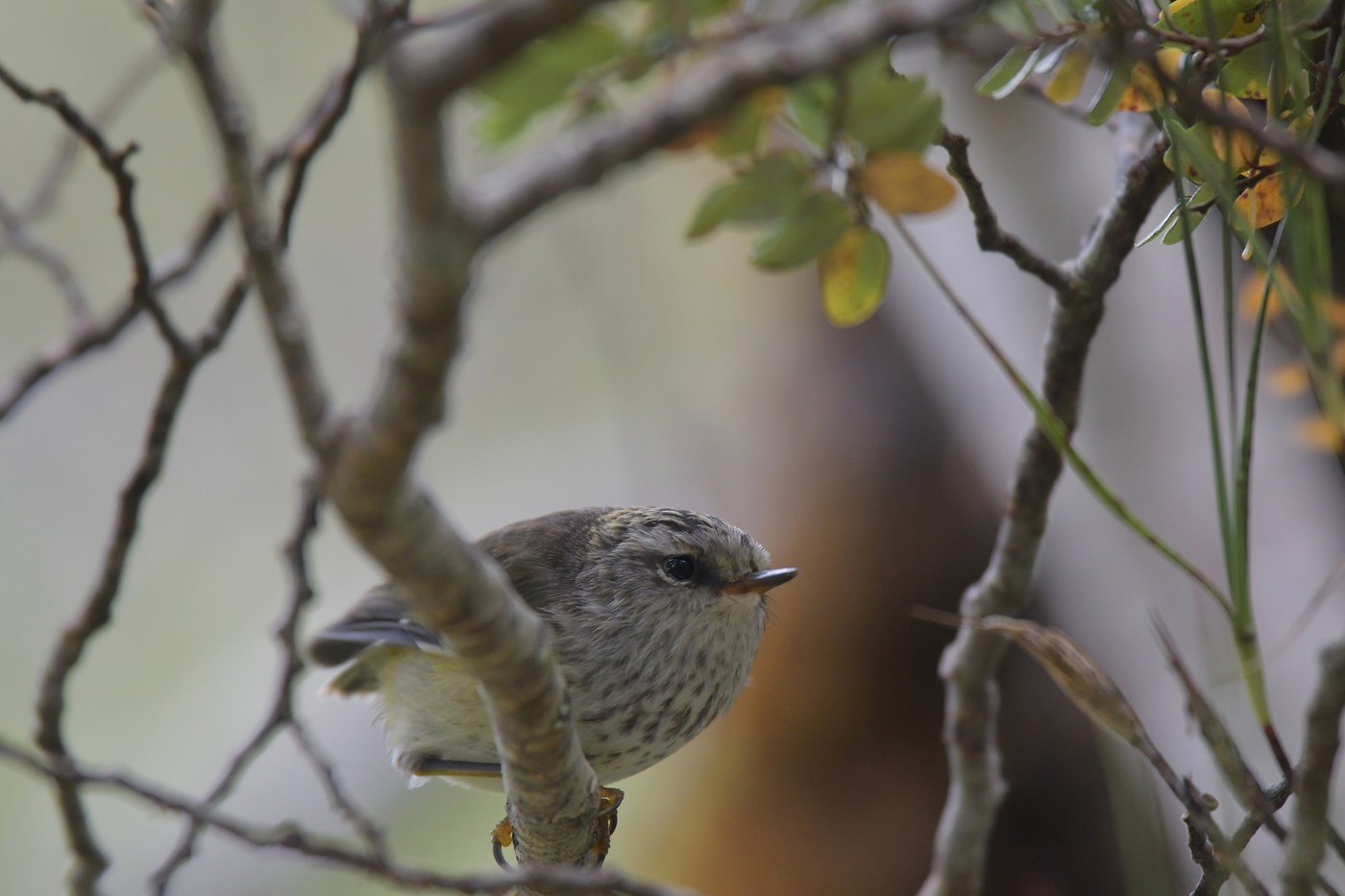
What Rifleman Feathers Look Like
The Rifleman (Acanthisitta chloris) is New Zealand's smallest bird, and its feathers are correspondingly tiny — often overlooked entirely because of their small scale.
- Upperparts (males): bright moss-green to yellowish-green, small and soft, giving a mossy, well-camouflaged look among native forest bark and lichen.
- Upperparts (females): streaked brown and buff rather than green, providing better camouflage on the ground and tree trunks where females forage more.
- Underparts: whitish to pale buff, often with a faint yellowish wash, and noticeably softer and less structured than the back feathers.
- Wing feathers: tiny, rounded, with a soft edge rather than a stiff, aerodynamic one — reflecting the bird's weak, whirring flight style used mostly for short hops between trunks.
- Tail feathers: extremely reduced — the Rifleman's tail is famously stubby, so any "tail feather" you find will be unusually short and stiff relative to body size, unlike almost any other songbird.
- Overall size: among the smallest feathers you could find from any songbird, typically under 3–4 cm even for the largest flight feathers, since adult birds weigh only about 6 grams.
Step-by-Step: Is This Feather From a Rifleman?
- Check the scale first. If a feather is under about 4 cm and clearly from a very small bird, Rifleman becomes a real possibility in New Zealand native forest.
- Note the color pattern. Mossy green upperparts (male) or streaky brown (female) with pale, whitish underparts fits the species; bright or strongly patterned colors do not.
- Assess the tail feathers specifically. An unusually stubby, short tail feather relative to the tiny body size is a strong Rifleman signature, since few other birds have such a reduced tail.
- Feel the texture. Soft, fine-barbed feathers consistent with a bird that forages by creeping over bark rather than flying long distances.
- Consider the habitat context. A tiny green or brown-streaked feather found on a native forest tree trunk in New Zealand, especially beech or podocarp forest, supports a Rifleman identification.
Similar Species & How to Tell Them Apart
- Rock Wren (New Zealand's other tiny native, a close relative): larger and browner overall, found in alpine rock habitat rather than forest, with a slightly less green tone.
- Grey Warbler: similarly small and found in the same forests, but overall grey-brown rather than moss-green, with a longer, more visible tail.
- Silvereye: green-tinged like the male Rifleman but noticeably larger, with a distinctive white eye-ring area (not visible on feathers alone, but body feather size is a useful differentiator).
- Fantail: shares the forest habitat but has a dramatically long, fanned tail — the opposite of the Rifleman's near-absent tail, making tail feathers easy to rule in or out.
Where & When You'll Find Them
Riflemen live in native forest throughout both main islands of New Zealand, favoring beech and podocarp forest where they forage by creeping up tree trunks and along branches gleaning insects, rarely descending to the ground. Feathers are most likely to be found on forest floor litter beneath foraging trees, with molt occurring after the breeding season, roughly from January through March (New Zealand's late summer to early autumn) once fledglings are independent.
Frequently asked questions
How small should a Rifleman feather actually be?
Very small — the bird itself weighs about as much as two teaspoons of sugar, so even the largest flight feathers rarely exceed 4 cm, smaller than most backyard songbird feathers.
Why is the tail feather so short?
Riflemen have an unusually reduced tail as part of their bark-creeping lifestyle, so a genuine tail feather will look stubby and small compared to the rest of the plumage, unlike almost any other perching bird.
Do males and females have different colored feathers?
Yes — males show a mossy green back while females are streaked brown, so both color patterns are normal for this one species rather than indicating two different birds.
Would I find this feather outside New Zealand?
No, the Rifleman is endemic to New Zealand and doesn't occur naturally anywhere else, so a tiny green or streaked-brown feather found outside New Zealand forest is not this species.