
How to Identify Reed Bunting Feathers
A guide to identifying Reed Bunting feathers by the male's black head-and-throat pattern with white collar, versus the streaky female, plus diagnostic white outer tail feathers.
Read the full Reed Bunting encyclopedia entry →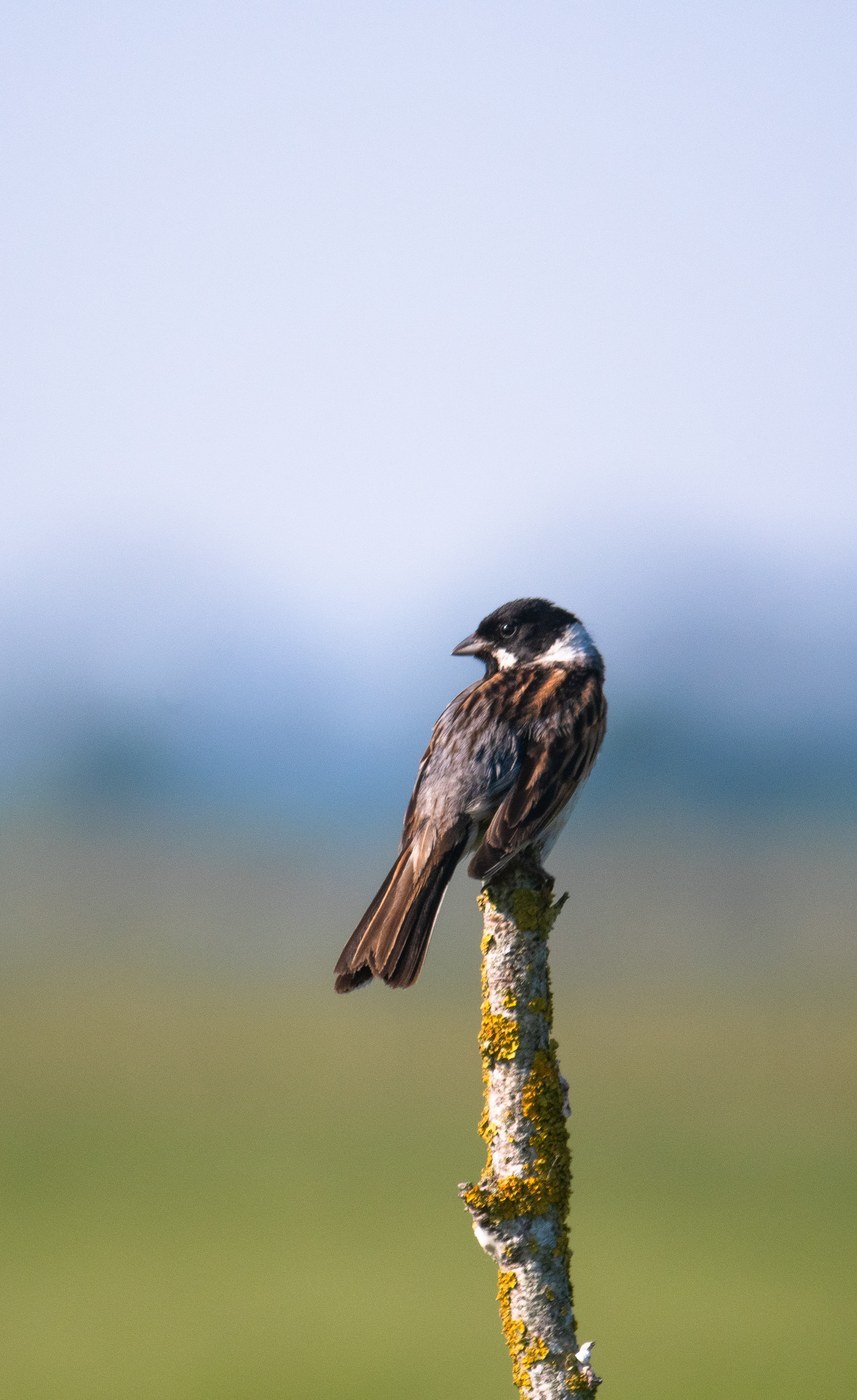
What Reed Bunting's Feathers Look Like
The Reed Bunting is a small European and Asian bunting closely tied to wetland edges, and its feathers show a strong seasonal and sexual pattern worth understanding. Breeding male head and throat feathers are solid black, forming a bold hood, set off by a white submoustachial (malar) stripe running down from the base of the bill and a white half-collar patch on the nape — this combination of black hood with white face-stripe and collar is highly distinctive among small streaky-plumaged birds. Back feathers are streaked rufous-brown and black, giving a more typical sparrow-like patterning below the bold head.
One of the most useful diagnostic clues doesn't require distinguishing sex or season at all: outer tail feathers show white edges/patches, visible as flashes of white in flight and around the tail when the bird flicks it — a feather from the outer tail position with a white portion is a strong clue for this species. Females and non-breeding (winter) males lack the bold black hood, instead showing streaky buffy-brown body feathers overall with dark crown stripes and a pale supercilium (eyebrow stripe), and a fainter malar stripe than breeding males.
Step-by-Step: Is This Feather From a Reed Bunting?
- Check for a black hood feather with white markings. A solid black feather from the head/throat area, especially if found alongside a white feather with a stripe-like shape (from the malar or collar area), strongly suggests a breeding male.
- Look for white in the outer tail. A dark tail feather with a distinct white edge or patch, especially from an outer tail position, is a reliable clue regardless of sex or season.
- Examine streaking on body feathers. Buffy-brown feathers with dark streaking and rufous tones support female or non-breeding male identification.
- Check for a pale supercilium feather. A creamy stripe-shaped feather from above the eye supports this species in non-breeding plumage.
- Consider wetland habitat. A streaky brown or black-hooded feather found near reedbeds, marshes, or wet scrub fits this species' specialized habitat preference.
Similar Species & How to Tell Them Apart
Various sparrows sharing similar streaky brown plumage can be confused with female/non-breeding Reed Buntings, but the white outer tail feathers are a reliable separator, since most sparrows lack this white tail-edge pattern, and Reed Buntings also favor wetland edge habitat more specifically than many sparrow species. Other buntings, such as the smaller Little Bunting, show different head stripe patterns and lack the bold black-hood-with-white-collar combination of breeding male Reed Bunting, so a solid black head feather with a clean white collar is fairly specific to this species among European buntings. Because Reed Bunting's most distinctive feature (the breeding male's black hood) is seasonal, feathers found outside the breeding season require relying more heavily on the white outer tail feather clue and habitat context.
Where & When You'll Find Them
Reed Buntings are closely tied to wetland habitats — reedbeds, marshes, wet scrub, and ditches — across Europe and temperate Asia, though they also use drier farmland and scrub more broadly outside the breeding season. Many populations are resident or short-distance migrants, with northern breeders moving south for winter, so feathers can be found near breeding wetlands in spring and summer, when males display their black hood and pairs nest low in reeds or waterside vegetation, and more broadly across farmland and scrub in winter, when birds form loose flocks away from the breeding reedbeds.
Frequently asked questions
What is the best feather clue that works regardless of season?
A white edge or patch on an outer tail feather is a reliable Reed Bunting indicator year-round, since it doesn't depend on the seasonal black hood plumage of breeding males.
How do I identify a breeding male Reed Bunting feather?
Look for a solid black head/throat feather combined with a white malar stripe or white nape collar feather — this bold black-and-white face pattern is distinctive.
Can Reed Bunting feathers be confused with sparrow feathers?
Yes, especially female or non-breeding feathers, but the white outer tail feather pattern and wetland habitat association help distinguish Reed Bunting from most sparrows.
Are Reed Bunting feathers harder to identify outside the breeding season?
Yes, since the diagnostic black hood is only present on breeding males, so relying on the white outer tail feathers and habitat context becomes more important in winter.
What habitat should I search for these feathers?
Reedbeds, marshes, wet scrub, and ditches during the breeding season, with a broader range into farmland and scrub during winter.