
How to Identify Red-billed Quelea Feathers
How to identify the small, sparrow-like feathers of the Red-billed Quelea, including the breeding male's black mask, and separate them from other African weavers.
Read the full Red-billed Quelea encyclopedia entry →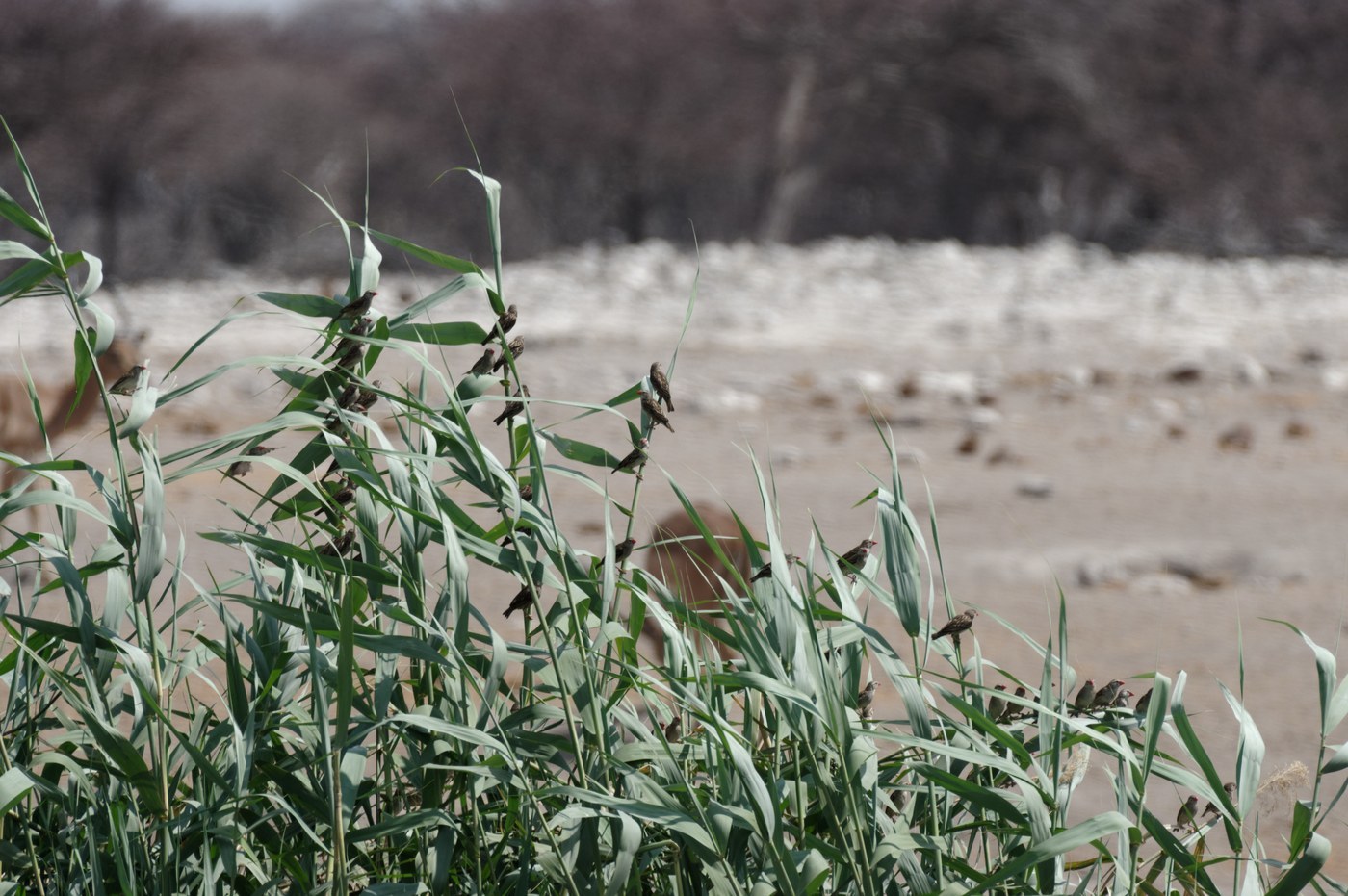
What Red-billed Quelea's Feathers Look Like
This small African weaver is best known for forming enormous flocks, and its feathers vary quite a bit between breeding and non-breeding condition:
- Breeding male face feathers: a bold black mask covering the face, bordered by a pinkish-buff to rosy wash on the crown, throat, and breast — this pink-and-black combination is the most distinctive plumage stage.
- Breeding male back feathers: warm buffy-brown with dark streaking, sparrow-like but with a slight rosy tinge overall.
- Non-breeding/female feathers: plain streaky brown above and buffy-white below, very sparrow-like and much less distinctive.
- Bill note: the bill itself turns red in breeding season and is duller otherwise (not a feather trait, but useful context if bill fragments are present).
- Wing feathers: brown with pale buff edging, creating a subtly scaled look typical of many weaver species.
- Size: very small — primaries under 6 cm, body feathers roughly 1–2 cm, consistent with a small finch-sized bird.
Step-by-Step: Is This Feather From a Red-billed Quelea?
- Check for small size first. A tiny, sparrow-sized feather is in the right range, though this alone doesn't distinguish it from many other small seed-eating birds.
- Look for a black facial feather bordered by pink. If you find this specific combination, it strongly suggests a breeding male quelea.
- Check for an overall rosy or pinkish wash on an otherwise streaky brown feather. This pink tint on body feathers supports the identification even without the black mask.
- Consider streaky brown feathers as inconclusive. Plain streaked brown-and-buff feathers, without pink or black, could be a female, juvenile, or non-breeding male, and are much harder to confirm to species.
- Factor in flock context. Found feathers in large numbers in one area (reflecting this species' massive flocking behavior) can support the identification when combined with plumage clues.
Similar Species & How to Tell Them Apart
- Red-headed Quelea: Breeding male shows a fully red head (not just a black mask with pink wash), a clearer distinction from Red-billed Quelea's black-and-pink combination.
- House Sparrow: Similar streaky brown pattern in non-breeding quelea, but lacks any pink wash or black facial mask at any life stage.
- Various weaver species (non-breeding): Many African weavers look similarly streaky brown outside the breeding season, making feathers from this group difficult to assign to species without the breeding male's distinctive black-and-pink pattern.
- Bishops (e.g., Southern Red Bishop): Breeding males show much more extensive, brighter red/orange plumage covering large body areas, rather than quelea's more limited pink wash confined near the face and breast.
Where & When You'll Find Them
Red-billed Quelea inhabit dry savanna and grassland across much of sub-Saharan Africa, forming some of the largest flocks of any bird species and often roosting or nesting in dense colonies in thorny trees and reeds. Because breeding is closely tied to seasonal rains and can occur at different times across its huge range, distinctive black-and-pink breeding feathers may turn up whenever local populations are nesting, while plainer streaky brown feathers can be found more broadly throughout the year.
Frequently asked questions
Why does the male's plumage change between pink-and-black and plain brown?
Like many weavers, Red-billed Quelea males molt into a striking black-masked, pink-washed breeding plumage tied to the local rainy season and breeding period, then revert to a plainer, more sparrow-like plumage the rest of the year for camouflage.
Can a plain brown quelea feather be confidently identified to species?
Not really — non-breeding and female Red-billed Quelea feathers look very similar to many other small African seed-eating birds, so the distinctive black-and-pink breeding male pattern is by far the most reliable identification clue.
How is this different from a Red-headed Quelea feather?
Red-headed Quelea males show a fully red head rather than a black facial mask bordered by pink, so checking whether red/pink coloring covers the whole head or is limited to a wash around a black mask helps separate the two.
Why does this species form such enormous flocks?
This is a well-documented behavioral trait of the species tied to its nomadic search for seeding grasses across the African savanna, and while it's not a feather characteristic itself, finding many similar small feathers together can be a helpful contextual clue.