
How to Identify Red-bellied Woodpecker Feathers
How to identify the zebra-barred back feathers and red nape of the Red-bellied Woodpecker, and why the 'red belly' itself is the least useful clue.
Read the full Red-bellied Woodpecker encyclopedia entry →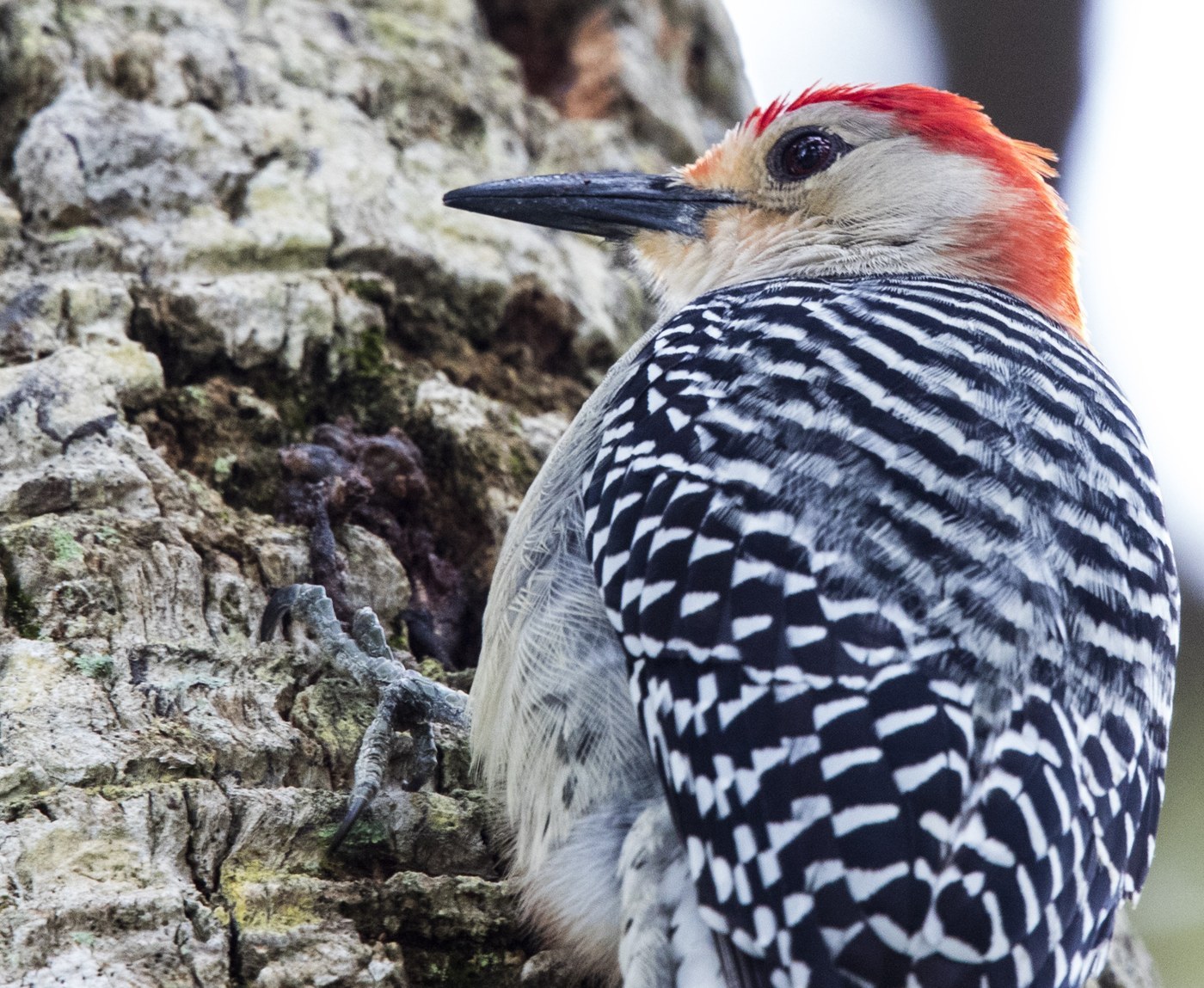
What Red-bellied Woodpecker's Feathers Look Like
Despite the name, the red belly is subtle — the back pattern is actually the most useful identification feature:
- Back and wing covert feathers: bold black-and-white horizontal barring, giving a "zebra-striped" or "ladder-backed" look — this is the single most recognizable feature of the species.
- Crown/nape feathers (male): bright red from the bill all the way over the crown to the nape; female shows red restricted to just the nape, with a gray crown in front — a very useful sex-difference clue.
- Underparts feathers: pale grayish-buff to whitish, with only a faint, often hard-to-see reddish or pinkish wash on the central belly — much less vivid than the name suggests.
- Flight feathers: black with white barring/spotting, stiff, and fairly broad, typical of a woodpecker built for controlled, undulating flight.
- Tail feathers: stiff, pointed, blackish with white barring, adapted to brace against tree trunks while climbing and drumming.
- Size: primaries around 10–12 cm; back feathers with barring roughly 3–5 cm.
Step-by-Step: Is This Feather From a Red-bellied Woodpecker?
- Check for black-and-white horizontal barring. A "ladder-backed" or zebra-striped feather pattern is the strongest single clue for this species among common backyard woodpeckers.
- Look at any red feathers for placement. Red covering the whole crown to the bill suggests a male; red limited to just the nape suggests a female.
- Look closely for a faint pink/red wash on a pale belly feather. It's subtle, so don't expect a vivid red belly feather — a mostly whitish feather with a slight rosy tinge still fits.
- Check feather stiffness. Stiff, pointed tail feathers with barring support a woodpecker identification broadly, then use the back barring to narrow to species.
- Compare bar width and spacing. Fine, evenly spaced black-and-white bars fit this species better than the bolder, larger-spotted patterns of some other woodpeckers.
Similar Species & How to Tell Them Apart
- Golden-fronted Woodpecker: Very similar barred back, but shows a yellow-orange nape patch rather than red, and a yellow patch above the bill — a southwestern/Texas counterpart best separated by nape color and range.
- Red-headed Woodpecker: Shows a solid, fully red head (not just crown/nape) contrasting with solid black-and-white body (large white wing patches, not fine barring) — a completely different pattern from the finely barred back of Red-bellied.
- Northern Flicker: Brown-and-black barred back rather than black-and-white, with a more spotted breast and no red nape (in most eastern birds) — overall warmer and browner.
- Hairy/Downy Woodpecker: Show a solid white back stripe rather than fine horizontal barring, quite different from the zebra pattern of Red-bellied.
Where & When You'll Find Them
Red-bellied Woodpeckers are common in deciduous and mixed woodlands, parks, and backyards across the eastern and central United States, frequently visiting suet feeders. As non-migratory residents, feathers can be found year-round, with a noticeable uptick after the late-summer post-breeding molt when adults replace worn flight and body feathers before winter.
Frequently asked questions
Why is the belly barely red if the bird is named for it?
The reddish wash on the belly is genuinely faint and often nearly invisible in the field, which is why the barred black-and-white back and the red nape/crown are far more reliable identification features than the belly color the name refers to.
How can I tell a male's feather from a female's?
Check how far the red extends: a male's red covers the crown all the way to the bill, while a female shows red only on the nape with a gray crown in front — this placement difference is the clearest sex clue.
What's the difference between this and a Golden-fronted Woodpecker feather?
The back barring looks almost identical, but Golden-fronted shows yellow-orange rather than red on the nape and above the bill, and the two species' ranges barely overlap, so location is also a helpful clue.
Why are the tail feathers so stiff compared to body feathers?
Woodpeckers use their stiff, pointed tail feathers as a brace against tree trunks while climbing and drumming, so tail feathers are noticeably tougher and more rigid than the softer body and belly feathers.
Red-bellied Woodpecker identified by the community
Recent Red-bellied Woodpecker feathers identified with Feather Identifier.


