
How to Identify Rainbow Bee-eater Feathers
A guide to the turquoise, green, and cinnamon feathers of the Rainbow Bee-eater, including its signature tail streamers, and how it differs from other colorful Australian birds.
Read the full Rainbow Bee-eater encyclopedia entry →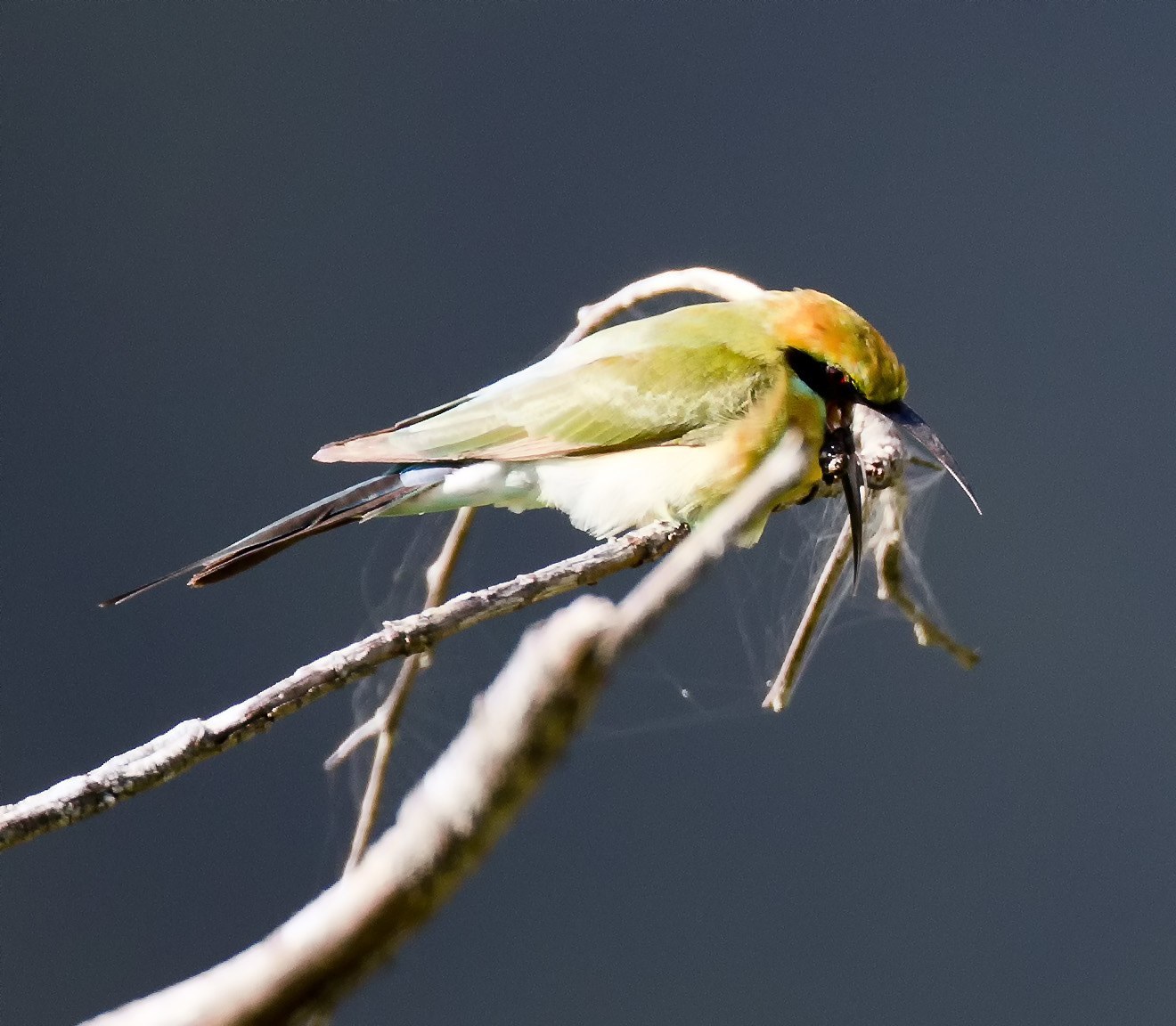
What Rainbow Bee-eater's Feathers Look Like
Australia's only widespread bee-eater is a riot of color from head to tail, making feather identification relatively approachable:
- Back and mantle feathers: bright, uniform green, glossy and smooth.
- Rump feathers: a distinct patch of sky-blue to turquoise, contrasting with the green back — visible as a bright blue-toned feather if found separately.
- Throat feathers: golden-yellow fading into a chestnut-orange band, bordered below by a thin black gorget line — this yellow-to-chestnut-to-black sequence on a single throat feather is highly diagnostic.
- Flight feathers: cinnamon-rufous on the inner webs with black tips, creating a warm orange flash in flight; a single primary or secondary will show this two-tone rufous-and-black pattern.
- Face feathers: black mask through the eye, contrasting with the green crown and turquoise brow line.
- Tail feathers: mostly blue-green, with the central pair elongated into thin black streamers extending well past the rest of the tail — an unmistakable feather if found intact.
- Size: body/wing feathers 4–8 cm; the elongated tail streamers can add several extra centimeters beyond the square tail tip.
Step-by-Step: Is This Feather From a Rainbow Bee-eater?
- Check for multiple bright colors on one feather. Green, turquoise, chestnut, and black combined on a single feather is very unusual and points strongly toward this species.
- Look at flight feathers for a rufous-and-black pattern. Cinnamon-orange inner webs with sharply defined black tips are a strong match.
- Identify a thin, elongated, blackish feather. This is likely one of the central tail streamers, unique among common Australian birds this size.
- Check for a turquoise rump feather. A vivid sky-blue feather paired with green body feathers supports the identification.
- Rule out lorikeets. If the feather shows red or heavy blue-purple on the head rather than a black eye mask, reconsider a lorikeet instead of a bee-eater.
Similar Species & How to Tell Them Apart
- Rainbow Lorikeet: Also intensely multicolored, but shows a blue head and orange/yellow breast band rather than a green back with turquoise rump and chestnut throat; lorikeet feathers are also broader and more parrot-like in texture.
- Sacred Kingfisher: Shows blue-green upperparts but a buffy-orange underside without the bee-eater's chestnut throat band or elongated tail streamers.
- Dollarbird: Deep blue-green overall with a stout red bill (not feather-relevant) but lacks the bee-eater's cinnamon flight feathers and tail streamers.
- Superb Fairywren (male): Much smaller, with cobalt-blue confined to head/back and black elsewhere, lacking any chestnut or cinnamon tones.
Where & When You'll Find Them
Rainbow Bee-eaters favor open woodland, farmland, and riverbanks across Australia, nesting in burrows dug into sandy banks and often seen hawking insects from open perches. Northern Australian populations are largely resident while southern populations migrate to northern Australia, New Guinea, or Indonesia for winter, so feathers are most likely to be found near breeding burrow colonies in spring and summer, with post-breeding molt in late summer producing the bulk of dropped feathers.
Frequently asked questions
Why are the flight feathers cinnamon-orange with black tips instead of just green like the body?
This rufous-and-black flight feather pattern creates a flash of color during flight, likely useful in flock coordination or display, while the green body provides camouflage when perched among foliage.
What's the easiest single feather to use for identification?
A throat feather showing the yellow-to-chestnut-to-black gorget sequence, or one of the elongated black tail streamers, are the two most unmistakable feather types for this species.
Do juveniles have the long tail streamers?
No, juveniles lack the elongated central tail feathers and have duller overall coloring, developing the full adult plumage and streamers as they mature.
How can I be sure it's not a Rainbow Lorikeet feather?
Check for a green back and turquoise rump versus a lorikeet's blue head and orange breast band — the two species share a 'rainbow' reputation but have almost entirely different color layouts.