
How to Identify Pinyon Jay Feathers
A guide to the crestless, all-blue plumage that separates Pinyon Jay feathers from Scrub-Jays and Steller's Jays in western pine-juniper woodland.
Read the full Pinyon Jay encyclopedia entry →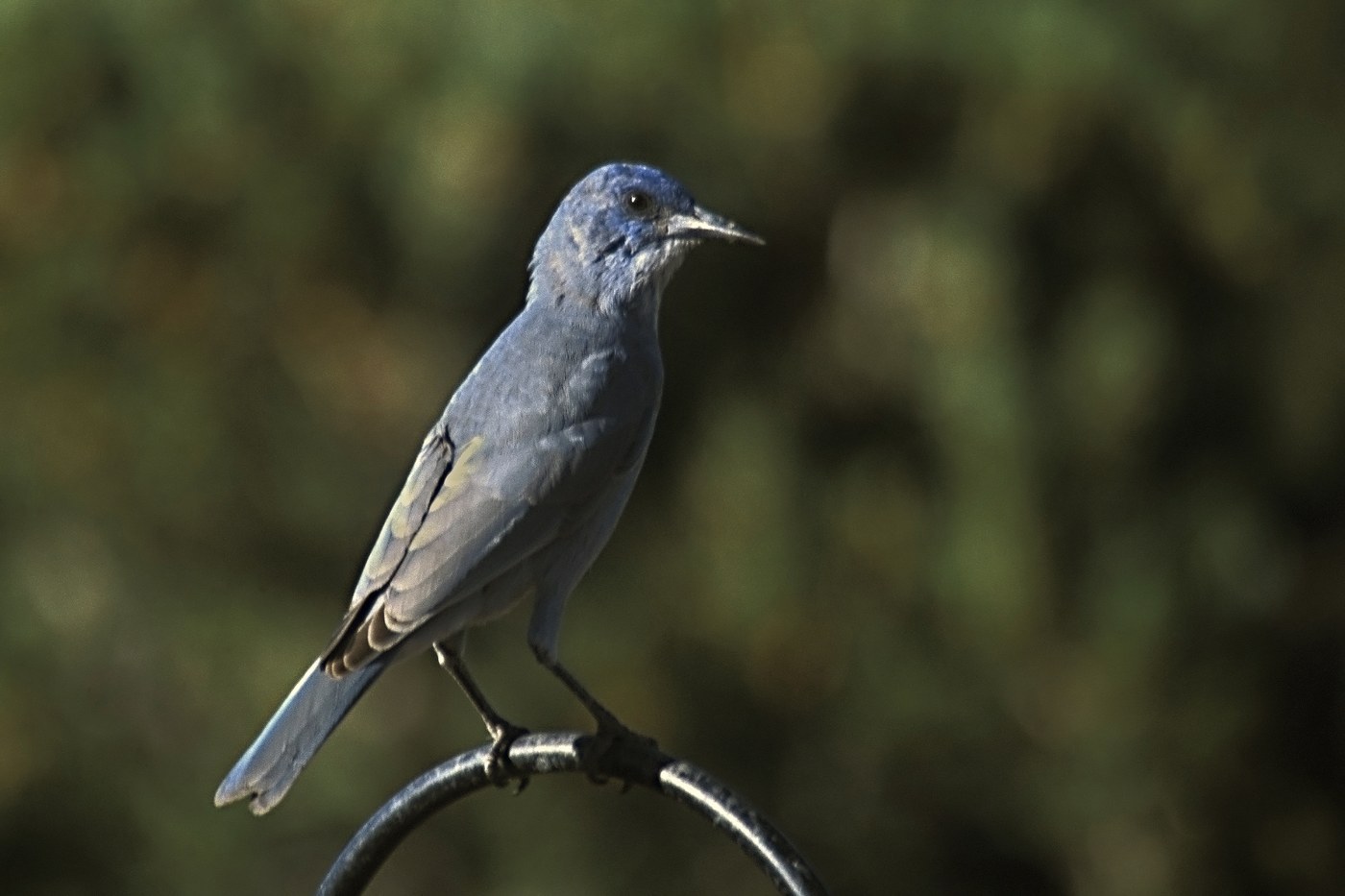
What Pinyon Jay Feathers Look Like
Pinyon Jay is a medium corvid whose entire plumage is a fairly uniform dull blue to blue-gray, slightly brighter and more azure on the head and slightly grayer on the back and underparts — and crucially, it shows no white, black, or bold pattern markings anywhere, unlike almost every other North American jay. Flight feathers are blue-gray with darker shafts and no barring. Throat feathers show only fine, faint whitish streaking — the sole pattern break on the whole bird, and easy to miss unless you look closely. Tail feathers are noticeably short relative to body size compared with other jays, blue-gray, and square-tipped rather than graduated. Flight feathers run about 4.5-6 inches, with body feathers 1-2 inches, and the feather texture is fairly dense, as in most corvids.
Step-by-Step: Is This Feather From a Pinyon Jay?
- Check overall color. A feather that is essentially all blue-gray, with no black, white, or crest coloring, strongly points to this species.
- Check the throat area for faint whitish streaking — present but subtle.
- Check tail feather length and shape. Shorter and squarer than expected for a jay this size, useful if a full tail or several tail feathers are available.
- Rule out crested jays. No crest feathers will be present, since Pinyon Jay is the one common jay in its range without a crest.
- Measure overall size. Mid-size corvid range — smaller than a crow feather, larger than most songbird feathers.
Similar Species & How to Tell Them Apart
Woodhouse's and California Scrub-Jays are also blue, but show a clear white throat with a distinct blue necklace or breast band and a contrasting grayish or brownish back patch — patterned feathers rather than a uniform wash. Steller's Jay has an obvious black crest and black head and chest feathers, entirely absent in Pinyon Jay. Mexican Jay is paler blue and slightly duller, but shows more contrast between blue head/wings and grayer underparts than Pinyon Jay's very even tone, and its range is more limited to the southwest borderlands rather than the broader pinyon-juniper belt.
Where & When You'll Find Them
Pinyon Jays are closely tied to pinyon-juniper woodland across the interior western U.S. — the Great Basin, Colorado Plateau, and parts of the Rockies and Southwest — living in large, nomadic flocks that track pinyon pine seed crops. Feathers are most often found in these woodlands, especially where flocks have been actively caching seeds, since they bury enormous numbers of pine seeds each fall. Molt occurs in late summer after breeding, so worn body feathers turn up around nesting colonies in pinyon-juniper stands from midsummer into fall, while flight feathers can appear anywhere the nomadic flocks have foraged that season.
Frequently asked questions
What's the fastest way to rule out other blue jays in feathers?
Look for any white or black patterning — Pinyon Jay feathers are an even blue-gray wash with no bold markings, while Scrub-Jays and Steller's Jays both show strong white or black patches.
Does this species have a crest?
No, Pinyon Jay is the one common North American jay without a crest, so any crest feather rules it out.
Is the whole bird exactly one shade of blue?
Nearly — it's slightly brighter on the head and slightly grayer on the back and underparts, but nowhere near as contrasty as other jays.
Where should I look for these feathers?
In pinyon-juniper woodland of the interior American West, especially where large nomadic flocks forage on pine seeds.