
How to Identify Patagonian Conure Feathers
A guide to identifying the olive-brown body and yellow-orange belly feathers of the Patagonian Conure, a burrow-nesting South American parakeet, and separating it from similar parrots.
Read the full Patagonian Conure encyclopedia entry →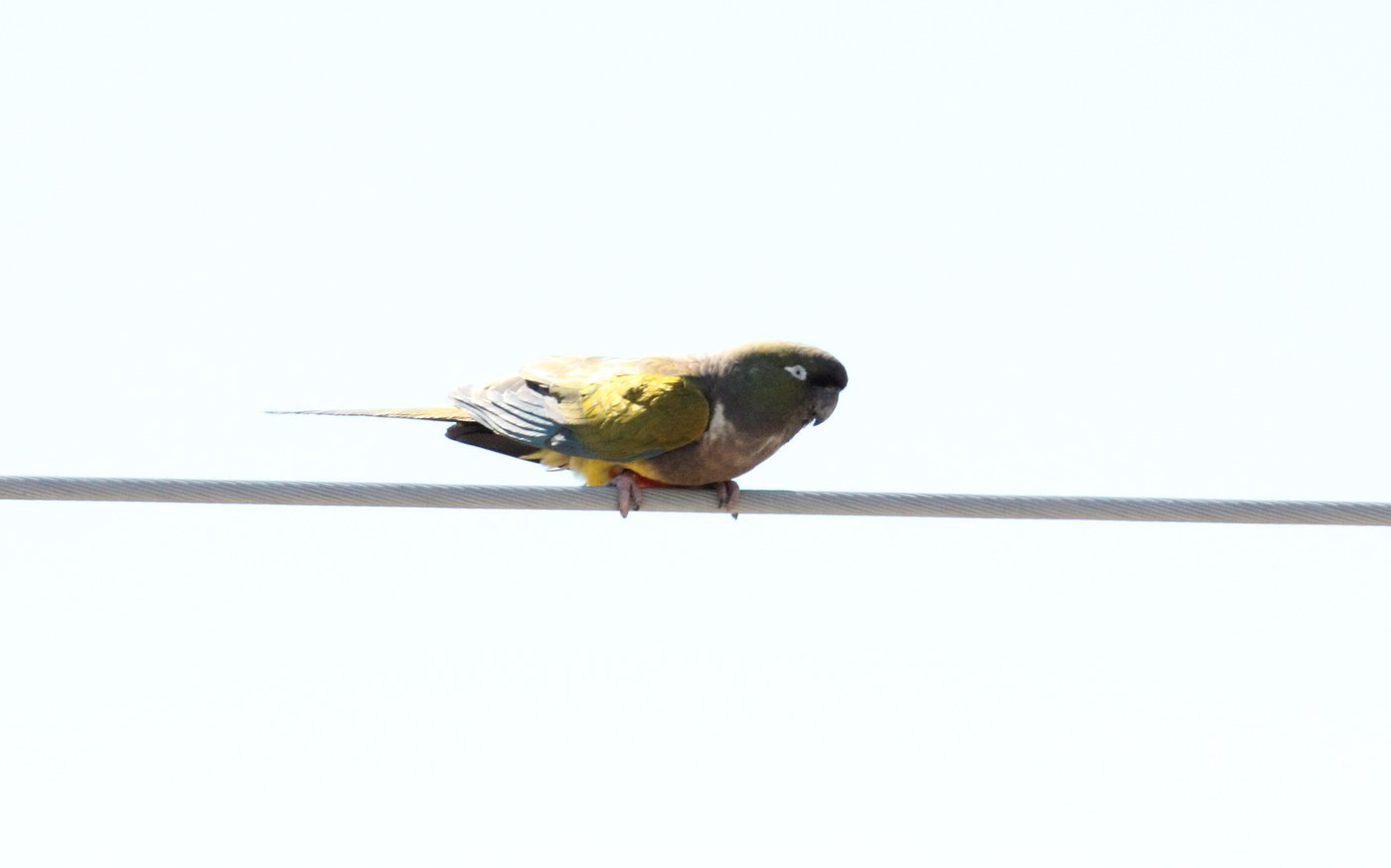
What Patagonian Conure's Feathers Look Like
Patagonian Conure (also known as Burrowing Parrot) feathers show a distinctive combination of subdued and bright tones for a parrot. Back, wing, and crown feathers are a muted olive-brown to grayish-olive, relatively drab compared to many parrots, providing camouflage against the arid, scrubby landscapes it inhabits. In contrast, the belly and lower breast feathers are a bright yellow-orange to reddish-orange, creating a bold splash of color that contrasts sharply with the duller upperparts — a useful diagnostic if you find a body feather from the lower belly region. A grayish-white to pale gray patch is often present on the upper breast/throat area, adding a third distinct tone to the plumage. Flight feathers are large and strong for a mid-sized parrot, typically 12–18 cm, mostly dark olive to blackish, sometimes with a subtle blue tint on the outer primaries. Shafts are thick and pale, reflecting a robust parrot build adapted for strong flight over open terrain between nesting cliffs and feeding grounds.
Step-by-Step: Is This Feather From a Patagonian Conure?
- Check for olive-brown upperparts paired with bright yellow-orange underparts. This two-tone contrast is a strong positive indicator for this species.
- Look for a pale gray throat/breast patch. A grayish-white feather from the upper chest area, distinct from both the olive back and orange belly, supports this identification.
- Measure size. Flight feathers in the 12–18 cm range fit a mid-sized parrot, larger than a typical small parakeet.
- Assess any blue tint. A subtle blue wash on outer flight feathers, if present, is consistent with this species.
- Match habitat. A feather found near eroded cliffs, canyons, or arid scrubland in Patagonia or central Argentina strongly supports this species, since it's one of the few parrots adapted to such dry, open habitat.
Similar Species & How to Tell Them Apart
Within South America, the main potential confusion is with other Aratinga-type conures and parakeets, though few share the specific olive-and-orange-belly combination. Monk Parakeet, which overlaps in parts of the range, shows a gray face and breast extending more broadly, with a duller, more uniformly green body and less contrast between upperparts and underparts than Patagonian Conure's sharper olive-to-orange transition. Various green Aratinga conures elsewhere in South America are predominantly green rather than olive-brown, lacking the muted, camouflage-toned upperparts of this species, which is adapted to arid rather than forested habitat. The combination of a drab olive-brown body, gray breast patch, and bright orange belly is distinctive enough among regional parrots that finding all three tones together is a strong confirmation, especially paired with an arid, cliff-associated habitat context.
Where & When You'll Find Them
Patagonian Conures are unusual among parrots for nesting in burrows dug into eroded cliff faces, often in large colonies, across arid and semi-arid regions of central and southern Argentina and Chile, extending into Patagonia. As a partially migratory species, with southern populations moving north in winter to escape the harshest cold, feathers can be found year-round in the core range, but breeding-colony feathers are most concentrated near cliff nesting sites during the spring and summer breeding season (roughly September–February in the Southern Hemisphere), when birds are constantly entering and exiting burrows and prone to feather wear. Search at the base of eroded sandstone or clay cliffs and canyon walls where colonies nest, as well as in surrounding scrubland and agricultural areas where the birds forage on seeds and fruit.
Frequently asked questions
What is the key color pattern for this species?
Muted olive-brown upperparts contrasting sharply with a bright yellow-orange to reddish-orange belly and lower breast, plus a pale gray patch on the upper chest.
How does this differ from a Monk Parakeet feather?
Monk Parakeet is more uniformly green with a broader gray face/breast area and much less contrast between upperparts and underparts than the sharp olive-to-orange transition in Patagonian Conure.
Why is this species associated with cliffs?
Patagonian Conures nest in burrows dug into eroded cliff faces, often in large colonies, so feathers concentrate near these nesting cliffs, unlike most tree-nesting parrots.
How big are the flight feathers?
Fairly large for a parakeet-type bird, typically 12–18 cm, reflecting a mid-sized, strong-flying parrot.
When and where should I search for these feathers?
Near eroded cliff and canyon nesting colonies in arid Argentina, Chile, and Patagonia, especially during the spring-summer breeding season from September to February.