
How to Identify Paradise Shelduck Feathers
A guide to identifying the strikingly different male and female feathers of the Paradise Shelduck, New Zealand's large sexually dimorphic duck, and telling them apart from other waterfowl.
Read the full Paradise Shelduck encyclopedia entry →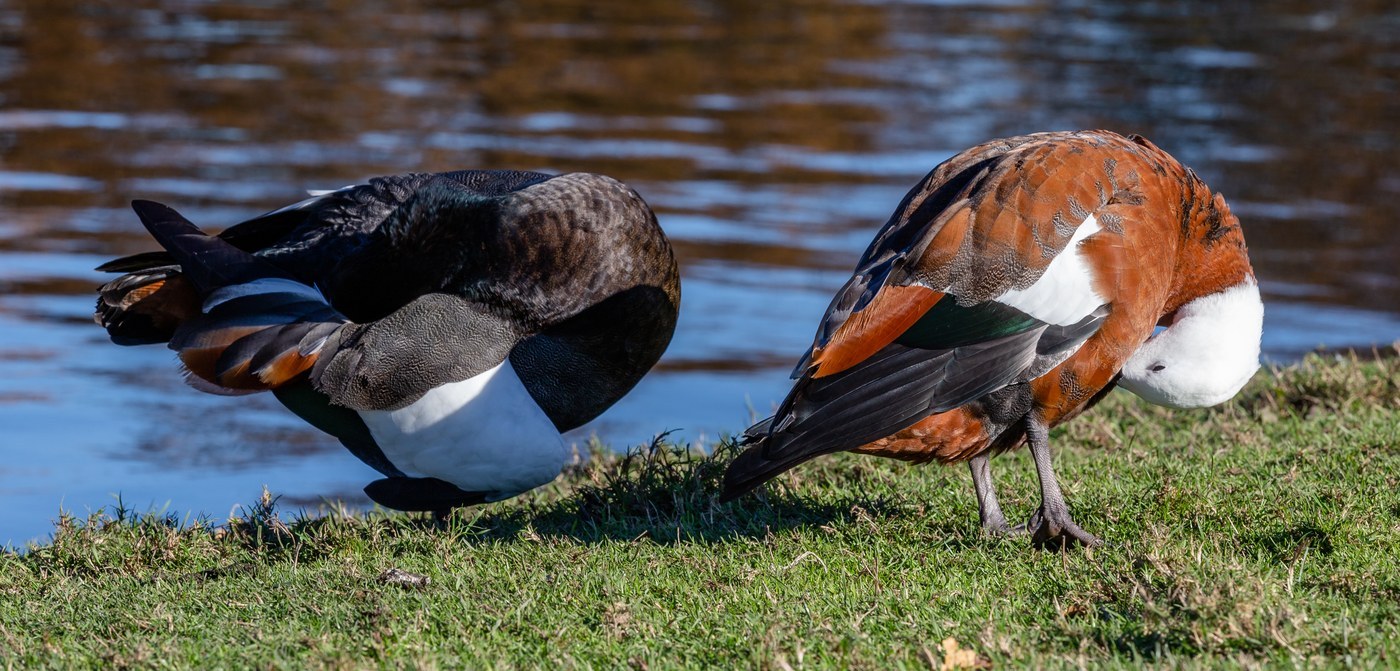
What Paradise Shelduck's Feathers Look Like
Paradise Shelduck feathers are unusual among ducks for showing dramatically different coloring between the sexes, so what you find depends heavily on which bird it came from. Male body feathers are predominantly dark, glossy black on the head and neck with an iridescent green sheen, transitioning to finely barred gray-brown feathers on the back and chestnut-tinged feathers on the flanks. Female feathers are far more striking: the head and neck feathers are pure white, sharply contrasting with a rich chestnut-orange to rufous-red body, making female feathers some of the most colorful waterfowl feathers in New Zealand. Both sexes show a bold white wing patch (speculum area) on the inner wing, bordered by iridescent green, visible on the greater coverts and secondaries as a flash of white and green even on an isolated wing feather. Flight feathers are large and strong, typically 15–25 cm, reflecting a big-bodied duck capable of strong sustained flight. Shafts are thick and pale.
Step-by-Step: Is This Feather From a Paradise Shelduck?
- Check for a white head feather with chestnut body feathers nearby. This striking combination is essentially diagnostic for a female Paradise Shelduck.
- Look for black head feathers with green iridescence, paired with barred gray-brown body feathers. This combination points to a male.
- Search for a white wing patch bordered in iridescent green. Both sexes share this feature, making it useful when sex-specific head/body feathers aren't available.
- Measure size. Flight feathers in the 15–25 cm range fit a large-bodied duck.
- Match habitat and location. A large duck feather with this coloring found in pasture, farmland, or near rivers and lakes in New Zealand is a strong fit, since this species is endemic there.
Similar Species & How to Tell Them Apart
Because Paradise Shelduck is endemic to New Zealand, there's limited native overlap, but introduced or vagrant waterfowl can cause confusion. Australian Shelduck, a close relative sometimes seen as a vagrant, is similar in structure but the female's white head is less extensive and the chestnut breast band is more sharply defined and separated from the rest of the body than in Paradise Shelduck, where the chestnut extends more broadly. Common farmyard or feral ducks (like Mallard-derived breeds) found in the same pastoral habitats have entirely different color patterns — mottled brown, or the male Mallard's glossy green head paired with a gray body and chestnut breast patch, not the black-and-barred-gray of a male Paradise Shelduck. The bold white-and-green wing patch is a useful cross-check feature, since it's consistently present in Paradise Shelduck of both sexes and helps confirm the species even from a plain body feather elsewhere.
Where & When You'll Find Them
Paradise Shelducks are common and conspicuous residents throughout New Zealand, found on pasture, farmland, riverbanks, lake margins, and wetlands, often in pairs or small flocks grazing on grass like geese. As a largely resident species with some local movements, feathers can be found year-round, but the best time to search is during the eclipse molt in summer (roughly December–February in the Southern Hemisphere), when both sexes molt their flight feathers simultaneously and become flightless for a period, leading to substantial feather loss concentrated near favored molting lakes and wetlands. Search open farmland, pasture edges, and the margins of lakes and rivers, since this species spends much of its time grazing on grass in open country rather than deep wetland vegetation.
Frequently asked questions
How different do male and female Paradise Shelduck feathers look?
Very different — males show glossy black head feathers with barred gray-brown body feathers, while females show a striking white head with a rich chestnut-orange body.
What feature is shared by both sexes?
A bold white wing patch bordered by iridescent green on the inner wing, useful for confirming the species even from a plain body feather.
How is this different from an Australian Shelduck feather?
In Australian Shelduck females, the white head area is less extensive and the chestnut breast band is more sharply separated from the rest of the body, unlike the broader chestnut extent in Paradise Shelduck.
When do these ducks molt their flight feathers?
During the summer eclipse molt, roughly December through February in New Zealand, when both sexes become flightless and shed feathers together at favored molting sites.
Where in New Zealand would I find these feathers?
On open pasture and farmland, and along the margins of lakes and rivers, since this species commonly grazes on grass in open country.